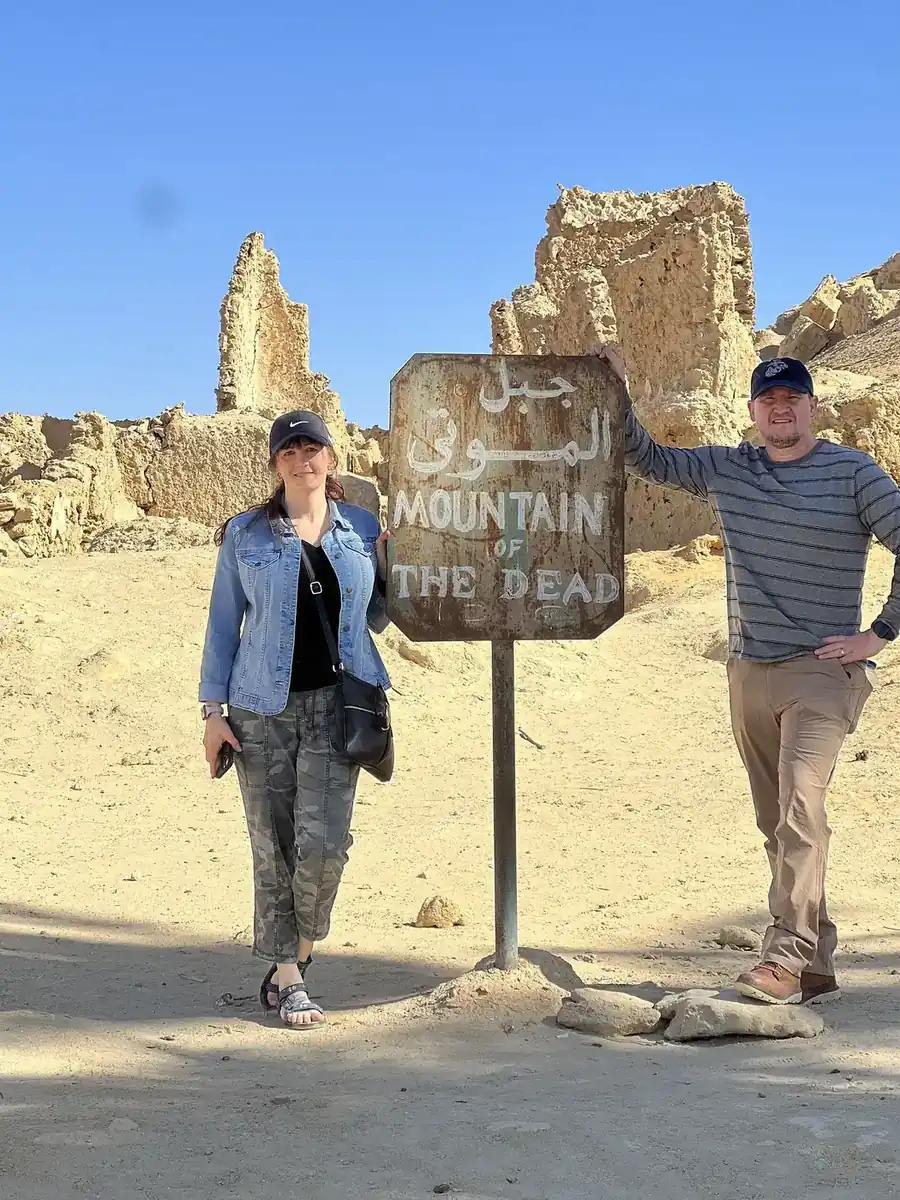
Mountain of the Dead Siwa is not a dramatic name invented for tourists. Also called Gebel al-Mawta or Jabal al-Mawta, it is a limestone hill pierced by ancient rock-cut tombs just outside Siwa town. The short climb gives you two experiences at once: a close look at Siwa’s layered Egyptian, Greek and Roman history, and one of the clearest panoramas over the oasis palm groves.
This guide explains what the site really is, which tombs matter, how long to allow, what may be open, how to visit respectfully and how to combine it with the rest of Siwa. It is written for travelers planning a real visit—not for people collecting a list of attractions.
Quick answer: allow about 60–90 minutes for Mountain of the Dead Siwa. Go in the cooler morning or late afternoon, wear shoes with grip, carry water and never touch painted surfaces. Tomb access, photography rules, opening hours and ticket prices can change, so confirm them at the entrance or with a licensed local guide on the day.
Planning a complete trip? Start with our Siwa Oasis Egypt travel guide, then compare a 3-day private Siwa tour from Cairo with our slower 4-day Siwa itinerary.
What is the Mountain of the Dead in Siwa?
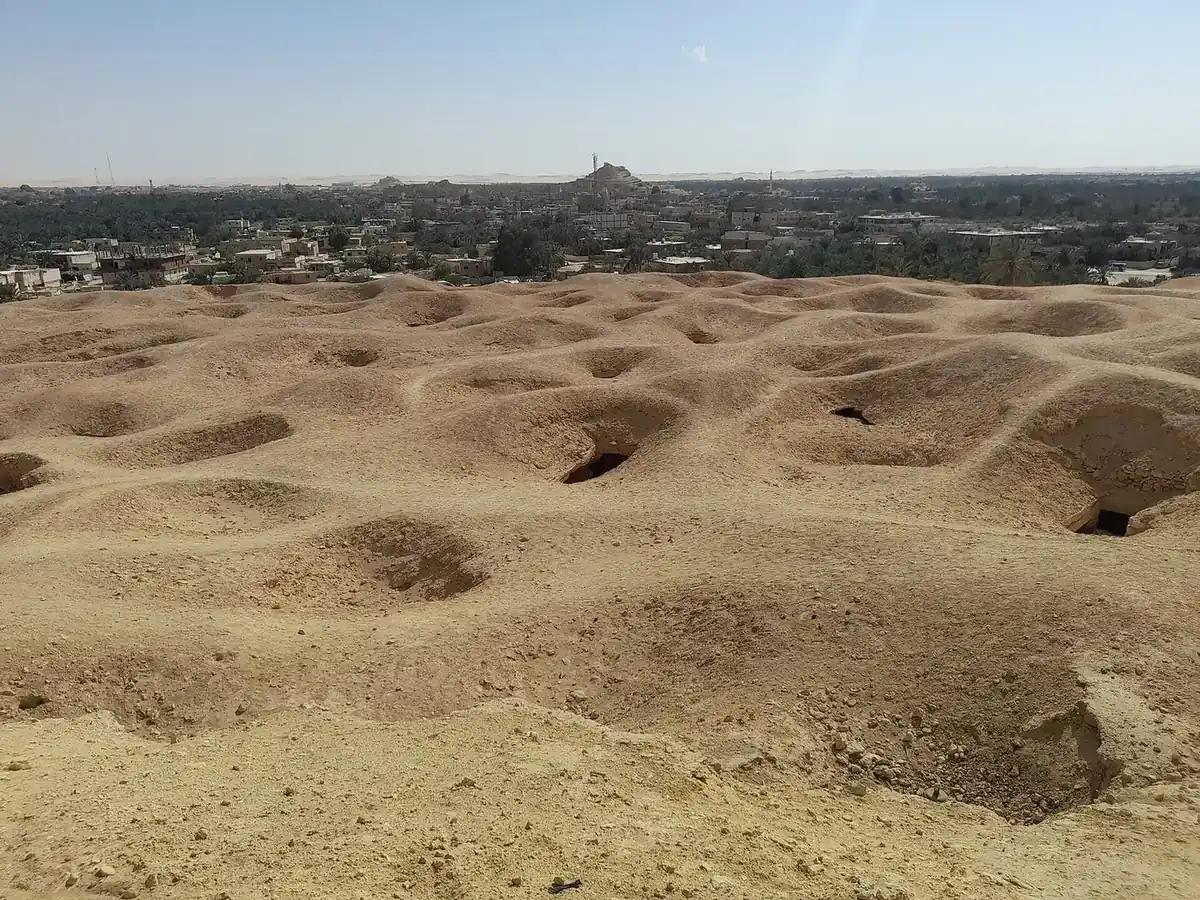
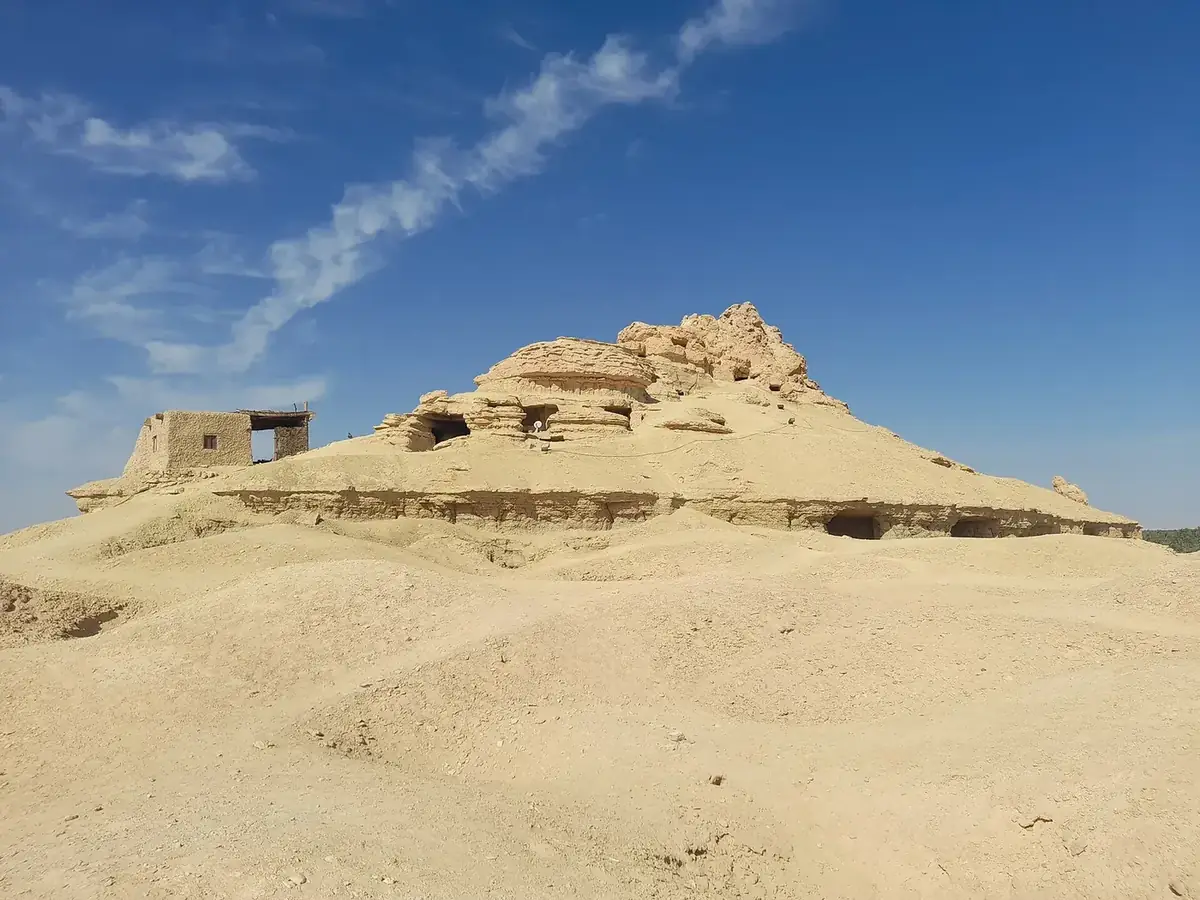
Mountain of the Dead is a conical limestone hill north of the old center of Siwa. Its slopes and summit contain numerous chambers cut into the rock as burial places. Some are simple cavities; a small number preserve fragments of painted decoration, religious imagery or architectural details that help explain the beliefs and status of the people buried here.
The site is a necropolis—a cemetery used over a long period—not a single royal tomb or temple. That distinction matters. Visitors sometimes arrive expecting a Valley of the Kings-style complex with long decorated corridors. Gebel al-Mawta is smaller, rougher and more intimate. Its power comes from seeing many tomb openings spread across one exposed hill while modern Siwa continues below.
Egypt’s official tourism platform dates the tombs across several phases, including the 26th and 30th Dynasties and the later Greco-Roman period. That long span explains why the decoration can feel culturally mixed. Siwa sat far from the Nile Valley yet remained connected to Egyptian religion, Mediterranean trade and the cult of Amun. The result is not a neat, single-period monument but evidence of an oasis community absorbing different influences over centuries.
Why is it called Gebel al-Mawta?
Gebel or jabal means mountain in Arabic, while al-Mawta means “the dead.” The English name is therefore a direct translation: Mountain of the Dead. You may see several spellings online—Gebel el-Mawta, Gebel al-Mawta, Jabal al-Mawta and Gabal al-Mawta. They refer to the same archaeological hill.
The name describes the necropolis, but the hill also has a striking twentieth-century story. According to the official Experience Egypt overview of Siwa’s ancient sites, local people used tombs on the hill as shelter during Italian bombing in the Second World War. The sheltering exposed chambers that had been hidden or less widely known. The story is important, but it should not be turned into a treasure-hunt myth: the site is protected heritage, and entering closed cavities or removing fragments is both damaging and unlawful.
How old are the tombs?
The safest way to understand the chronology is as a sequence rather than a single construction date:
- Late Period foundations: some tombs are associated with Egypt’s 26th Dynasty, when Siwa’s religious and political importance was growing.
- Later indigenous use: burial activity continued into the 30th Dynasty.
- Ptolemaic and Roman phases: later tombs and decoration reflect the centuries when Greek and Roman rule interacted with established Egyptian beliefs.
This is why labels such as “Roman cemetery” or “pharaonic tombs” are only partly correct. The necropolis spans more than one era. It is also why a local guide adds real value: small details in iconography and layout are easy to miss, while unsupported legends can blur the difference between documented history and modern storytelling.
The four tombs travelers hear about most
Do not assume every named tomb will be accessible during your visit. Conservation work, staffing, safety checks or local instructions can change what is open. Treat the following as the site’s historical highlights, not a promise that every door will be unlocked.
1. Tomb of Si Amun
The Tomb of Si Amun is usually described as the artistic highlight of Mountain of the Dead Siwa. Its surviving decoration is valuable because it combines Egyptian funerary themes with elements that suggest a multicultural elite. Scenes include the deceased before Egyptian deities, and the colors can still be striking despite age and damage.
Look rather than rush. The useful questions are: Which figures face the deceased? What offerings are shown? Where does the painter use Egyptian conventions, and where does the style feel different? Painted tombs are extremely sensitive to humidity, dust, flash and contact. Never lean on a wall for a photograph, and obey any no-photography instruction even if another visitor ignores it.
2. Tomb of the Crocodile
The original owner’s name is not known, so the tomb is identified by its painted crocodile. The animal is commonly connected with Sobek, the ancient Egyptian crocodile deity. The image is memorable, but it is only one part of a wider decorative program. A guide can help you separate what is actually visible from modern reconstructions repeated online.
3. Tomb of Mesu-Isis
This unfinished tomb is noted for decorative elements near its entrance, including vividly colored cobras. “Unfinished” does not mean unimportant. In archaeology, incomplete work can reveal how chambers were cut, surfaces were prepared and decoration was planned. It also reminds visitors that ancient monuments were working projects shaped by money, time and changing circumstances.
4. Tomb of Niperpathot or Pathout
Names are transliterated differently in guidebooks, which is why you may see Niperpathot, Niper Pathot or simply Pathout. This tomb is associated with religious scenes and inscriptions. If it is accessible, focus on the relationship between the chamber’s architecture and its decoration rather than expecting the scale of a royal burial in Luxor.
What a visit actually feels like
The approach is brief compared with a desert safari. You leave the palm-lined streets of Siwa, reach the foot of a dry limestone hill and begin walking among openings cut into pale rock. The ground is uneven and exposed. There is little shade on the slopes, so the temperature feels higher than it did in town.
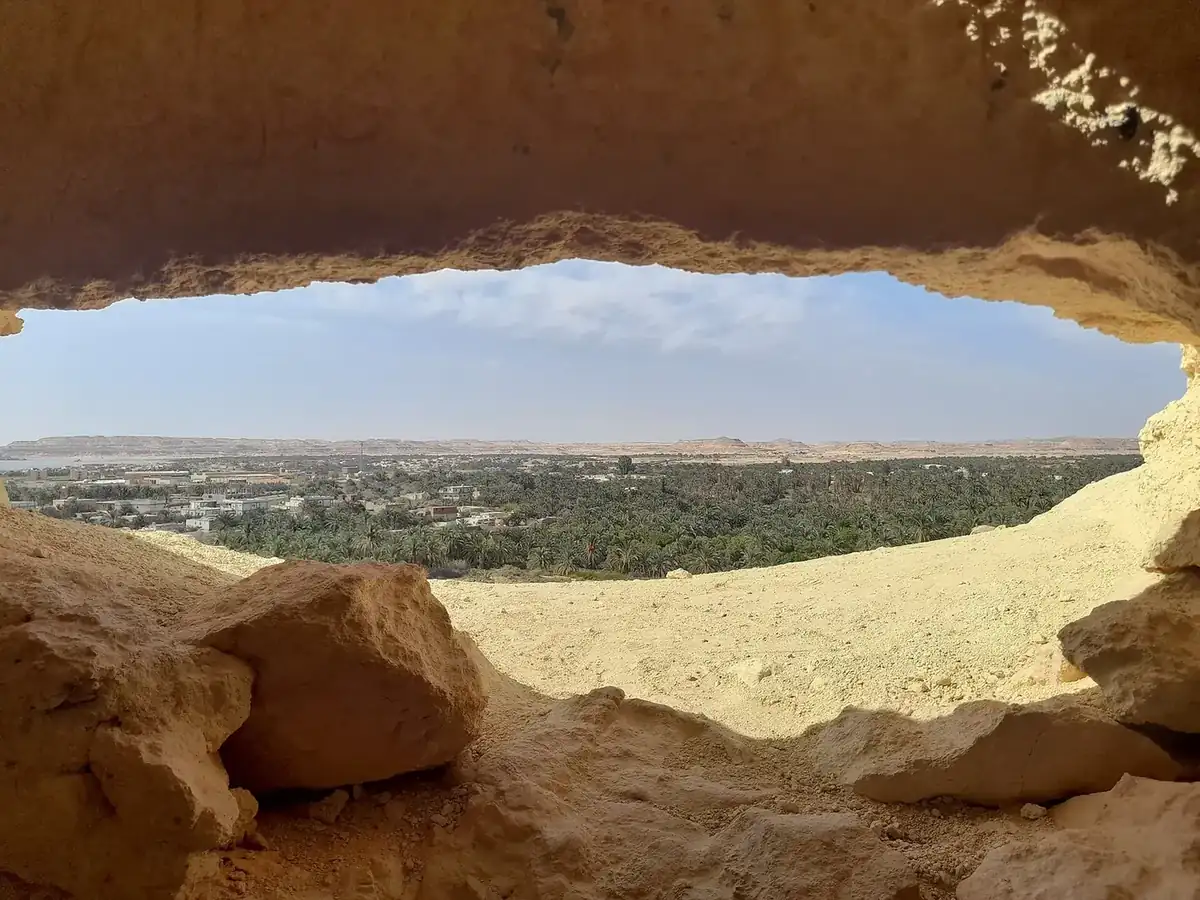
The first impression is geological: the hill seems porous, almost honeycombed. As you climb, the oasis opens behind you. Palm groves form a dark green band against the desert, while salt lakes and distant ridges change color with the light. The contrast helps explain why communities valued this elevated ground and why the site feels connected to the landscape rather than isolated from it.
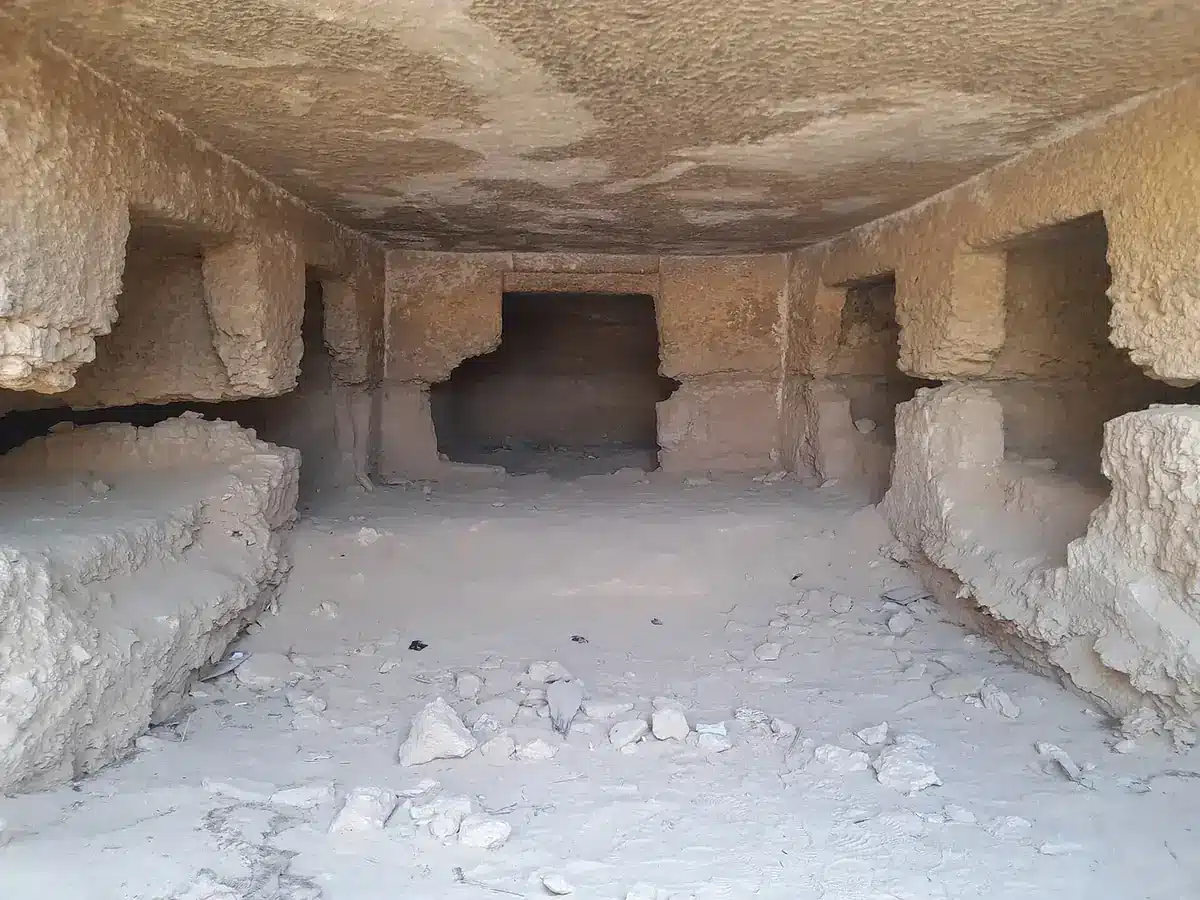
Inside an accessible chamber, the experience becomes quiet and close. The spaces are modest, and painted details may be fragmentary. Give your eyes time to adjust. A five-minute explanation in front of one authentic scene is more valuable than racing through several openings for photographs.
Mountain of the Dead Siwa visiting guide
Where is it?
Gebel al-Mawta is near Siwa town rather than deep in the Great Sand Sea. It can normally be reached by local vehicle, tuk-tuk, bicycle or as part of a guided sightseeing circuit. Exact travel time depends on where you stay, but it is a short local transfer—not an all-day desert excursion. Read our practical guide to getting from Cairo to Siwa before planning arrival-day activities.
How long do you need?
Allow 60–90 minutes for a balanced visit. Fast visitors can see the main accessible area in less time, but archaeology deserves a slower pace. Add extra time if you enjoy photography, travel with children, need frequent rests or want a guide to explain the tombs carefully.
Best time of day
Morning usually offers cooler climbing conditions and clearer concentration inside the tombs. Late afternoon brings warmer light across the oasis but can create stronger contrast for photography. Midday is the least comfortable time because the hill is exposed. Seasonal conditions matter too; see our month-by-month guide to the best time to visit Siwa Oasis.
Opening hours and ticket price
Do not build a trip around a price copied from an old blog. Egyptian site hours, ticket categories, accepted payment methods and photography rules can change. Confirm the current information at the official ticket point or through your guide shortly before the visit. Carry small local currency as a practical backup, but follow the payment method requested at the gate.
What to wear and carry
- Closed shoes with reliable grip for dusty, uneven rock.
- A hat, sunscreen and at least one bottle of water per person.
- Modest, lightweight clothing suitable for both heat and a conservative local community.
- A small bag that keeps your hands free on steps and slopes.
- No food inside tomb chambers and no bulky tripod unless permission is clear.
Photography rules and responsible behavior
The best photograph is never worth damaging the site. Rules can differ between the open hillside and decorated interiors. A phone camera may be allowed where flash, video equipment or tripods are restricted. Ask before shooting inside any chamber. If a guard says no, treat the answer as final.
Do not touch pigments, brush dust from a wall, sit on carved stone, climb over barriers or enter a closed opening. Oils from skin and repeated contact cause cumulative harm. Keep children close, speak quietly in chambers and take all litter back to town. When sharing images, use the correct site name rather than inventing a sensational claim about a “secret pharaoh tomb.” Accuracy is part of responsible tourism.
The wider Siwa archaeological area appears on Egypt’s UNESCO Tentative List, which is a reminder that the oasis should be treated as a connected cultural landscape rather than a collection of photo stops.
Accessibility, children and older travelers
The archaeological hill is not a fully accessible modern attraction. Surfaces can be sandy, rocky and irregular; some entrances are low or narrow; and shade is limited. Travelers with reduced mobility may still enjoy the lower viewpoints, but the complete route may be unsuitable. Tell your tour operator about mobility needs before arrival so the day can be paced honestly.
School-age children who enjoy stories and exploration often like the site, especially with a guide who can explain symbols without turning the visit into a lecture. Very young children need close supervision near drops and openings. For older travelers, an early visit, water, a slow ascent and planned rest stops make a significant difference.
How to combine Gebel al-Mawta with other Siwa sights
Mountain of the Dead works best as one chapter in a connected heritage day. A logical private route is:
- Mountain of the Dead in the morning: cooler walking and time to understand the necropolis.
- Temple of the Oracle: compare funerary beliefs with the political and religious power of Amun.
- Cleopatra’s Spring: pause for lunch or a drink and decide whether swimming conditions suit you.
- Shali Fortress in late afternoon: finish with kershef architecture and town views.
Do not force every major attraction into one rushed day. The Siwa salt lakes need their own practical preparation, while a Siwa desert safari belongs to a separate 4×4 experience in the Great Sand Sea. Our 3-, 4- and 5-day Siwa itinerary shows how to distribute them without turning the oasis into a checklist.
Is Mountain of the Dead worth visiting?
Yes—especially for travelers interested in archaeology, local history or landscape photography. It is one of the few places where Siwa’s ancient burials and its living oasis can be read in the same view. It is also close enough to town that the visit does not consume an entire day.
However, set the right expectation. This is not the Valley of the Kings, and the most delicate tombs may not always be accessible. Travelers who value context will find it rewarding; visitors looking only for a large, perfectly restored monument may prefer the visual drama of Shali or a desert sunset. A good itinerary includes the hill because it deepens the story of Siwa, not because it is the largest site.
Five common planning mistakes
- Arriving at midday: exposed limestone, little shade and strong glare make the climb harder.
- Trusting old prices and hours: operational details change, so check locally.
- Expecting every tomb to be open: conservation and safety decisions come first.
- Using the site as a quick selfie stop: the value lies in interpreting the tombs and landscape.
- Overloading the same day: heritage sites, salt lakes and a desert safari require different clothing, timing and energy.
Private Siwa tours that include the site properly
A private tour is useful here because the best sequence depends on heat, current access, your hotel location and your interests. Egypt Safari Travel uses local knowledge to pace archaeological stops, oasis scenery and desert activities rather than forcing every group into the same timetable.
Choose the 3-day Siwa Oasis tour from Cairo if time is limited and you want the essential heritage circuit. Choose the 4-day private Siwa tour if you prefer slower sightseeing, better light for photography and more flexibility around the desert. For transparent planning, compare inclusions in our Siwa tour cost guide and review where to stay in Siwa.
Build a private Siwa route around your pace
Tell us your travel dates, group size, hotel preference and whether archaeology, photography or desert adventure matters most. We will suggest a realistic route and confirm current access before the visit.
Frequently asked questions
Is Mountain of the Dead the same as Gebel al-Mawta?
Yes. Mountain of the Dead is the English translation of Gebel or Jabal al-Mawta. Different spellings refer to the same necropolis in Siwa Oasis.
How far is Mountain of the Dead from Siwa town?
It is a short local transfer from the town center, not a remote desert expedition. Travel time varies by hotel and traffic, so combine it with other nearby archaeological stops rather than with the Great Sand Sea on the same outing.
How much time should I allow?
Plan about 60–90 minutes. Add time if you want detailed guiding, need a slower climb or intend to photograph the oasis views carefully.
Can I enter the tombs?
Access depends on which chambers are open on the day. Some tombs may be closed for protection, maintenance, staffing or safety. Follow barriers and instructions at the entrance.
Can I take photographs inside?
Photography rules can vary by chamber and equipment. Ask before photographing, never use flash where it is prohibited and do not assume that a phone, camera, tripod and commercial shoot have the same rules.
What is the best time to visit?
Morning is usually best for cooler walking. Late afternoon can be beautiful for landscape light. Avoid the hottest part of the day, particularly in warmer months.
Is it suitable for children?
It can be rewarding for school-age children, but the ground is uneven and there are open edges and low chambers. Close adult supervision is essential.
Do I need a guide?
A guide is not simply there to point at entrances. Good interpretation explains the site’s chronology, tomb imagery and local history while helping you follow current access rules. For most first-time visitors, that context substantially improves the experience.
Final planning advice
Visit Mountain of the Dead Siwa when you are rested, the light is soft and you have enough time to look closely. Confirm practical details locally, respect every closure and connect the necropolis with the Temple of the Oracle, Shali Fortress and the living landscape around them. That approach turns a one-hour stop into a clear story of how Siwa has linked desert, religion and community for more than two thousand years.
For broader trip design, return to our complete Siwa travel guide or contact Egypt Safari Travel for a private itinerary built around your dates.
Image licensing: the lead image is CC0 by Egypt Tour Magic. Four photographs are by Marsupium under CC BY 4.0. Original file and license information is stored in each item’s WordPress Media Library description. Additional image reference: Wikimedia Commons Gebel el-Mawta collection.