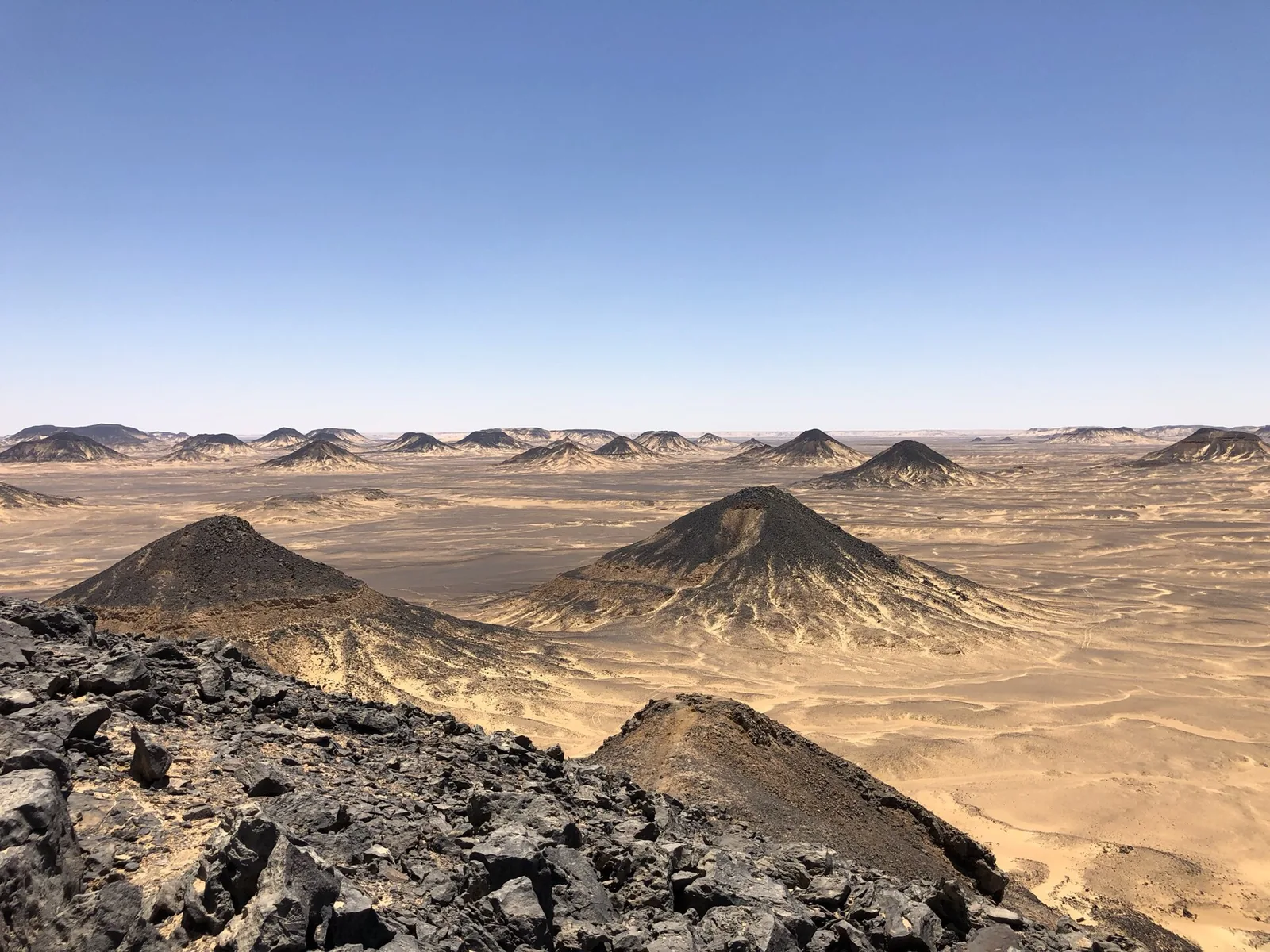
Black Desert Egypt is a field of dark, isolated hills and iron-rich rock south of Bahariya Oasis in the Western Desert. The landscape is usually explored on the same 4×4 route as the White Desert, but it is not simply a short photo stop or a darker version of the White Desert. Its geology, colours and viewpoints are different, and the contrast between the two deserts is one of the strongest reasons to take the Bahariya route from Cairo.
Black Desert Egypt: quick planning answer
- Location: south of Bahariya Oasis, on the wider route toward Farafra and the White Desert.
- Best gateway: Bahariya, reached by road from Cairo.
- Best way to visit: with a licensed local guide and suitable 4×4 as part of a Black and White Desert circuit.
- Time needed: a half-day can cover selected viewpoints from Bahariya, but two days from Cairo is the practical minimum when the White Desert and one camp night are included.
- Best season: generally October to April for more comfortable daytime temperatures.
Read the complete White Desert Egypt guide or see the private 2-day desert route.
What is the Black Desert in Egypt?
The Black Desert is a distinctive landscape of sand, dark stones and widely spaced hills in Egypt’s Western Desert. Its Arabic name, Al-Sahra Al-Sawda, refers to the black material that coats many hilltops and slopes. From a distance, the darker peaks can look as though ash has been scattered across pale desert ground.
The area belongs to the wider Bahariya landscape. Egypt’s official tourism portal describes Bahariya as home to both the White and Black Deserts and places the oasis about 370 kilometres southwest of Cairo. Bahariya’s towns, local drivers, accommodation and supply points make it the normal base for exploring the surrounding desert.
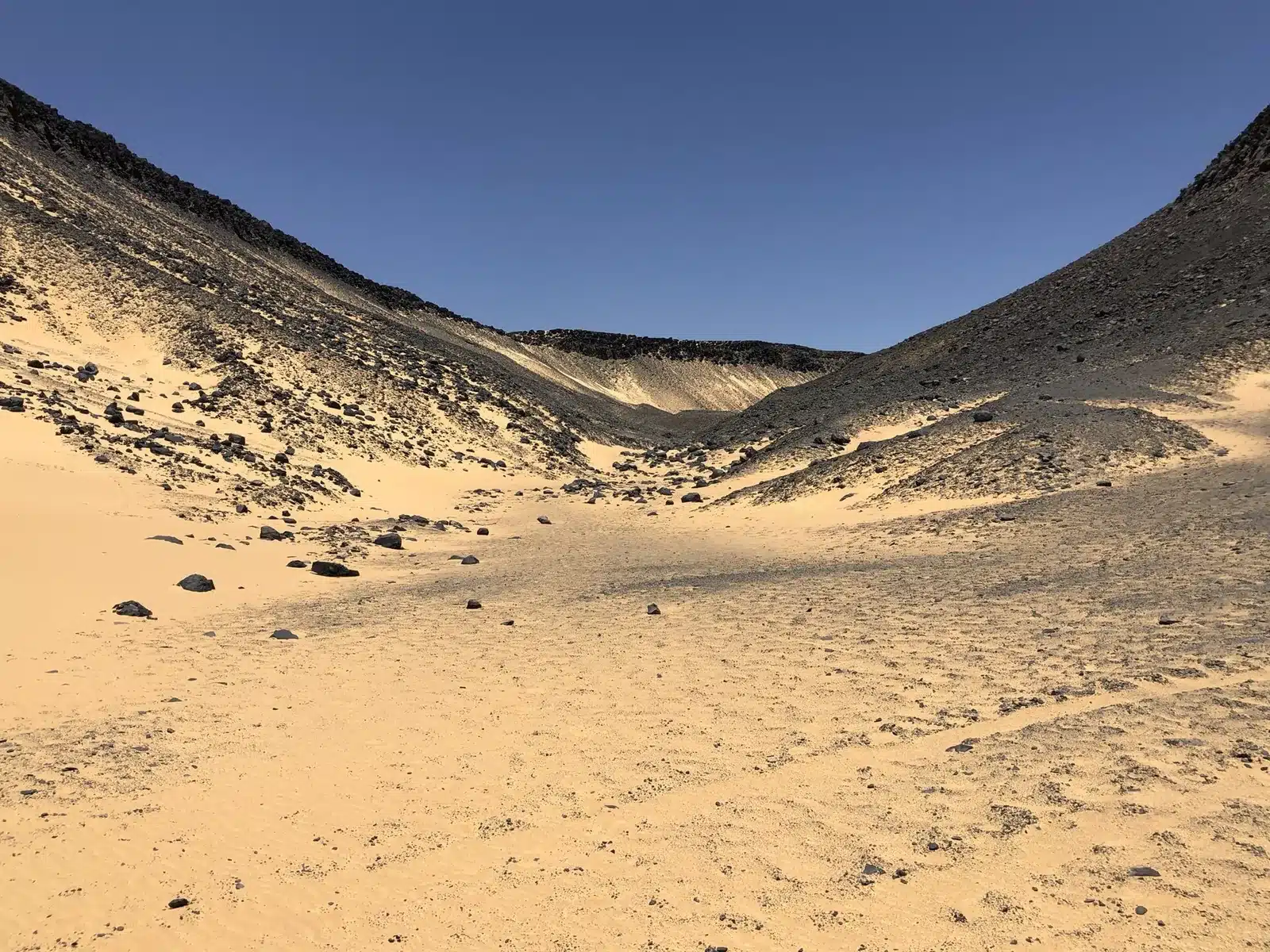
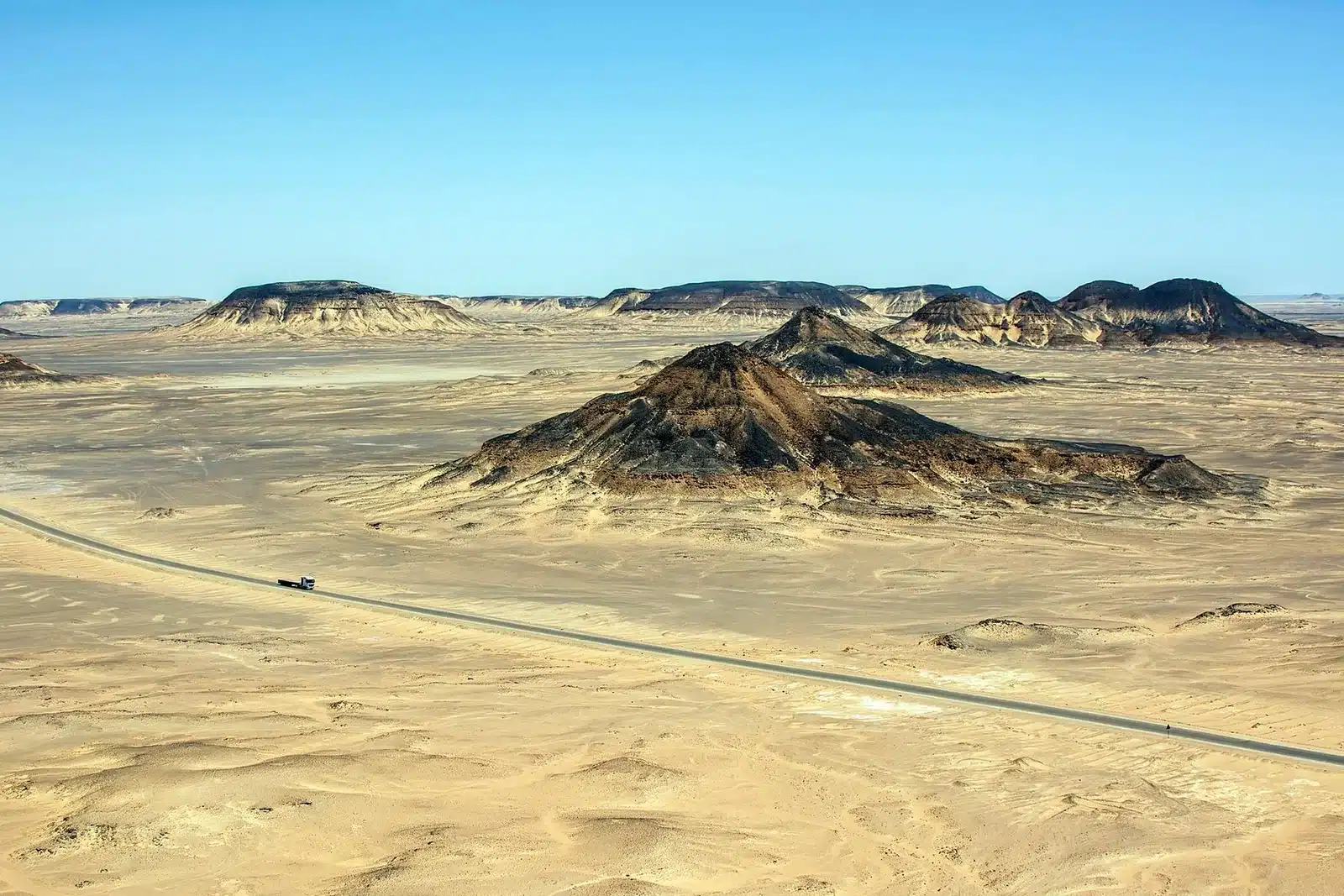
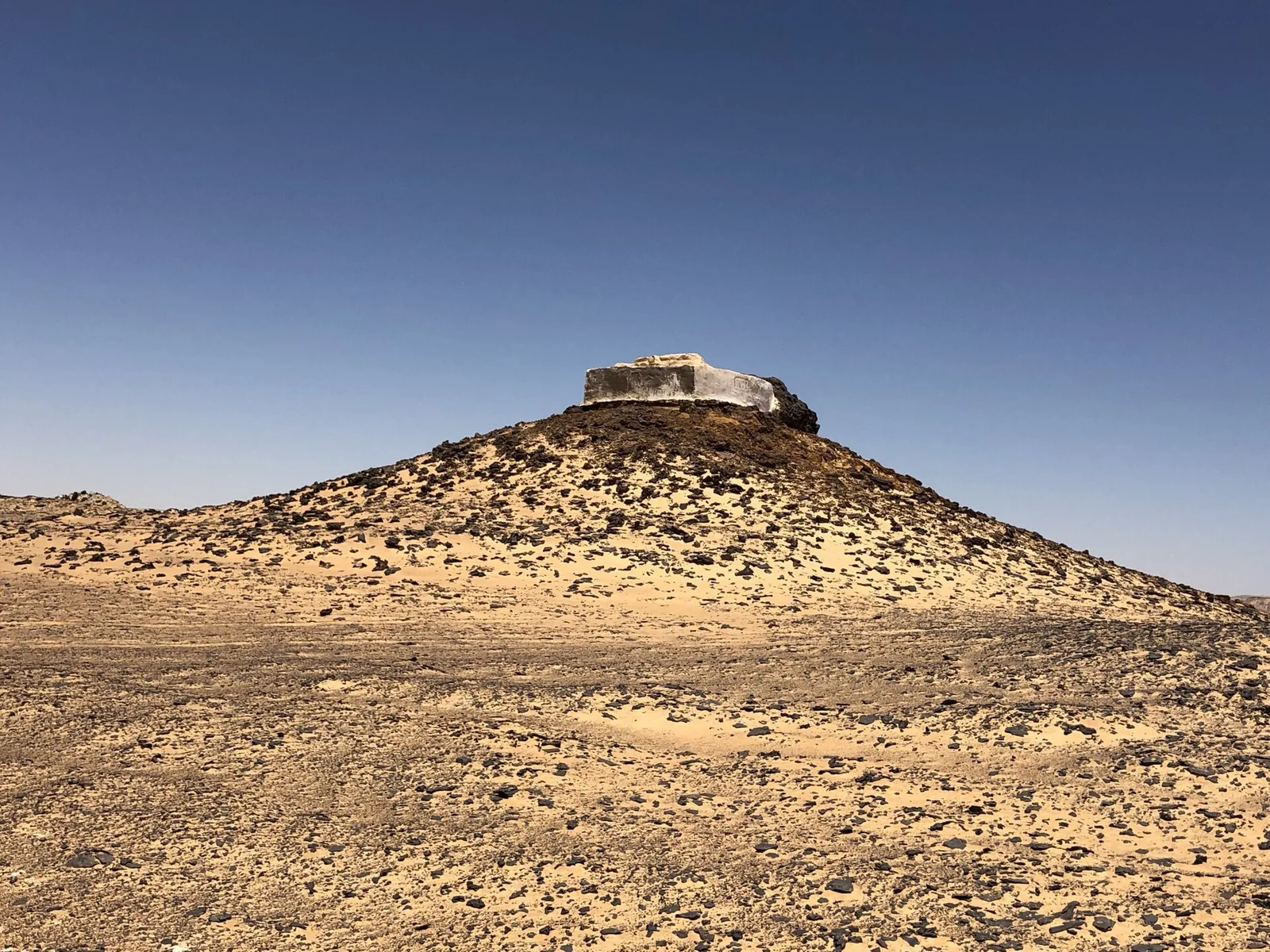
There is no single gate or viewing platform that represents the whole Black Desert. The experience is a changing sequence: low black fragments on sand, conical hills, broad views from higher ground and occasional bands of brown, red or orange. Some formations can be seen from the Bahariya–Farafra road, while closer viewpoints require an appropriate route and local guidance.
Why is the Black Desert black?
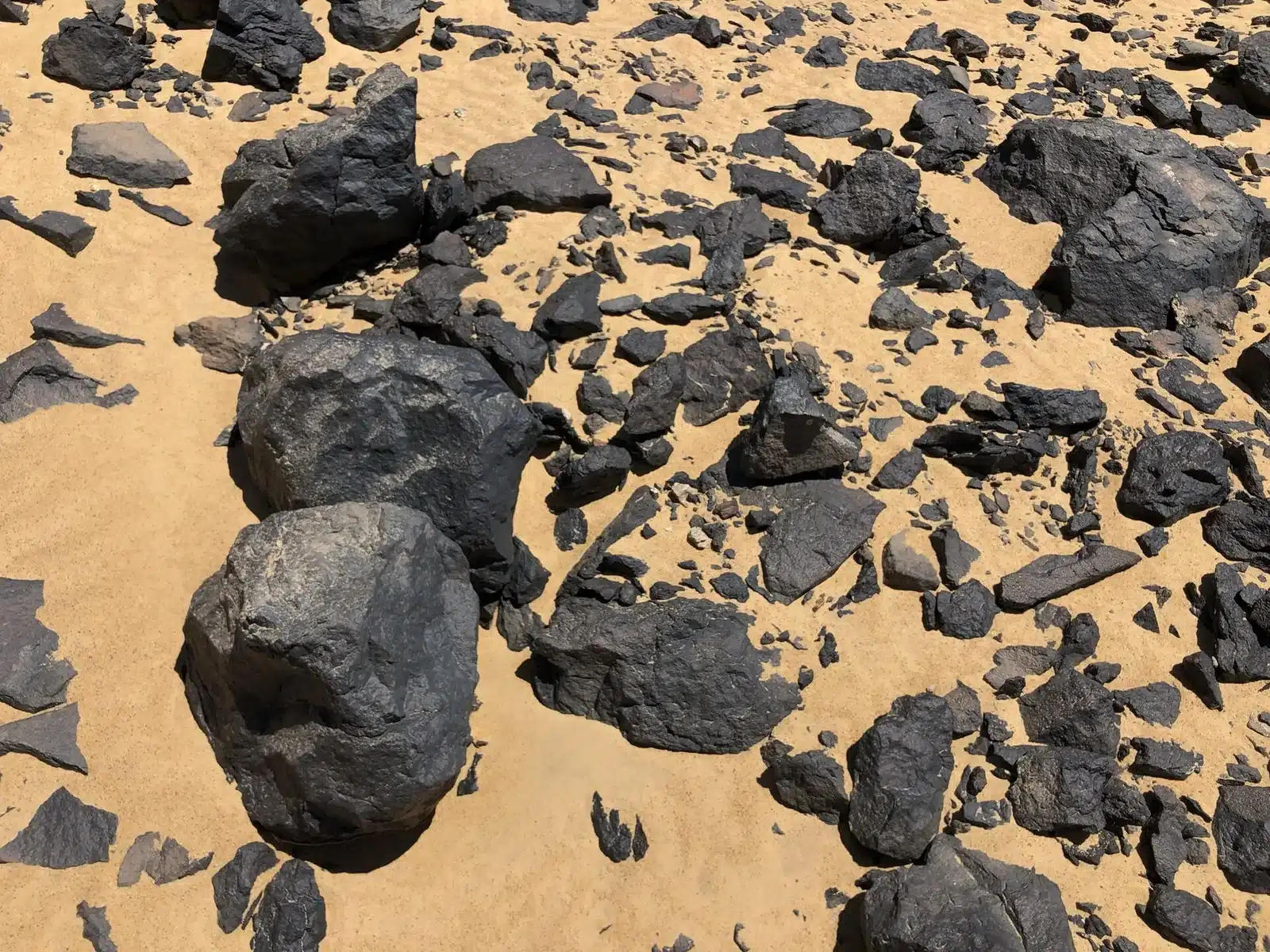
The simple answer is that dark volcanic and iron-rich material covers lighter sedimentary ground. Official Egyptian sources describe the Black Desert as a landscape formed by volcanic activity and explain that oxidation of manganese and iron-bearing rocks contributes to its dark colour.
The black is not uniform. In strong midday light, some rocks look deep brown or charcoal rather than pure black. Other areas show rust-red, orange or yellow tones from iron oxides. This colour variation is one reason photographs taken at different times can make the same hill appear different.
Calling the whole landscape “lava” is misleading. Visitors see a mixture of rock types and eroded hills, with darker dolerite or basalt-like material, iron-rich sandstone and lighter limestone present in the wider region. The important visual story is contrast: dark fragments and caps remain across pale sand and sediment as erosion exposes and redistributes material.
Is the Black Desert a protected area?
The Black Desert forms part of the protected natural heritage around Bahariya. Egypt’s State Information Service states that the Bahariya Oasis Reserve includes the Black Desert, Gebel al-Ingleez, and the Dast and Magharfa areas. The reserve was declared in 2010 and is described as a natural monument reserve with geological and biological value.
Official tourism guidance also highlights wildlife in the Bahariya protectorate, including desert mammals, birds and reptiles. Seeing wildlife is never guaranteed, and visitors should not feed or pursue animals. The practical rule is to treat the dark stones and hill slopes as protected landscape, not as a source of souvenirs.
Do not remove black rocks, mineral fragments or fossils. A small piece may feel insignificant, but repeated collecting damages the very geology people travel to see. Vehicle tracks also last in dry terrain, which is why guides choose established routes and suitable stopping points.
Where is Black Desert Egypt?
The Black Desert lies south of Bahariya Oasis, between the oasis and the White Desert region farther toward Farafra. Cairo is the starting point for most international visitors, but Cairo is not the immediate gateway: the long road transfer first reaches Bahariya, where travellers normally meet the local desert crew and change to a 4×4.
Official Egyptian tourism information describes the drive to Bahariya as approximately five hours, depending on vehicle, traffic, stops and the Cairo pick-up point. Times advertised online are often too optimistic. A private trip should still leave early because the day includes the Cairo transfer, a practical stop in Bahariya and desert driving before sunset.
Do not confuse three places that are frequently mixed together in short articles:
- Bahariya Oasis: the inhabited depression with Bawiti, villages, palm groves, springs and archaeological sites.
- The Black Desert: the wider dark-hill landscape south of the oasis.
- Gebel al-Ingleez: a separate hill close to Bawiti, known for views and historical remains. Its dark summit does not make it a substitute for the Black Desert circuit.
Our Bahariya Oasis Egypt guide explains what to add before or after the desert route.
What do you actually see in the Black Desert?
Isolated dark hills
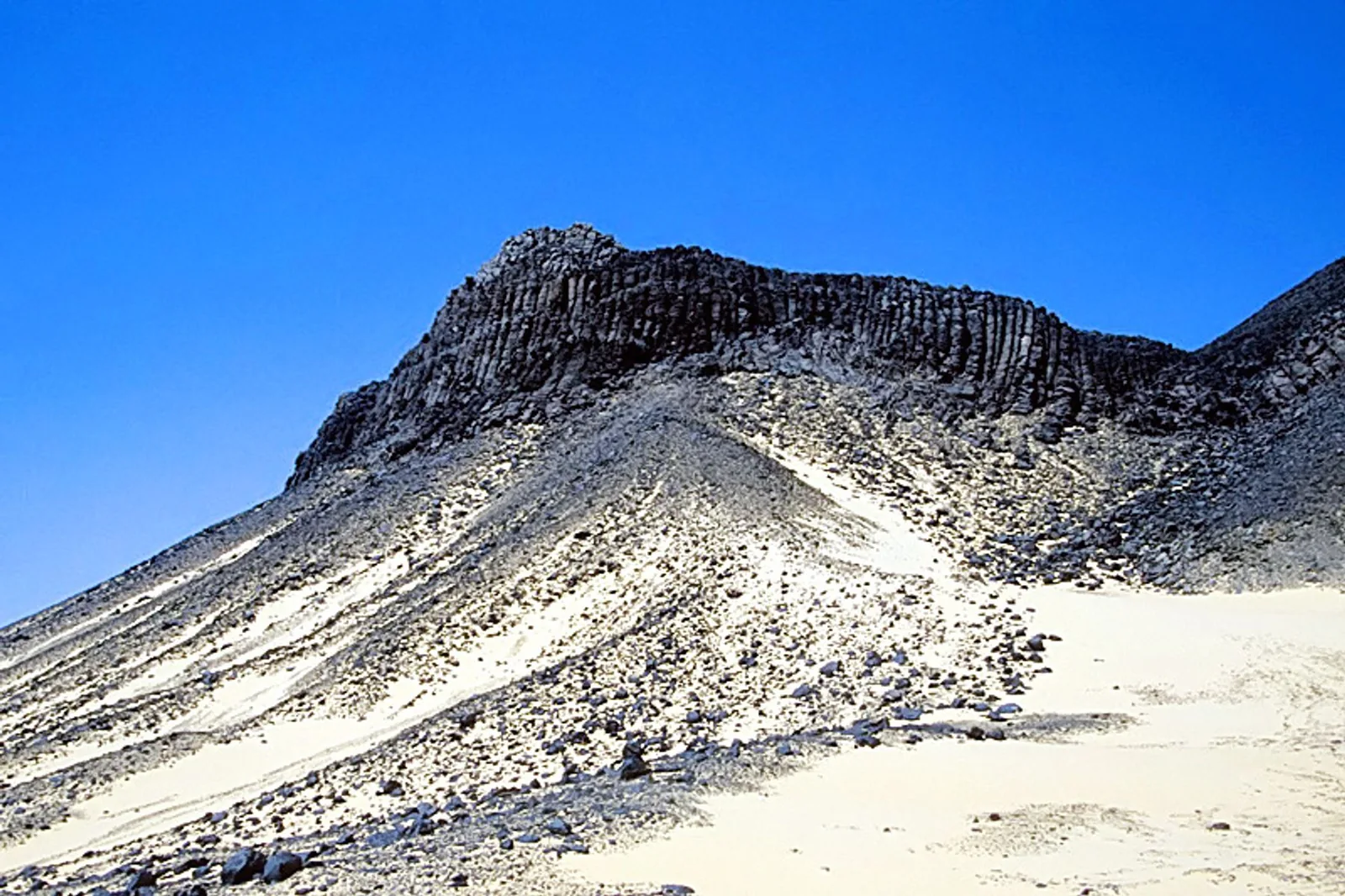
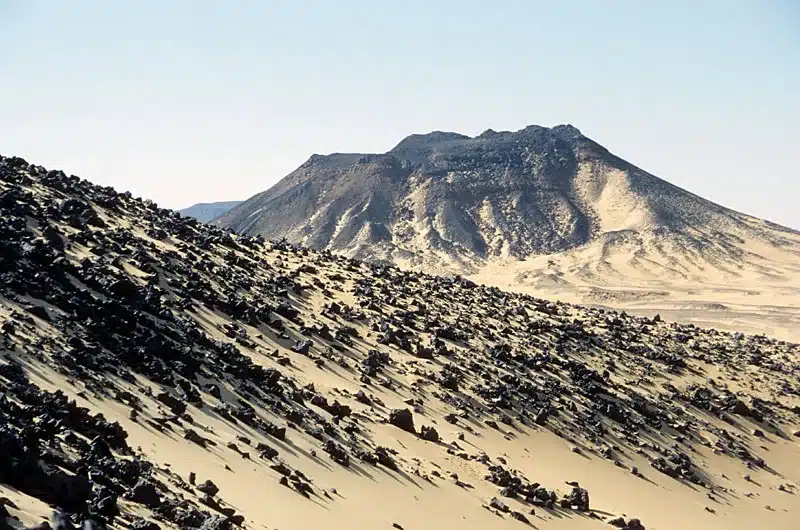
The defining view is a series of hills rising separately from a broad desert floor. Their shapes and spacing make distance difficult to judge. From low ground, one hill can dominate the view; from a safe elevated point, dozens of peaks may appear across the horizon.
Black stones scattered over sand
Closer to the ground, the desert’s name becomes easier to understand. Dark fragments rest on yellow and beige sand, sometimes densely and sometimes in thin patches. These details produce strong close-up photographs, but they also make walking less comfortable than on smooth sand. Closed shoes are better than sandals.
More colours than the name suggests
Black is only the headline colour. Brown, red, orange, cream and grey appear as the angle of light changes. The official description of the area notes iron oxides in several colours. Late-afternoon light is especially useful for showing texture rather than turning every slope into a flat silhouette.
Recognisable hills such as Gebel Marsus
Some tours identify individual hills, including Gebel Marsus, whose darker cap and exposed layers create a memorable shape. Names and stop choices vary between local teams. Treat named formations as route possibilities, not guaranteed checklist items; weather, permissions and time may lead the guide to use a different viewpoint.
Black Desert vs White Desert: what is the difference?
| Question | Black Desert | White Desert |
|---|---|---|
| Main visual character | Dark hills, iron-rich stones and volcanic-looking terrain | Pale chalk, limestone and wind-carved formations |
| Position on the route | Closer to Bahariya Oasis | Farther south toward Farafra |
| Best experience | Viewpoints, short walks and geological contrast | Walking among formations, sunset, sunrise and camping |
| Typical visit length | Selected stops during the first or final safari day | Usually the focus of an overnight desert camp |
| Ground conditions | Rocky slopes, fragments and loose surfaces | Sand, chalk fragments and varied formation fields |
The two landscapes complement rather than replace each other. A tour advertised as a “Black and White Desert Egypt” trip should show how much time is spent at each area. On a rushed itinerary, the Black Desert can become a five-minute roadside photo while most time goes to Cairo transfers. Ask for the written sequence before booking.
For the southern part of the circuit, use our White Desert camping and safari guide. It covers our complete Crystal Mountain Egypt guide, Agabat Valley, permits, sleeping arrangements and the difference between two- and three-day tours.
How to visit the Black Desert from Cairo
Step 1: Cairo to Bahariya
Leave Cairo early in a road vehicle suitable for the highway transfer. The drive crosses a long desert road with limited services. Bring water and a light snack, even when meals are included later. Confirm whether pick-up covers central Cairo, Giza, New Cairo or airport-area hotels because location changes timing.
Step 2: Meet the Bahariya desert team
At Bahariya, trips normally pause for food, supplies and the change to a local 4×4. This handover is important. A comfortable Cairo car and an experienced off-road vehicle perform different jobs; one vehicle does not need to pretend to be both.
Step 3: Enter the Black Desert circuit
The guide selects stops based on daylight, road conditions and the planned overnight. Short walks reveal rock texture, while a higher viewpoint shows the distribution of the hills. The safest hill is not always the tallest-looking one. Loose rock and steep slopes make local judgement more useful than following a pin copied from social media.
Step 4: Continue toward Crystal Mountain, Agabat and the White Desert
Most two-day trips move south rather than returning to Bahariya after the Black Desert. Crystal Mountain and Agabat Valley lie on the wider route before the White Desert camp. This sequence gives the journey visual progression: black hills, pale cliffs, sand and finally the white formations.
Can the Black Desert be visited as a day trip?
From Bahariya, a half-day or full-day desert outing can focus on the Black Desert and nearby oasis experiences. From Cairo, a same-day return is possible only as a very long transfer-heavy day and is not the best use of the route. You would spend most of your time on the highway and miss the White Desert camp that makes the journey worthwhile.
For most foreign travellers, these are the practical choices:
- One night in Bahariya: useful if you want the Black Desert, oasis villages, springs and a hotel rather than wilderness camping.
- Two days from Cairo: the efficient option for Black Desert highlights plus one White Desert camp.
- Three days from Cairo: better for photography, longer walks, Bahariya sights and a route with fewer rushed stops.
Compare the Bahariya Oasis safari from Cairo, the 2-day Black and White Desert route and the 3-day private safari.
Best time to visit Black Desert Egypt
October to April is generally the most comfortable season for Western Desert travel. The dark ground absorbs heat, and shade is limited, so cooler months make viewpoints and short walks more enjoyable. Winter nights can still be cold, especially when the same trip includes White Desert camping.
- October and November: usually warmer nights with more manageable daytime conditions than summer.
- December to February: comfortable walking weather can be balanced by cold early mornings and camp nights.
- March and April: pleasant periods are possible, but wind and dust can change quickly.
- May to September: heat requires cautious timing, extra water and route flexibility; some travellers should avoid summer desert trips.
Weather averages do not replace a same-week local check. A responsible operator may shorten a walk or change the order of stops because of wind, heat or an official access instruction.
Safety and choosing a Black Desert tour
Official Egyptian tourism guidance recommends experienced, licensed guides and suitable 4×4 transport for excursions outside Bahariya. It also advises travellers to confirm permits, transport and logistics through an authorised operator. The Black Desert may look accessible from the road, but an image of a visible hill does not tell you whether the surface, route or stopping area is safe.
Before booking, ask:
- Is the trip private or shared, and how many guests travel in each 4×4?
- Which Black Desert stops are planned, and how long is actually allocated?
- Are Cairo transfer time and Bahariya vehicle changes shown clearly?
- Are permits and protected-area fees handled at the current official rate?
- What water, first-aid, recovery and communication equipment is carried?
- What changes if heat, wind or a checkpoint affects the route?
- Does the quoted price include meals, sleeping equipment and Cairo return transport?
Avoid an operator who promises unrestricted off-road driving, rock collecting or climbing every hill. Flexibility should mean responding to conditions, not ignoring protected-area rules.
Photography tips for the Black Desert
The strongest photographs show contrast and scale. A very wide lens can make distant hills appear tiny, while a telephoto lens compresses layers and makes separate cones feel closer together. Use both if available, but a phone with a normal and 2x view is enough for varied images.
- Photograph one frame from low ground to show black stones against pale sand.
- Use a road, vehicle or person only when safe to provide scale.
- Protect the horizon from tilting; broad desert views make a small angle obvious.
- Expose for the bright sand so black rocks keep texture instead of becoming featureless shapes.
- Avoid climbing unstable slopes only for a social-media angle.
- Carry a dust cloth and change camera lenses inside the vehicle when possible.
What to pack
- Closed shoes with grip for loose dark stones and sandy slopes.
- A hat, sunglasses and high-SPF sunscreen.
- Breathable clothing plus warm layers when the trip includes camping.
- A personal water bottle and extra electrolytes you already tolerate.
- A headlamp for an overnight White Desert camp.
- A power bank because charging and signal are not reliable after Bahariya.
- Medication, tissues and a small rubbish bag for personal waste.
- Camera or phone protection from dust and impact inside the 4×4.
Is the Black Desert suitable for families and older travellers?
Many viewpoints can be enjoyed close to the vehicle, so the area can work well for families and older visitors on a private route. The more demanding parts are the Cairo road time, climbing into a 4×4, uneven stones and the cold or limited facilities if camping is included.
Tell the operator about mobility needs before departure. Ask for short, specific answers: how far is the walk, how steep is the slope, is there a step into the vehicle, and what toilet arrangement is available? “Easy” means different things to different travellers.
How much does a Black Desert Egypt tour cost?
Price depends on party size, private or shared status, number of days, Cairo pick-up location, vehicles, camp equipment, meals, permits and whether Bahariya accommodation is included. A Black Desert-only outing from Bahariya cannot be compared directly with a two-day private trip from Cairo that includes the White Desert and overnight camp.
Ask for the total price for your exact date and group, then compare the inclusion list. The lowest headline price may exclude Cairo transport, protected-area fees, camp bedding or private 4×4 allocation. Current prices belong on live tour pages, not in an article that can become outdated.
Responsible travel in the Black Desert
- Leave every rock, mineral and fossil where it is.
- Use established vehicle tracks and designated stopping areas.
- Do not carve, stack or move stones for photographs.
- Pack out plastic, tissues, wipes, batteries and food waste.
- Never feed desert wildlife.
- Keep noise low near animals, villages and other camps.
- Follow the guide when a slope or formation is considered unsafe or fragile.
Black Desert Egypt FAQ
Is Black Desert Egypt really volcanic?
Official Egyptian tourism sources describe it as formed by volcanic activity. Its dark appearance also reflects manganese and iron-bearing rocks and their oxidation. The visible landscape includes several rock types, not one continuous sheet of lava.
How far is the Black Desert from Cairo?
Bahariya Oasis is about 370 kilometres southwest of Cairo, and the Black Desert lies south of the oasis. Allow approximately five hours for the Cairo–Bahariya road transfer before the local desert section, rather than treating the Black Desert as a nearby Cairo attraction.
Can I drive there in a rental car?
A normal car can travel on the paved route toward Bahariya, but it is not a substitute for an experienced local guide and suitable 4×4 on desert tracks. Current access and permit arrangements should be confirmed before departure.
Can I camp in the Black Desert?
Camping arrangements depend on permissions, wind, route and operator. Most short circuits spend sightseeing time in the Black Desert and choose the White Desert for the main overnight because of its formations and sunrise scenery.
Which is better, the Black Desert or White Desert?
They deliver different scenery and are best combined. The Black Desert provides dark hills and geological contrast; the White Desert provides pale sculpted formations and the classic overnight camp.
Do Black Desert tours include Crystal Mountain?
Many two- and three-day circuits continue from the Black Desert toward Crystal Mountain, Agabat Valley and the White Desert. Always verify the written itinerary because a short Bahariya outing may not travel that far south.
Is the Black Desert safe for solo travellers?
Solo guests can book a private or shared organised safari, but independent off-road travel is not recommended. Share medical needs and emergency contact details with the operator and use a team that knows the current route.
Plan a Black and White Desert safari
Tell us when you hope to travel, your group size, any children’s ages, where you are staying in Cairo and how many desert nights you can spare. We will explain how much time is allocated to the Black Desert, which White Desert camp arrangement is included, and what may change with current conditions.
Ask for a private desert plan Compare Egypt safari tours
Authoritative planning sources
- Experience Egypt: Bahariya Oasis
- Experience Egypt: Bahariya natural wonders and safari guidance
- Experience Egypt: Bahariya Protectorate and Black Desert
- Egypt State Information Service: Bahariya Oasis Reserve
Image credits and licences
Black Desert photographs 02, 06, 17 and 21: Viktor Lazić, CC BY-SA 4.0. Gebel Marsus and Bahariya Black Desert panorama: Roland Unger, CC BY-SA 3.0. Road viewpoint: Myousry6666, CC BY-SA 4.0. Images were resized and converted to WebP.