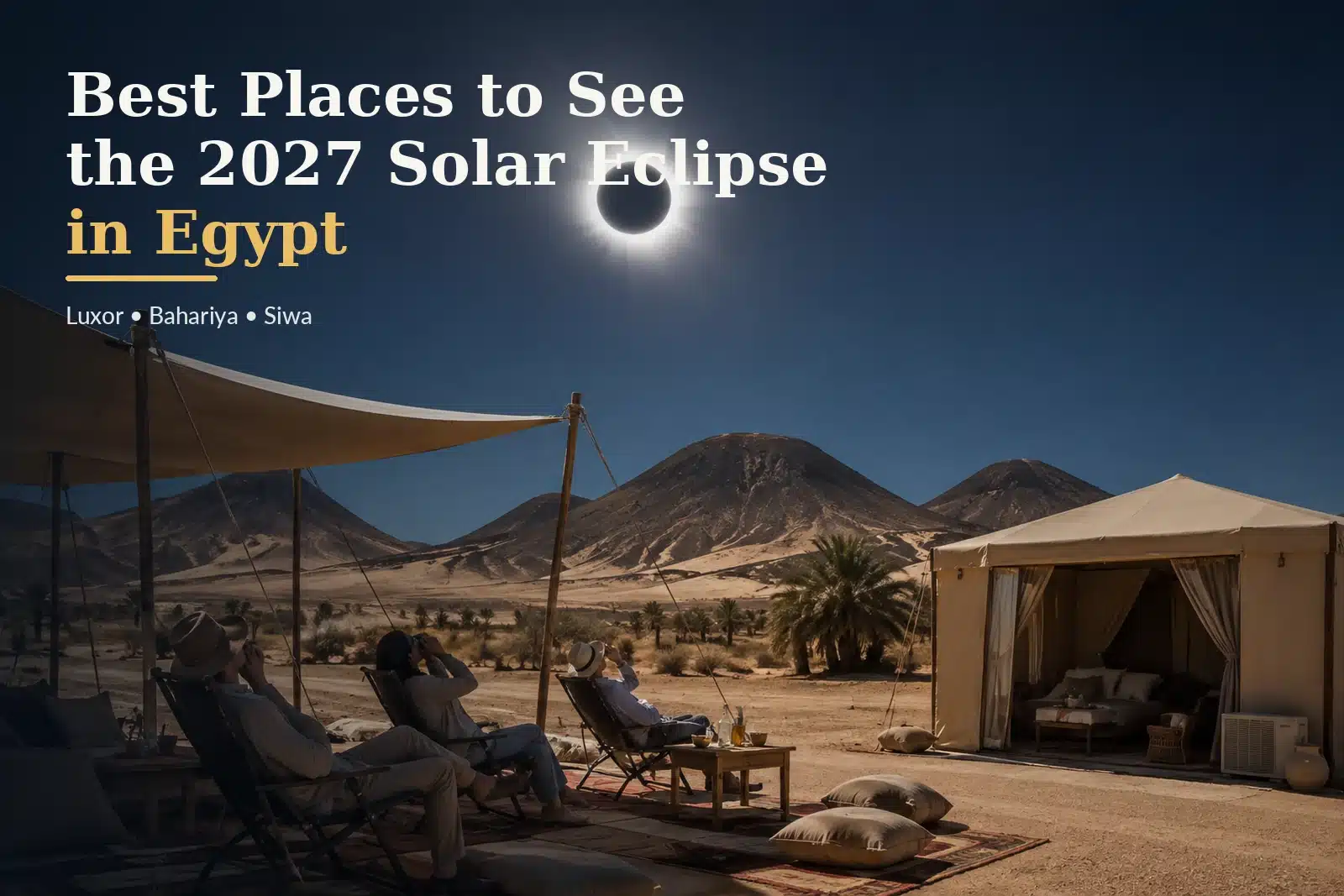
On 2 August 2027, millions of people across a broad part of Egypt will see the Moon cover most of the Sun.
But only some of them will experience totality.
That distinction changes everything.
For travelers searching “best place to see 2027 solar eclipse Egypt”, the real decision begins with one non-negotiable: choose a verified point inside totality.
A traveler standing in central Cairo will see an extraordinary partial eclipse.
A traveler in Hurghada will see an even deeper partial eclipse.
A traveler in Aswan will watch almost the entire solar disk disappear.
And yet none of those three city-center locations experiences the defining moment that eclipse travelers cross continents to see: the Sun becoming completely covered and the corona emerging around the black disk of the Moon.
To experience that, you need to stand inside the path of totality.
Egypt gives travelers several serious choices.
There is Luxor, where totality lasts approximately 6 minutes 22 seconds at the city reference point and where the eclipse can be combined with one of the world’s great archaeological destinations.
There is Bahariya Oasis and the Black Desert, where Al Bawiti receives around 6 minutes 18 seconds of totality and where travelers can experience the eclipse in a radically different Western Desert environment. (Time and Date)
There is Siwa Oasis, with approximately 5 minutes 31 seconds of totality among palms, salt landscapes and the far-western Egyptian desert. (Time and Date)
There are also less-discussed totality locations such as Asyut, with roughly 6 minutes 8 seconds, and Marsa Alam, where the reference location receives around 5 minutes 30 seconds. (Time and Date)
So which is the best?
The answer is not simply:
Luxor, because it has the longest number.
A difference of four seconds separates the published Luxor and Al Bawiti reference durations.
Four seconds.
That is almost irrelevant compared with differences in transport, landscape, crowd environment, accommodation, heat management, photography space and what you want the rest of your Egypt journey to look like.
This guide compares the strongest viewing regions from a traveler’s perspective.
If you need the complete astronomy, path, eclipse safety and travel fundamentals first, read our 2027 Solar Eclipse in Egypt complete guide.
If you already know you want Egypt and are trying to decide where to stand when totality begins, this guide is for you. You can also compare trip formats in our Egypt Solar Eclipse Tours 2027 comparison guide.
Quick Answer: Best Place to See 2027 Solar Eclipse Egypt
There is no single best place for every traveler.
Use this as a starting point:
| Location | Eclipse at Reference Location | Approx. Totality | Best For |
|---|---|---|---|
| Luxor | Total | 6m 22s | Maximum-duration travelers + classical Egypt |
| Bahariya / Al Bawiti | Total | 6m 18s | Private Western Desert experience |
| Asyut | Total | 6m 08s | Long totality without Luxor |
| Siwa Oasis | Total | 5m 31s | Oasis + cultural/desert journey |
| Marsa Alam | Total | 5m 30s | Red Sea region travelers |
| Cairo | Partial | None | Gateway only, not totality |
| Hurghada | Partial | None | Not suitable if totality is your goal |
| Aswan | Partial | None | Very deep partial, but not total |
Luxor’s published city reference gives approximately 6:22 of totality, while Al Bawiti in Bahariya gives about 6:18. Siwa receives 5:31. (Time and Date)
That immediately gives us an important lesson:
You do not have to choose between an excellent eclipse and the Western Desert.
Bahariya gives up only a few seconds compared with Luxor at these reference locations.
What Actually Makes an Eclipse Location “Best”?
The obvious answer is:
the place with the longest totality.
But that is incomplete.
Totality duration matters.
If one location gives you 25 seconds and another gives four minutes, duration can completely change the experience.
But Egypt’s strongest 2027 choices are not separated by enormous differences.
Luxor is around 6 minutes 22 seconds.
Al Bawiti in Bahariya is around 6 minutes 18 seconds.
That is approximately four seconds of difference at the published reference points. (Time and Date)
Even Siwa, with approximately 5 minutes 31 seconds, still provides an exceptionally long totality compared with many famous eclipses around the world. (Time and Date)
So once you are safely and comfortably inside the path, other questions become important.
How easy is the location to reach?
A theoretical perfect coordinate is useless if you cannot get your party and equipment there reliably.
Where will you be the night before?
An eclipse location should not require a desperate multi-hour transfer on the morning of 2 August.
What will you be looking at?
A desert horizon feels completely different from a city, river valley or Red Sea resort.
How will you manage the August midday heat?
Shade, seating, drinking water and a cooled rest space can matter enormously.
Are you bringing tripods?
A family using eclipse glasses has different spatial requirements from four photographers carrying large lenses.
What will the rest of your journey contain?
Do you want ancient temples?
White Desert formations?
Siwan culture?
Giza?
The Mediterranean?
How much privacy do you want?
“Inside the totality path” says nothing about the viewing atmosphere.
Those questions are why this article does not simply rank locations by seconds.
The 2027 Path of Totality Across Egypt
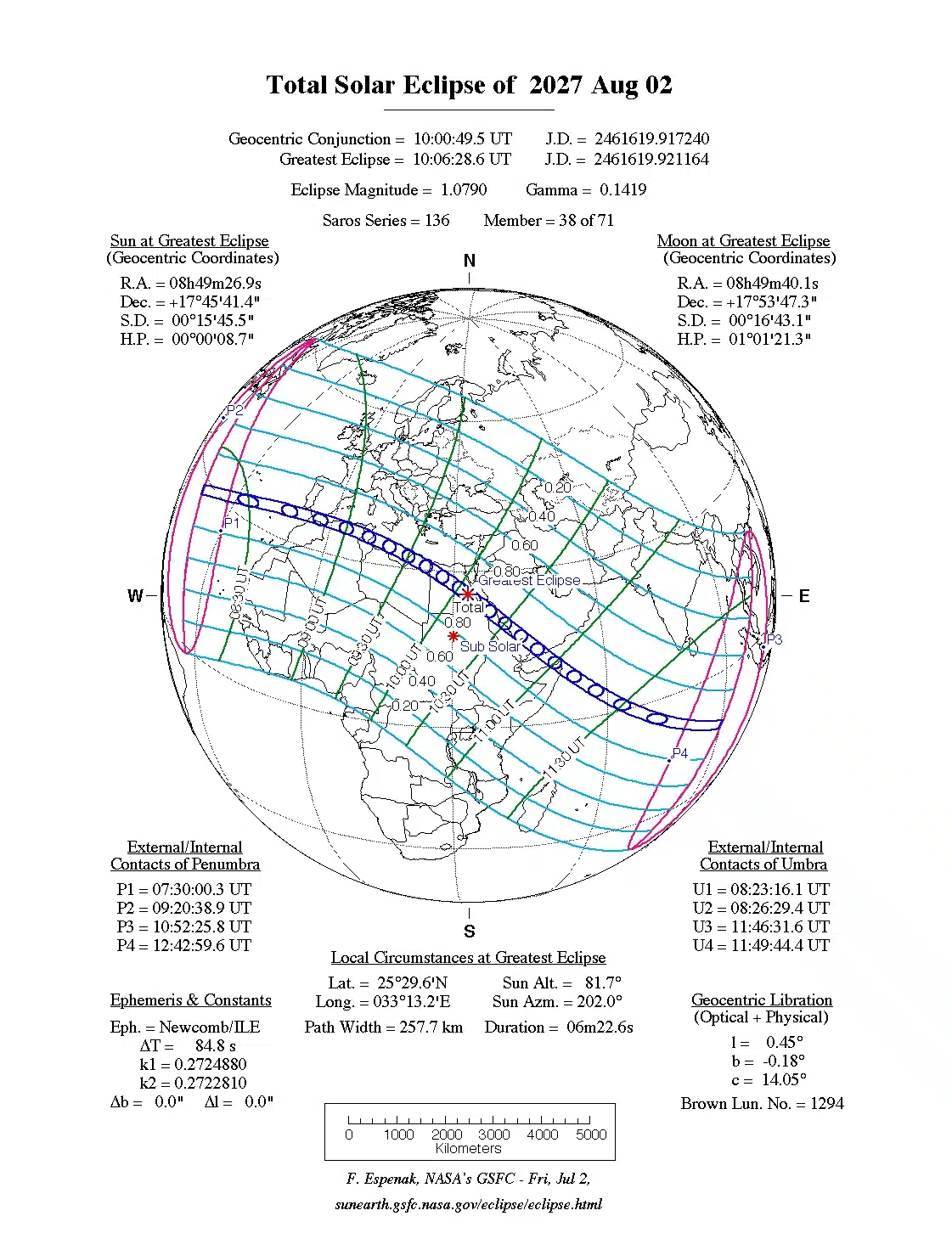
NASA lists Egypt directly inside the totality path of the 2 August 2027 eclipse, with a global maximum duration of approximately 6 minutes 23 seconds. (NASA Eclipse)
Across Egypt, the shadow travels generally from west to east.
The exact local time changes as the shadow moves.
Siwa reaches maximum eclipse earlier, around 12:45 pm local time.
Al Bawiti is around 12:53 pm.
Luxor reaches maximum at approximately 1:05 pm. (Time and Date)
This means the path intersects several very different Egyptian environments.
Far-western oasis.
Western Desert.
Nile Valley.
Eastern Desert.
Red Sea region.
That variety is unusual.
Many total eclipses force travelers to choose whatever geography happens to lie in the shadow.
Egypt lets travelers choose among very different types of journey while remaining inside totality.
Location Comparison at a Glance
| Factor | Luxor | Bahariya | Siwa | Asyut | Marsa Alam |
|---|---|---|---|---|---|
| Approx. totality | 6:22 | 6:18 at Al Bawiti reference | 5:31 | 6:08 | 5:30 |
| Landscape | Nile Valley / desert edges | Black Desert / oasis | Salt flats / oasis / desert | Nile Valley | Red Sea / Eastern Desert |
| Classical sightseeing | Exceptional | Limited | Cultural oasis sites | Regional | Limited compared with Luxor |
| Western Desert experience | No | Excellent | Excellent | No | No |
| Best for short Cairo extension | Moderate | Excellent | Poor | Moderate | Poor |
| Best for Siwa lovers | No | No | Excellent | No | No |
| Dedicated desert photography potential | Good | Excellent | Excellent | Moderate | Good |
| Egypt Safari Travel eclipse program | No current package | Yes | Yes | No current package | No current package |
Important: This table does not imply that locations without an Egypt Safari Travel package are inferior. They are included because a useful guide should show travelers the real options, not only the destinations we sell.
That matters for trust.
Luxor: The Famous Maximum-Duration Choice
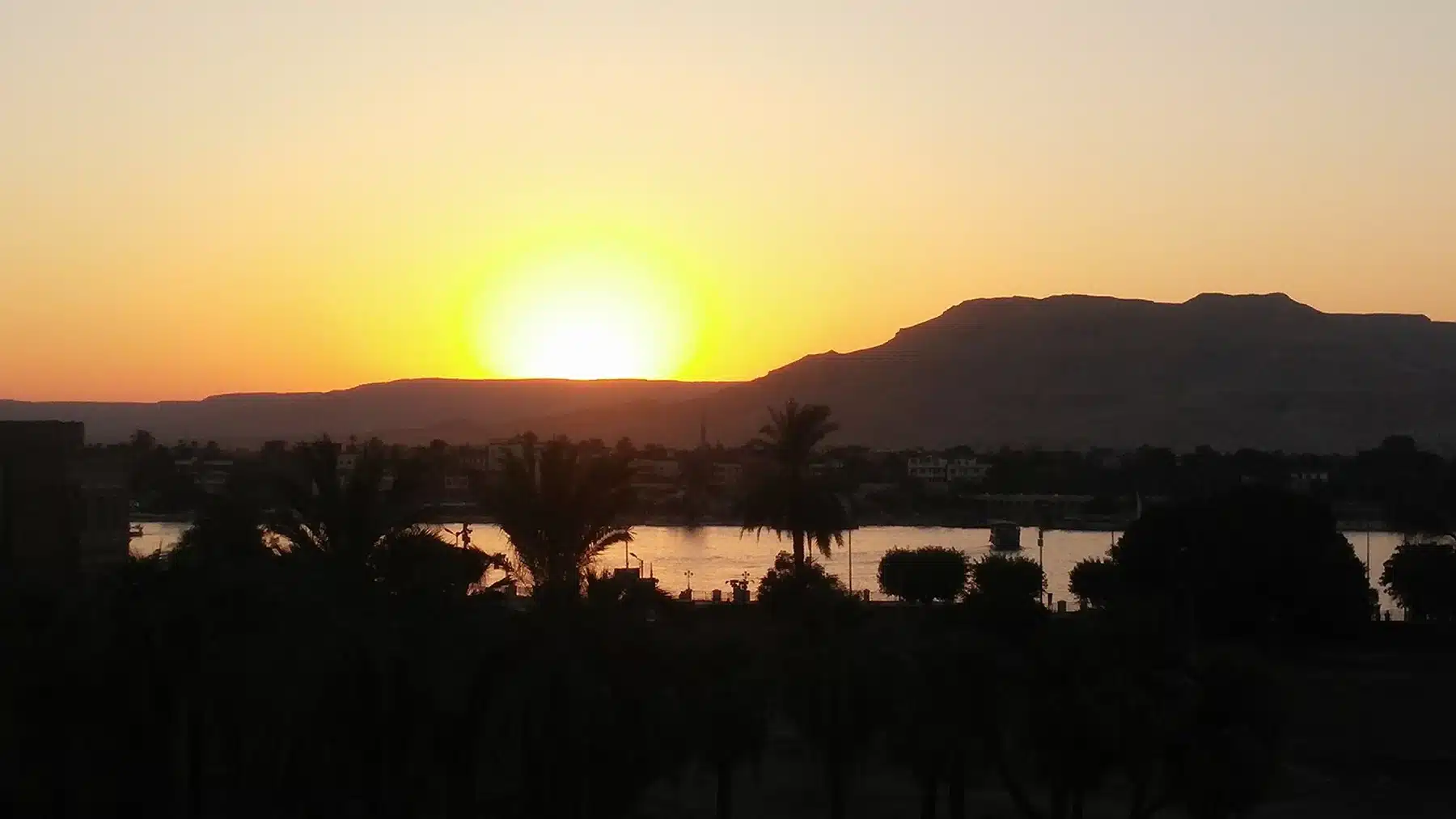
If somebody has already researched the 2027 eclipse for ten minutes, they have probably encountered Luxor.
There is a good reason.
Timeanddate currently calculates approximately 6 minutes 22 seconds of totality at its Luxor reference point, with maximum eclipse around 1:05 pm local time. (Time and Date)
Nearby locations can reach essentially the global maximum; one Luxor-area reference point currently calculates 6 minutes 23 seconds. (Time and Date)
From an astronomical perspective, Luxor is extraordinary.
But the travel argument is equally strong.
Luxor offers:
Karnak;
Luxor Temple;
Valley of the Kings;
West Bank monuments;
Nile scenery;
hotels;
restaurants;
and one of Egypt’s most established international-tourism infrastructures.
For somebody visiting Egypt for the first time and wanting ancient history around the eclipse, Luxor is an obvious candidate.
Why choose Luxor?
Choose Luxor if your priorities sound like this:
“I want as close as practical to the maximum duration.”
“I want the temples and Nile to be a major part of my trip.”
“I prefer conventional hotel infrastructure.”
“I want an easy-to-understand international tourism destination.”
Luxor can deliver that combination extremely well.
What should you think about?
Popularity.
It would be irresponsible to claim exactly how crowded Luxor will be in August 2027 this far in advance.
But it is reasonable to expect Luxor to receive enormous eclipse-tourism attention because of its duration, global name recognition and tourism infrastructure.
If the idea of observing totality alongside a significant organized-event atmosphere excites you, that may not be a problem.
If what you imagine is six people, dark desert hills, equipment spaced out and no large event around you, Western Desert options deserve serious consideration.
Bahariya Oasis: Almost Luxor-Length Totality in the Western Desert
This is the location that may surprise travelers most.
At Al Bawiti, the main town of Bahariya Oasis, Timeanddate currently calculates about 6 minutes 18 seconds of totality, with maximum eclipse around 12:53 pm. (Time and Date)
Luxor’s city reference is around 6:22.
The difference is approximately four seconds.
Four seconds is not enough to determine an entire international trip.
That opens the door to a completely different question:
Would you rather spend those six-plus minutes in the Nile Valley or the Western Desert?
Bahariya is accessible overland from Cairo and acts as the gateway to the Black Desert and White Desert region.
That makes it particularly useful for travelers who want the eclipse incorporated into a desert safari rather than a Nile-centered program.
Egypt Safari Travel’s current private Black Desert field is published at:
28.16208° N, 28.76423° E
with the itinerary describing more than six minutes of totality. (Egypt Safari Travel)
The current field plan includes:
private shade;
cooled rest space;
chairs;
food;
water;
electrolytes;
toilets;
charging;
eclipse glasses;
and a separate tripod area. (Egypt Safari Travel)
That illustrates an important principle.
A great eclipse location is not simply a latitude and longitude.
It is a coordinate that has been turned into somewhere people can safely and calmly spend hours.
The Black Desert: Why Landscape Changes the Experience
Totality does something unusual to landscape.
During an ordinary sunset, the Sun itself creates warm side lighting and color.
During totality, the light changes rapidly and unnaturally.
That makes the environment around you part of the event.
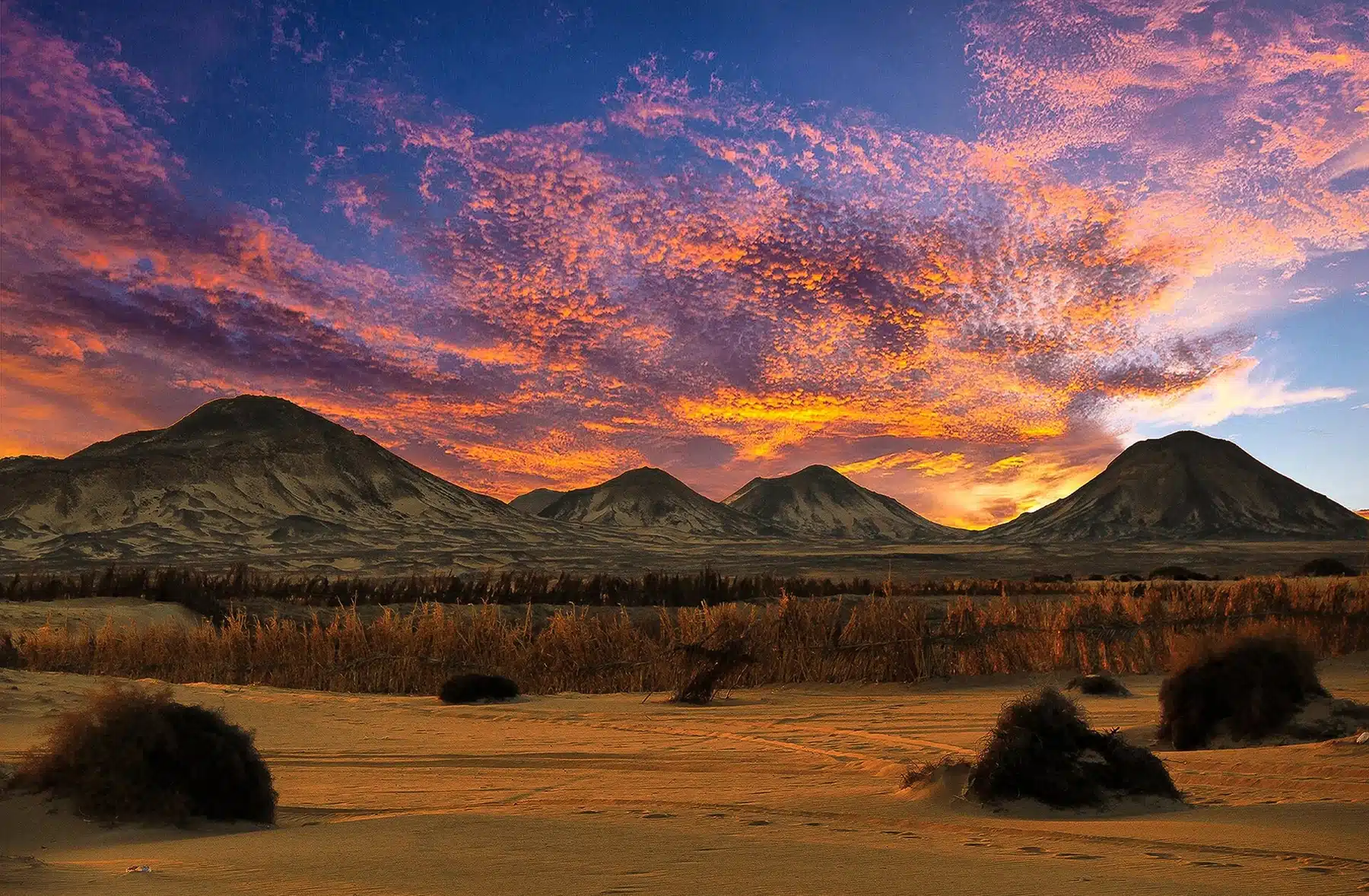
The Black Desert offers a strong visual identity even before anything happens in the sky.
Dark volcanic hills rise out of pale desert terrain.
Black rock scatters across golden ground.
Open spaces create broad horizons.
For photographers, that means the location can produce more than a photograph of the corona against empty sky.
It can produce an environmental eclipse image.
The distinction matters.
One photographer may want a 600 mm frame containing only the Sun.
Another may want:
tripod;
traveler silhouette;
dark volcanic ridge;
eclipse;
and Western Desert horizon.
Bahariya allows both styles to coexist.
The four-day Black & White Desert photography itinerary is built around this idea, combining the fixed Black Desert eclipse field with time in landscapes such as Crystal Mountain, Agabat and the White Desert. (Egypt Safari Travel)
Siwa Oasis: The Destination Choice
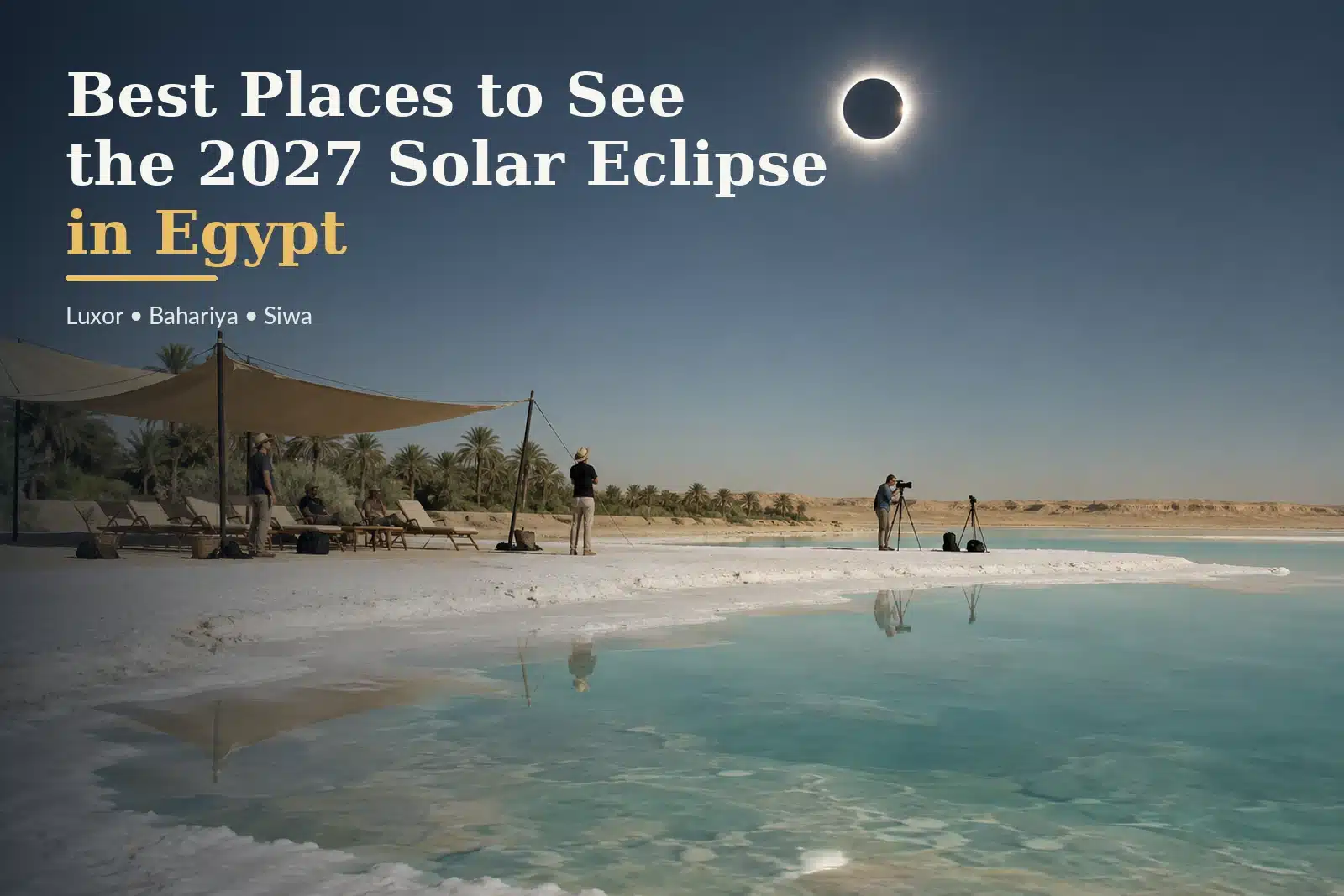
Siwa does not win the comparison by totality duration.
It wins by being Siwa.
Timeanddate currently calculates approximately 5 minutes 31 seconds of totality, with maximum eclipse around 12:45 pm. (Time and Date)
Compared with Luxor, that is about 51 seconds less.
Compared with Al Bawiti, around 47 seconds less.
Would you notice the difference?
Of course.
Fifty seconds during totality is valuable.
But five and a half minutes is still an exceptionally long totality.
And what you receive in exchange is a very different journey.
Siwa offers:
palm groves;
salt landscapes;
freshwater springs;
Shali Fortress;
the Oracle of Amun;
the Great Sand Sea;
local culture;
and the experience of traveling deep into Egypt’s Western Desert.
For some travelers, that is worth far more than 47 seconds.
Egypt Safari Travel’s current Siwa eclipse field is published at:
29.21366° N, 25.63071° E
on the eastern salt-flat side of the oasis.
The existing five-day program describes more than five minutes of totality along with shade, cooled rest space, reclining chairs, water, food, toilets, charging and a separate tripod zone. (Egypt Safari Travel)
Choose Siwa if…
You would want to visit Siwa even without an eclipse.
That is the simplest test.
If the answer is yes, the 2027 eclipse becomes an extraordinary reason to finally make the journey.
If the answer is no and your only metric is maximum duration, Luxor or Bahariya makes more sense.
Asyut: A Strong but Less Discussed Eclipse Location
Asyut deserves more attention than it usually receives in international eclipse discussions.
Timeanddate currently gives the city reference approximately 6 minutes 8 seconds of totality, with maximum eclipse around 12:59 pm. (Time and Date)
That is an excellent astronomical position.
It is substantially longer than many famous eclipses.
Why, then, is Asyut not discussed as much as Luxor?
Because eclipse-tour planning is not based only on astronomy.
Luxor has enormous global tourism recognition.
Bahariya and Siwa have distinctive desert-trip identities.
Asyut occupies a different position.
It may appeal to independent eclipse travelers or specialist groups interested in exploring alternatives inside the path.
But this site does not currently offer a dedicated Asyut eclipse package.
We include it because a fair location guide should acknowledge that excellent totality extends well beyond the destinations being sold here.
Marsa Alam: A Red Sea Totality Option
Marsa Alam is another interesting case.
Unlike Hurghada, the Marsa Alam reference location is inside totality.
Timeanddate currently calculates approximately 5 minutes 30 seconds, with maximum around 1:10 pm. (Time and Date)
For travelers already planning a southern Red Sea holiday, that may be interesting.
It combines a total eclipse with a region known for marine tourism and Eastern Desert landscapes.
But precise location remains important.
The Red Sea coast stretches a long way.
Do not assume that because one Red Sea destination receives totality, every resort town does.
Hurghada demonstrates exactly why.
Cairo: Why a Deep Partial Eclipse Is Still Not Totality
Cairo is Egypt’s main international gateway.
It is also outside the totality path.
Timeanddate currently lists maximum eclipse in Cairo at approximately 12:55 pm, with a local eclipse magnitude of about 0.947. (Time and Date)
That will be a dramatic partial eclipse.
But it will not be totality.
This difference cannot be overstated.
A traveler should not think:
“94 or 95 percent sounds close enough.”
The final fraction of the Sun’s bright photosphere is extraordinarily powerful.
Until it disappears completely, eclipse glasses remain necessary.
The corona does not reveal itself in the same way.
The daytime environment does not transition into true totality.
If you are flying internationally specifically for the 2027 eclipse, Cairo should usually be treated as the gateway to the viewing region—not the final viewing point.
Hurghada: Deep Partial, Not Total
Hurghada creates an even more dangerous assumption because it sits much farther south than Cairo.
A traveler might look at an Egypt map and think:
“Luxor is total, Hurghada is approximately the same latitude, so it must be total too.”
Not necessarily.
Eclipse paths do not align with tourism intuition.
Timeanddate currently classifies Hurghada as partial, with maximum around 1:05 pm and eclipse magnitude about 0.980. (Time and Date)
That is extremely deep.
It is still not totality.
If total eclipse is your objective, do not book a Hurghada resort and assume the remaining difference is insignificant.
Move into the confirmed totality path.
Aswan: Almost Total Is Still Partial
Aswan provides perhaps the clearest example of why eclipse percentage can mislead travelers.
At the city reference point, Timeanddate currently calculates eclipse magnitude around 0.996.
That sounds unbelievably close to total.
And it is.
But the total phase is still not visible from Aswan city. (Time and Date)
This is the difference between mathematics and experience.
An extremely deep partial eclipse can be spectacular.
But if totality is the reason you traveled, the edge of the path is not where you want to discover that “almost” is not enough.
Luxor vs Bahariya: The Most Interesting Comparison in Egypt
This may be the comparison that deserves the most attention.
Totality
Luxor:
approximately 6m 22s.
Al Bawiti:
approximately 6m 18s.
Difference:
roughly 4 seconds. (Time and Date)
If duration were the only factor, Luxor wins.
But by such a small margin that the rest of the trip should dominate the decision.
Environment
Luxor:
Nile Valley, temples, major tourism destination.
Bahariya:
Western Desert, oasis, dark volcanic hills.
Tourism style
Luxor naturally fits hotel-based and classical Egypt itineraries.
Bahariya naturally fits 4×4 desert programs and private camps.
Cairo connection
Bahariya works particularly well as a shorter overland extension from Cairo.
Luxor is a different regional journey.
Photography
Luxor offers a culturally iconic setting.
Bahariya offers a cleaner Western Desert landscape and easy connection to the White Desert.
Which should you choose?
Choose Luxor if the ancient sites and maximum-duration prestige are central to your trip.
Choose Bahariya if you want an intimate desert environment without sacrificing meaningful totality duration.
There is no honest reason to pretend one is universally superior.
Bahariya vs Siwa
This comparison is less about seconds than journey style.
Bahariya
About 6m 18s at Al Bawiti reference.
Closer and easier to integrate with Cairo.
Black Desert.
White Desert available on longer routes.
Suitable for two-, three- or four-day eclipse journeys.
Siwa
About 5m 31s.
Much farther west.
Distinct oasis culture.
Salt landscapes.
Great Sand Sea.
Works better as a genuine five- or seven-day journey.
The simplest decision rule
If you want the shorter, highly focused Western Desert eclipse route, choose Bahariya.
If you specifically want Siwa, choose Siwa.
Do not choose Siwa because you think a more distant location must automatically be more exclusive.
Do not choose Bahariya only because it has more totality if your dream is actually Siwa.
Luxor vs Siwa
These two options represent almost opposite Egypt experiences.
Luxor is among the world’s most famous archaeological tourism destinations.
Siwa is remote, low-rise and oasis-centered.
Luxor gives you about 51 additional seconds at the respective city/oasis reference points.
Siwa gives you a completely different journey.
A first-time visitor who dreams of temples may find Luxor irresistible.
A repeat visitor who has already seen Luxor may value Siwa far more.
Again, the eclipse is not the only variable.
Which Location Is Best for Photography?
There are several types of eclipse photography.
That matters.
For long-lens corona photography
Any properly selected location inside totality can work.
Your primary concerns become:
stable setup;
appropriate solar filter;
clear view of the high Sun;
tripod space;
equipment handling;
and operational reliability.
For environmental eclipse photography
Landscape becomes much more important.
Bahariya offers:
black volcanic hills;
open desert;
and connection to White Desert landscapes.
Siwa offers:
salt edges;
palms;
water reflections;
and oasis terrain.
Luxor offers the possibility of incorporating a globally recognizable cultural destination into the larger photography journey, although actual monument/viewing-site access should never be assumed without permission.
Our strongest dedicated photography route
Among Egypt Safari Travel’s current programs, the 4-Day Black & White Desert Eclipse Photography Journey is specifically designed around photographers.
It uses the fixed Black Desert eclipse field while allowing time for White Desert landscape photography before the event. (Egypt Safari Travel)
Which Location Is Best for Families?
The best family location is usually the location with the most appropriate logistics, not the most impressive astronomy statistic.
A family should think about:
road time;
number of nights;
heat;
shade;
toilets;
seating;
children’s ages;
food;
sleep arrangements;
and recovery time after totality.
For families already based in Cairo, Bahariya may be easier to integrate than Siwa.
A three-day Bahariya program provides more breathing room than a very compressed two-day trip.
Siwa can still be excellent for families who genuinely enjoy longer road journeys and want the oasis experience.
Luxor may suit families who prefer hotel infrastructure and classical sightseeing.
There is no meaningful “best family eclipse city” without knowing the family.
Which Location Is Best for Couples?
Couples can choose more emotionally.
Do you picture yourselves beside the Nile and ancient temples?
Luxor.
Do you picture a private desert camp beneath dark hills?
Bahariya.
Do you picture several days of salt lakes, palms and Great Sand Sea landscapes?
Siwa.
Because the duration at all three is long, couples can prioritize the journey they will enjoy together rather than obsessing over seconds.
Which Location Is Best for Serious Eclipse Chasers?
A dedicated eclipse chaser usually cares about:
being comfortably inside the path;
duration;
solar altitude;
weather climatology;
mobility;
site access;
and contingency.
Luxor is extremely difficult to ignore because it sits near the maximum-duration zone.
Bahariya is equally interesting because the duration difference is minimal while the operational environment can be radically different.
A serious eclipse chaser should also remember that the exact observing point matters more than a city label.
An individual GPS position can gain or lose seconds compared with a city-center reference.
That is why final contact times should be calculated for the actual field.
Which Location Is Best for First-Time Visitors to Egypt?
If this is your only likely trip to Egypt, think beyond 2 August.
A Luxor-based journey naturally exposes you to Upper Egypt.
A Bahariya itinerary can combine Cairo and the Western Desert.
A Siwa itinerary can combine Cairo, Alexandria, the Mediterranean coast and the oasis.
Egypt Safari Travel’s current seven-day journey follows the third approach: Cairo, Giza, the Grand Egyptian Museum, Alexandria, the Mediterranean route and Siwa before and after the eclipse. (Egypt Safari Travel)
There is no need to see everything.
But if you are flying twelve hours to Egypt, deciding what else matters to you should influence where you watch totality.
Which Is Best if You Prefer a Small Private Setting?
Location and group format are separate questions.
Luxor itself is not automatically crowded.
Bahariya itself is not automatically private.
Siwa itself is not automatically quiet.
Privacy comes from the actual operational arrangement.
For travelers specifically seeking a small-group or private desert setup, Bahariya and Siwa lend themselves naturally to this model because camps and 4×4 routes can be designed around individual parties.
Egypt Safari Travel’s current eclipse programs state that each booking party remains private rather than being intentionally merged with unrelated guests. (Egypt Safari Travel)
That does not mean the entire desert belongs to the party.
It means your service arrangement is private.
Totality Duration vs Travel Experience
This deserves its own section because eclipse marketing often turns duration into a scoreboard.
Let’s convert the three main examples to seconds.
Luxor:
382 seconds.
Al Bawiti:
378 seconds.
Siwa:
331 seconds.
Bahariya therefore gives approximately 99% of Luxor’s totality duration at those two reference points.
That is not an official eclipse metric.
It is simply arithmetic.
Its purpose is to reveal how small the Luxor–Bahariya duration difference actually is.
Siwa gives less, but 331 seconds of totality is still more than five and a half minutes.
So ask:
Would four additional seconds change your memory more than changing the entire landscape?
Would 47 additional seconds make you happier than spending several days in the destination you actually prefer?
Sometimes yes.
Sometimes no.
That is why there is no universal winner.
Why the Exact GPS Coordinate Matters
A city name is useful for researching.
It is not sufficient for final eclipse operations.
The edge of totality is a geometric boundary.
Move closer to the centerline and totality generally becomes longer.
Move toward the edge and it becomes shorter.
Cross outside it and there is no totality at all.
This is why serious eclipse trips identify the actual viewing region and eventually the exact field.
For example, Egypt Safari Travel currently publishes:
Black Desert field:
28.16208° N, 28.76423° E
and:
Siwa field:
29.21366° N, 25.63071° E. (Egypt Safari Travel)
Travelers do not need to become eclipse mathematicians.
But they should understand that:
“Bahariya”
is not as precise as:
“this confirmed field inside the path.”
Horizon, Terrain and Viewing-Site Design
For the 2027 eclipse, the Sun will be high during totality across Egypt.
That reduces some horizon-related problems compared with low-Sun eclipses.
But terrain still matters.
A good site should provide:
safe vehicle access;
stable ground;
space between general viewers and tripods;
clear sky visibility;
shade positioned without blocking the observing area;
toilets away from camera lines;
water nearby;
and enough room for people to move without touching equipment.
For photographers, ground stability can matter more than scenic beauty.
Salt edges, soft sand and loose rock can all create practical challenges.
This is why an attractive Google Maps pin is not necessarily an operational eclipse field.
August Heat and Location Choice
The 2027 eclipse occurs close to midday in August.
That is true whether you choose Luxor, Bahariya or Siwa.
Do not pick a location based only on how beautiful it looks at sunset.
On eclipse day, you may be at the site for hours.
The practical questions are:
What shade exists?
Where can I sit?
Is there drinking water?
Is there a cooled rest area?
Are toilets available?
Can a child or older traveler leave the direct heat without leaving the field entirely?
Where is first aid?
How quickly can somebody return if they feel unwell?
A strong totality coordinate with poor field planning can still produce a difficult day.
This is why operational planning must sit beside astronomical planning.
Weather: What We Can and Cannot Know
Egypt’s dry climate is one reason the 2027 eclipse is attracting international interest.
But nobody can guarantee a clear sky on 2 August 2027.
Not Luxor.
Not Bahariya.
Not Siwa.
Not NASA.
Historical climate data is useful for understanding general conditions.
It is not a forecast.
Timeanddate currently notes that actual weather forecasts become available much closer to the event and separates historical cloud information from the future forecast. (Time and Date)
A responsible location decision therefore combines:
historical climate;
site quality;
access;
and logistical resilience.
It does not rely on somebody promising “guaranteed clear skies.”
Where Should You Stay the Night Before?
This may matter more than whether your location has four additional seconds of totality.
The night before the eclipse, you want to be inside or very close to your operational viewing region.
You do not want to wake up hundreds of kilometers away with a road journey that must go perfectly.
For the current Bahariya eclipse itineraries, guests leave Cairo on 1 August and sleep in the Western Desert before eclipse day. (Egypt Safari Travel)
For Siwa, the programs arrive several days earlier or position in the oasis before 2 August. (Egypt Safari Travel)
The principle applies everywhere.
Luxor travelers should already be in the Luxor/selected totality region.
Asyut travelers should already be positioned there.
Marsa Alam travelers should not assume they can improvise a long transfer that morning.
The eclipse occurs whether traffic cooperates or not.
A Simple Location Decision Tree
Is maximum possible duration your overriding priority?
YES
Start with:
Luxor / near-central Upper Egypt locations.
If you also want a private Western Desert experience with almost the same duration:
consider Bahariya.
Do you want a Western Desert journey?
YES
Do you want the shortest practical Cairo-based option?
→ Bahariya
Do you specifically want Siwa culture, salt lakes and the Great Sand Sea?
→ Siwa
Is photography central to the trip?
Want Black + White Desert landscape photography?
→ Bahariya / 4-Day Photography Journey
Want oasis/salt-flat environmental images?
→ Siwa
Want classical Egypt around the eclipse?
→ Luxor
Is this your first visit to Egypt?
Want ancient Upper Egypt?
→ Luxor
Want Cairo + Western Desert?
→ Bahariya
Want Cairo + Alexandria + Siwa?
→ Siwa / 7-Day Journey
Our Recommendation by Traveler Type
| Traveler | Strongest Starting Point |
|---|---|
| Maximum-duration eclipse chaser | Luxor |
| Western Desert eclipse chaser | Bahariya |
| Short private trip from Cairo | Bahariya |
| White Desert photographer | Bahariya |
| Siwa lover | Siwa |
| Oasis/salt landscape photographer | Siwa |
| Ancient Egypt-focused first-timer | Luxor |
| Private desert-camp traveler | Bahariya or Siwa |
| Traveler already staying in Cairo | Bahariya |
| Traveler already holidaying near southern Red Sea | Investigate Marsa Alam carefully |
| Independent traveler wanting a less-discussed Nile option | Asyut |
Notice that we did not put Egypt Safari Travel beside every answer.
The purpose of a location guide is to help you choose the right location—even if that location is not one of our current packages.
If Luxor is the journey you truly want, choose Luxor.
If you want the Western Desert, that is where our private programs become relevant.
So, What Is the Best Place to See the 2027 Solar Eclipse in Egypt?
There are two ways to answer.
Astronomically
Luxor and nearby central-path locations are extraordinary.
Around Luxor, totality approaches the eclipse’s global maximum.
For a traveler whose overriding priority is extracting every available second, this is difficult to beat. (Time and Date)
As a complete travel experience
The answer becomes personal.
Choose Luxor if you want maximum-duration totality wrapped inside the archaeological heart of Upper Egypt.
Choose Bahariya if you want more than six minutes of totality in the Western Desert, easy connection from Cairo and the possibility of Black and White Desert landscapes.
Choose Siwa if you are willing to give up some duration in exchange for one of Egypt’s most distinctive oasis journeys.
Consider Asyut if you are planning independently and want a long-totality Nile Valley alternative.
Consider Marsa Alam if the southern Red Sea is already central to your Egypt trip and you confirm the exact observing site inside the total path.
And do not choose Cairo, Hurghada or Aswan city if your purpose is totality.
They will experience impressive partial eclipses.
But partial is not total.
The final decision should not be:
Where can I gain four more seconds?
It should be:
Where do I want to be when those extraordinary minutes begin?
Because years after 2 August 2027, you will probably remember far more than a stopwatch.
You will remember the landscape.
The people beside you.
The strange light.
The temperature changing.
The corona.
The horizon.
And where in Egypt you happened to be when day briefly became something else.
Frequently Asked Questions
Where is the best place to see the 2027 solar eclipse in Egypt?
There is no universal best location. Luxor is one of the strongest choices for maximum totality duration, Bahariya combines more than six minutes with a Western Desert setting, and Siwa offers more than five minutes within a distinctive oasis journey.
How long is totality in Luxor in 2027?
Timeanddate currently calculates approximately 6 minutes 22 seconds at its Luxor city reference point on 2 August 2027. (Time and Date)
How long is totality in Bahariya Oasis?
At Al Bawiti, Timeanddate currently calculates approximately 6 minutes 18 seconds. Egypt Safari Travel’s current fixed Black Desert field is also described as receiving more than six minutes. (Time and Date)
How long is totality in Siwa?
The current Timeanddate calculation for Siwa Oasis is approximately 5 minutes 31 seconds. (Time and Date)
Is Luxor better than Bahariya?
Luxor has a slightly longer city-reference duration, but the difference from Al Bawiti is only about four seconds. Luxor is better for travelers prioritizing Upper Egyptian monuments and maximum duration; Bahariya is stronger for travelers wanting a private Western Desert experience.
Is Bahariya better than Siwa?
For duration and shorter access from Cairo, Bahariya generally has the advantage. For travelers specifically wanting Siwa’s oasis culture, salt landscapes and Great Sand Sea, Siwa may provide the better overall journey.
Is Cairo inside totality?
No. Cairo sees a partial solar eclipse. (Time and Date)
Is Hurghada inside the path of totality?
Hurghada city is not. Timeanddate currently classifies the eclipse there as partial. (Time and Date)
Is Aswan inside totality?
Aswan city is outside totality at the reference location despite an extremely deep partial eclipse. (Time and Date)
Is Marsa Alam inside totality?
Yes at the Marsa Alam reference location. Timeanddate currently calculates about 5 minutes 30 seconds of totality. (Time and Date)
Is Asyut inside totality?
Yes. The current reference calculation gives approximately 6 minutes 8 seconds. (Time and Date)
Why does the exact GPS location matter?
Totality duration changes depending on your position within the Moon’s shadow. A city name covers a large area, so the final viewing field should be checked using its actual coordinates.
Should I choose the place with the longest totality?
Duration matters, but once several locations provide five or six minutes of totality, transport, landscape, site quality, heat management and your preferred Egypt itinerary may matter more than a few additional seconds.
Which location is best for eclipse photography?
Bahariya is especially strong for Western Desert and White Desert photography, while Siwa provides oasis and salt landscapes. Luxor may appeal to photographers combining the eclipse with classical Egyptian locations.
Which location is best for families?
It depends on children’s ages, road tolerance, accommodation style and comfort needs. Bahariya can be easier to integrate with Cairo, while Luxor offers conventional tourism infrastructure and Siwa works best for families that genuinely want a longer oasis journey.
Which location is best for a short trip from Cairo?
Bahariya is one of the strongest totality options for a short private Western Desert extension from Cairo.
Can I drive from Cairo to the eclipse site on the morning of 2 August?
That is not a recommended strategy for a fixed astronomical event. It is safer to be positioned inside the chosen totality region before eclipse morning.
Will the weather definitely be clear in the Western Desert?
No. Historical desert climate can be favorable, but no location can guarantee clear skies for a specific future date.
Is the Black Desert viewing field private?
Egypt Safari Travel’s current eclipse itineraries state that each booking party has its own private service/camping configuration. This does not mean the surrounding entire desert region is closed to everyone else. (Egypt Safari Travel)
Where is the Egypt Safari Travel Black Desert field?
The current published coordinate is 28.16208° N, 28.76423° E. (Egypt Safari Travel)
Where is the Siwa field?
The current published eastern Siwa field coordinate is 29.21366° N, 25.63071° E. (Egypt Safari Travel)
Does Egypt Safari Travel currently operate a Luxor eclipse package?
The five current eclipse programs on the site focus on Bahariya/Black Desert and Siwa rather than Luxor. Luxor is included in this guide because it is an important real viewing option for travelers comparing Egypt locations.
What should I do if I cannot decide between Luxor, Bahariya and Siwa?
Decide which matters most: totality duration, ancient sites, Western Desert landscapes, road time, private camping, photography or Siwa itself. If Bahariya or Siwa are your leading choices, you can send Ahmed your party details and ask which private itinerary fits.
Official Eclipse Sources & Further Reading
The location classifications and approximate durations in this guide were rechecked before publication against NASA/GSFC and Timeanddate reference pages. The precise experience at any field site still depends on the final observing coordinate.
- NASA/GSFC Solar Eclipse Catalog — confirms the 2 August 2027 total eclipse and a global maximum duration of about 6m 23s.
- NASA/GSFC 2027 eclipse-path map.
- Timeanddate: Luxor — total, approximately 6m 22s.
- Timeanddate: Al Bawiti / Bahariya — total, approximately 6m 18s.
- Timeanddate: Siwa Oasis — total, approximately 5m 31s.
- Timeanddate: Asyut — total, approximately 6m 08s.
- Timeanddate: Marsa Alam — total, approximately 5m 30s.
- Timeanddate: Cairo — partial.
- Timeanddate: Hurghada — partial.
- Timeanddate: Aswan — partial.
Continue Planning