Bahariya vs Siwa eclipse 2027: an honest comparison of totality, travel time, landscapes, private camps, photography and cost.
Bahariya or Siwa?
If you have already decided that you want to experience Egypt's 2 August 2027 total solar eclipse in the Western Desert, this may be the most important decision left.
Both destinations are inside the path of totality.
Both can give you several extraordinary minutes beneath the Moon's shadow.
Both offer private desert travel rather than a conventional city-based eclipse experience.
And both can surround the eclipse with landscapes you would remember even if the Sun never disappeared.
But they are not interchangeable.
Bahariya is the shorter, more eclipse-focused Western Desert choice.
It is closer to Cairo, offers more than six minutes of totality around the oasis and Black Desert region, connects naturally with the Black and White Deserts, and can work as a two-, three- or four-day addition to a wider Egypt holiday.
Siwa is the deeper destination journey.
It takes much longer to reach, gives roughly five and a half minutes of totality at the oasis reference location, and rewards the extra road time with salt lakes, palm groves, Amazigh culture, historic oasis sites and the Great Sand Sea.
If your only question is:
“Which gives me more totality?”
Bahariya wins.
If your question is:
“Which destination gives me the journey I most want to experience?”
the answer becomes much more interesting.
This guide compares the two honestly—astronomy, road time, camps, photography, landscapes, families, couples, costs and travel style—so you can decide without assuming that the more remote destination must be better or that a longer eclipse automatically creates the better holiday.
For the wider Egypt-wide comparison including Luxor, Asyut and Marsa Alam, read our Best Places to See the 2027 Solar Eclipse in Egypt guide.
If you are already certain the Western Desert is where you want to be, keep reading.
Quick Answer: Bahariya or Siwa for the 2027 Eclipse?
Here is the simplest comparison.
| Factor | Bahariya / Black Desert | Siwa Oasis |
|---|---|---|
| Eclipse | Total | Total |
| Reference totality | About 6m 18s at Al Bawiti | About 5m 31s at Siwa |
| Difference | About 47 seconds longer | About 47 seconds shorter |
| From Cairo | About 370 km / roughly 5 hours to Bahariya | Roughly 740–760 km / most of a travel day |
| Minimum sensible eclipse itinerary | 2 days | Around 5 days for the current eclipse program |
| Main current package compared | 3-Day Bahariya Comfort Tour | 5-Day Siwa Oasis Eclipse Tour |
| Current starting price | $1,195 | $1,595 |
| Current solo total | $1,695 | $2,095 |
| Private party maximum | Up to 12 | Up to 10 |
| Main landscape | Black volcanic hills, oasis, desert | Salt lakes, palms, oasis, Great Sand Sea |
| White Desert access | Excellent | Not the natural focus |
| Culture / oasis immersion | Moderate | Strong |
| Best for short Cairo extension | Excellent | Poor |
| Best for dedicated oasis journey | Good | Excellent |
| Best for more totality | Bahariya | — |
| Best for someone specifically dreaming of Siwa | — | Siwa |
The eclipse figures above refer to the Al Bawiti and Siwa reference locations, not every point inside each oasis. Timeanddate currently gives Al Bawiti about 6 minutes 18 seconds and Siwa about 5 minutes 31 seconds.
The current private Egypt Safari Travel programs use separate fixed fields: the Black Desert field at 28.16208° N, 28.76423° E, described as receiving more than six minutes of totality, and the eastern Siwa field at 29.21366° N, 25.63071° E, described as receiving more than five minutes.
The Difference in One Sentence
If we had to reduce the entire comparison to one sentence:
Choose Bahariya for the more efficient eclipse journey; choose Siwa for the deeper oasis journey.
Bahariya is approximately 370 km southwest of Cairo and is officially described by Egypt's tourism portal as the closest Western Desert oasis to the capital. Travel by road is commonly around five hours before the local 4×4 desert section begins.
Siwa requires roughly twice that road distance from Cairo. The current Egypt Safari Travel Siwa guide gives approximately 740–760 km depending on route and starting point and recommends allowing roughly 9–11 hours for a private transfer with realistic stops.
That difference changes nearly everything else.
It changes the minimum trip length.
It changes how much of your holiday is spent traveling.
It changes which landscapes can be included.
It changes how sensible each destination is as an extension to a Cairo trip.
And it changes the type of traveler likely to love each itinerary.
Totality: How Much Eclipse Time Do You Get?
Let's start with the astronomy because that is why the journey exists.
At Al Bawiti, the main settlement in Bahariya Oasis, totality is currently calculated at approximately:
6 minutes 18 seconds.
Maximum eclipse is around 12:53 pm local time.
At Siwa Oasis, the equivalent reference calculation is:
5 minutes 31 seconds.
Maximum eclipse is around 12:45 pm local time.
That creates a difference of approximately:
47 seconds.
Bahariya wins on duration.
There is no reason to pretend otherwise.
For a serious eclipse observer, 47 seconds is meaningful. During totality, 47 seconds can mean more time to study the corona, look for planetary visibility, absorb the horizon and stop photographing long enough to experience the event directly.
But 47 seconds should not automatically decide a five-day journey.
Because the comparison is not between:
6:18 and 0:00.
It is between:
6:18 and 5:31.
Both are long totalities.
Does 47 Seconds Really Matter?
Yes.
And no.
That is not a contradiction.
For someone whose primary objective is the eclipse itself, every additional second has value.
Imagine waiting years, flying internationally and organizing specialist equipment around one astronomical event.
Forty-seven more seconds is not trivial.
But consider the other side.
Siwa still gives approximately 331 seconds of totality at the reference location.
That is more than five and a half minutes.
There is enough time for the initial emotional shock of totality, enough time to look at the corona, enough time to glance around at the landscape, enough time to photograph, and enough time—if you plan properly—to stop touching your camera and simply watch.
Bahariya's reference duration is roughly 378 seconds.
So the real decision is:
Are those additional 47 seconds worth more to you than changing the entire surrounding journey?
For some eclipse chasers, yes.
For some Siwa travelers, absolutely not.
That is why the answer should come from your priorities, not from a stopwatch.
Cairo to Bahariya vs Cairo to Siwa
This may be the biggest practical difference.
Bahariya
Egypt's official tourism portal places Bahariya about 370 km southwest of Cairo and describes it as the Western Desert oasis closest to the capital. Its travel information puts the road trip at roughly five hours depending on transport and conditions.
That makes Bahariya relatively easy to add to a Cairo-focused holiday.
You can spend several days in Cairo, travel to Bahariya on 1 August, sleep in the desert before totality and return afterward without rebuilding the entire Egypt itinerary.
Siwa
Siwa is a far more substantial transfer.
Egypt Safari Travel's current destination guide places the Cairo road distance at approximately 740–760 km, with a private road journey often needing 9–11 hours once realistic stops and road conditions are considered.
The official tourism portal describes Siwa as one of Egypt's most remote desert oases and highlights the sense of entering a culturally and geographically distinct environment.
That is why the current Siwa eclipse tour begins on 30 July, three days before the return journey begins and well before eclipse morning.
You do not “pop over” to Siwa.
You travel to Siwa.
Why Road Time Changes the Whole Trip
Distance is not automatically bad.
Some of the world's most memorable travel experiences exist because they are difficult to reach.
But pretending the road does not matter helps nobody.
For a couple who enjoys long overland journeys, stopping for food, watching the landscape change and treating the road as part of the experience, Siwa can be wonderful.
For parents traveling with young children who ask “Are we there yet?” after ninety minutes, the same road may feel very different.
For a traveler with back discomfort or limited mobility, driving time can be more important than whether totality is 47 seconds longer or shorter.
For a photographer carrying hard cases, a longer overland route means more equipment handling and more time protecting gear from vibration and dust.
The destination you choose should match the traveler you actually are.
Not the traveler an Instagram reel makes you imagine yourself becoming.
What Bahariya Actually Feels Like
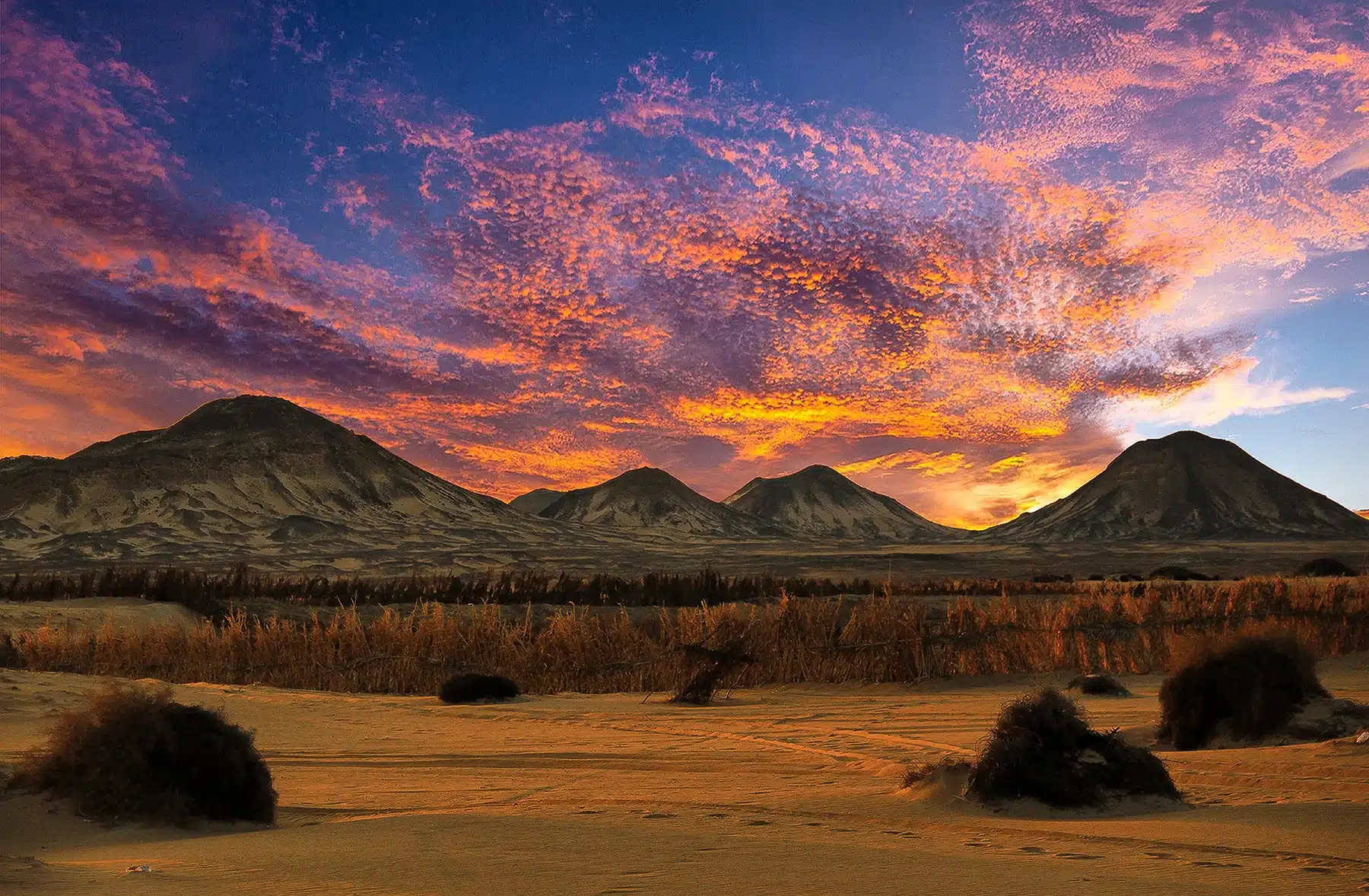
Bahariya combines two identities.
It is a real oasis community with palms, springs, agriculture and villages.
And it is the gateway into landscapes that look far more austere: the Black Desert and the wider Western Desert route toward Crystal Mountain, Agabat and the White Desert.
Egypt's official tourism portal specifically describes Bahariya as home to the White Desert and Black Desert, with palm and olive groves, springs and archaeological sites forming part of the oasis itself.
That contrast is part of its appeal.
You can spend the morning around greenery and palms.
Then drive into a landscape of dark hills, black stone and wide empty ground.
For an eclipse, this visual contrast is powerful.
The black volcanic terrain gives totality a stark setting.
It feels like an eclipse expedition.
That is Bahariya's strongest identity in this comparison.
What Siwa Actually Feels Like
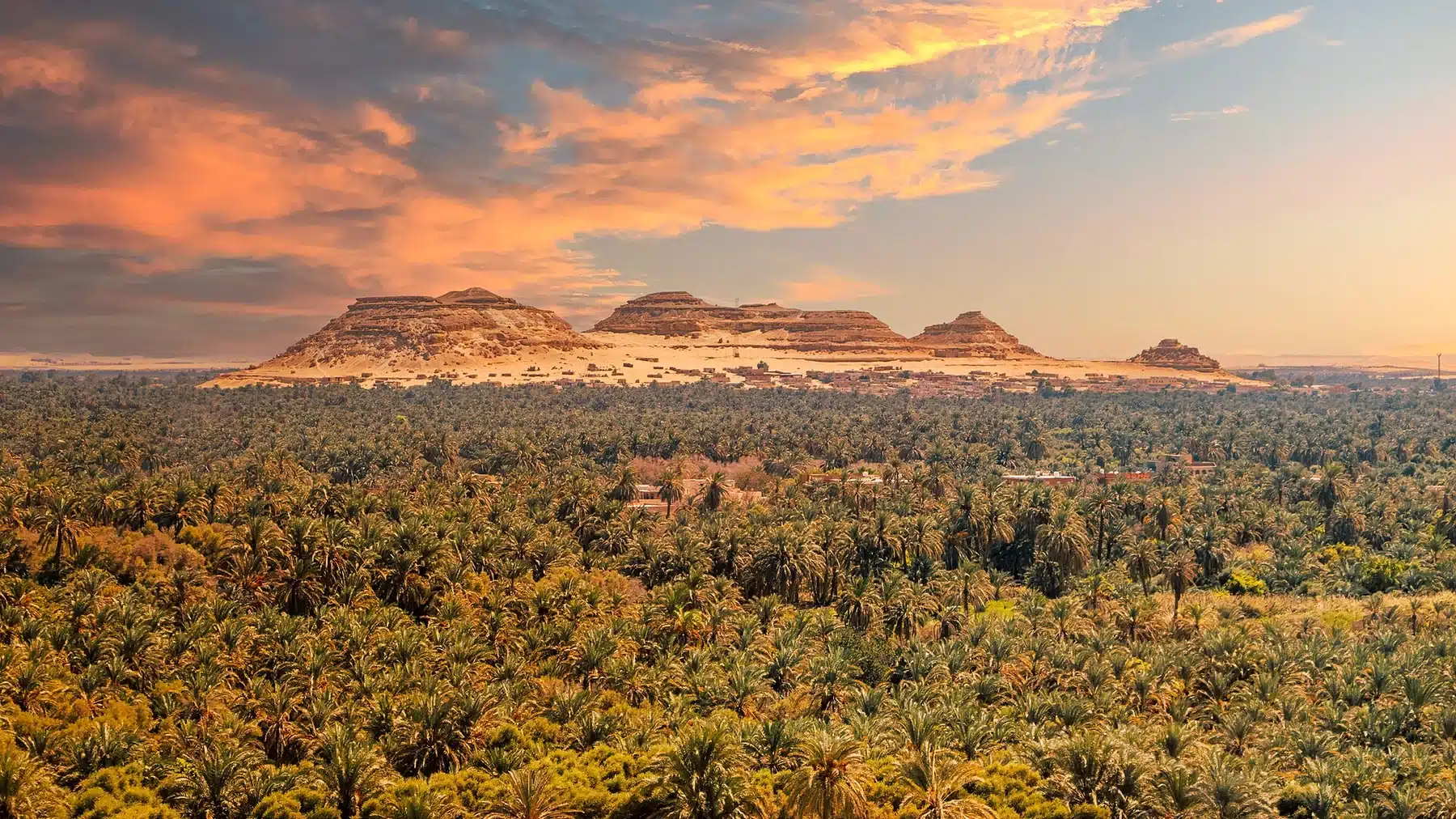
Siwa is softer visually but deeper culturally.
Palms dominate many views.
Salt lakes create extraordinary blues and whites.
Mud-brick architecture gives Shali Fortress and the old oasis areas a distinct visual language.
Freshwater springs interrupt the desert.
Beyond the oasis, dunes of the Great Sand Sea create another completely different environment.
Egypt's official tourism portal highlights Siwa's salt lakes, springs, palm and olive groves, archaeological ruins and Amazigh cultural traditions.
That means the eclipse is almost competing for attention with the destination around it.
And that is a compliment.
If someone told you tomorrow that the eclipse had been cancelled by the laws of physics—which obviously cannot happen—Siwa could still justify an international trip for many travelers.
That is a useful test.
Would you want to visit the destination even without totality?
If yes, Siwa becomes much easier to choose.
Black Desert vs Salt Lakes
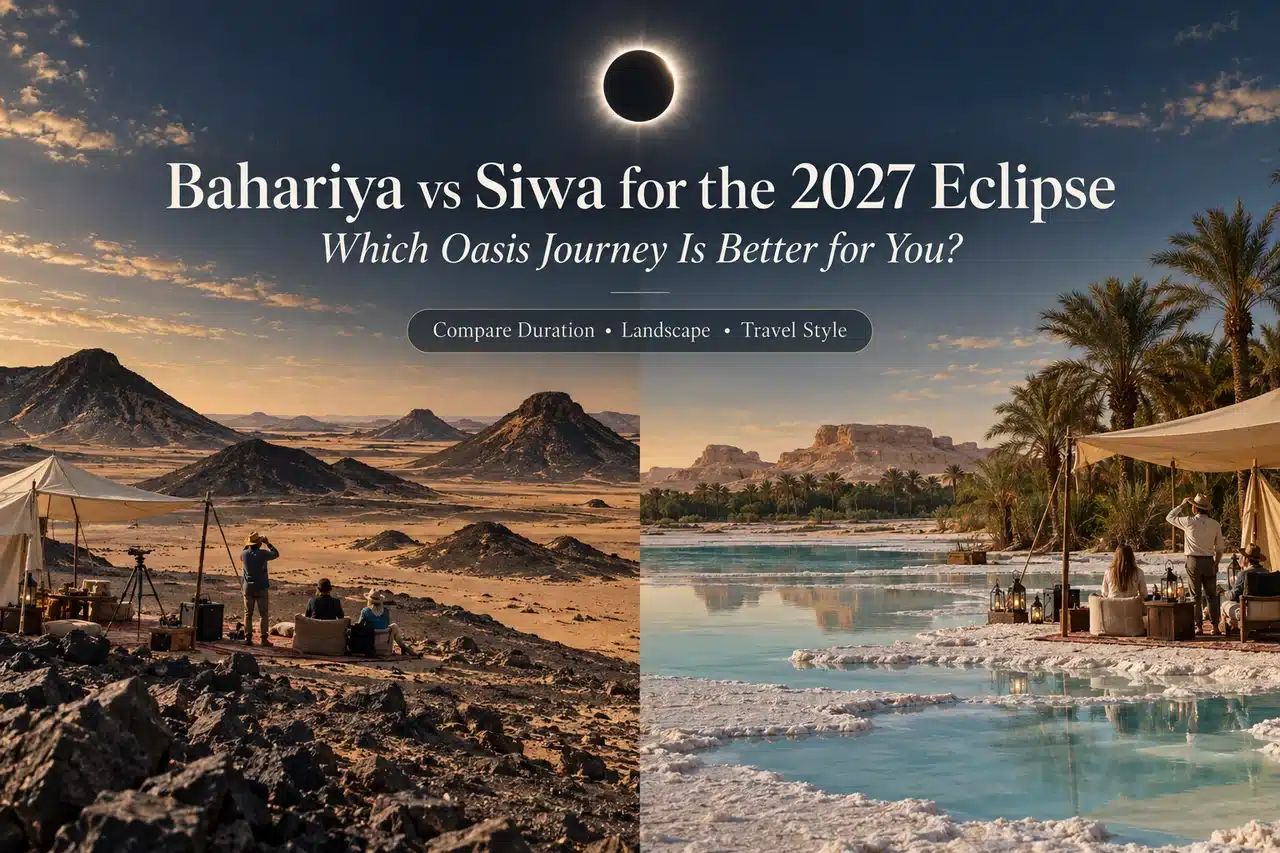
The two images in this article tell much of the story.
Bahariya's Black Desert is about:
dark rock;
volcanic-looking hills;
golden sand;
large horizons;
and a visually rugged desert atmosphere.
Siwa's salt-lake environment is about:
white salt;
turquoise water;
palms;
reflections;
and a softer oasis landscape.
Neither is objectively prettier.
But they photograph differently.
They feel different when you arrive.
And they create completely different foregrounds for the memory of eclipse day.
White Desert vs Great Sand Sea
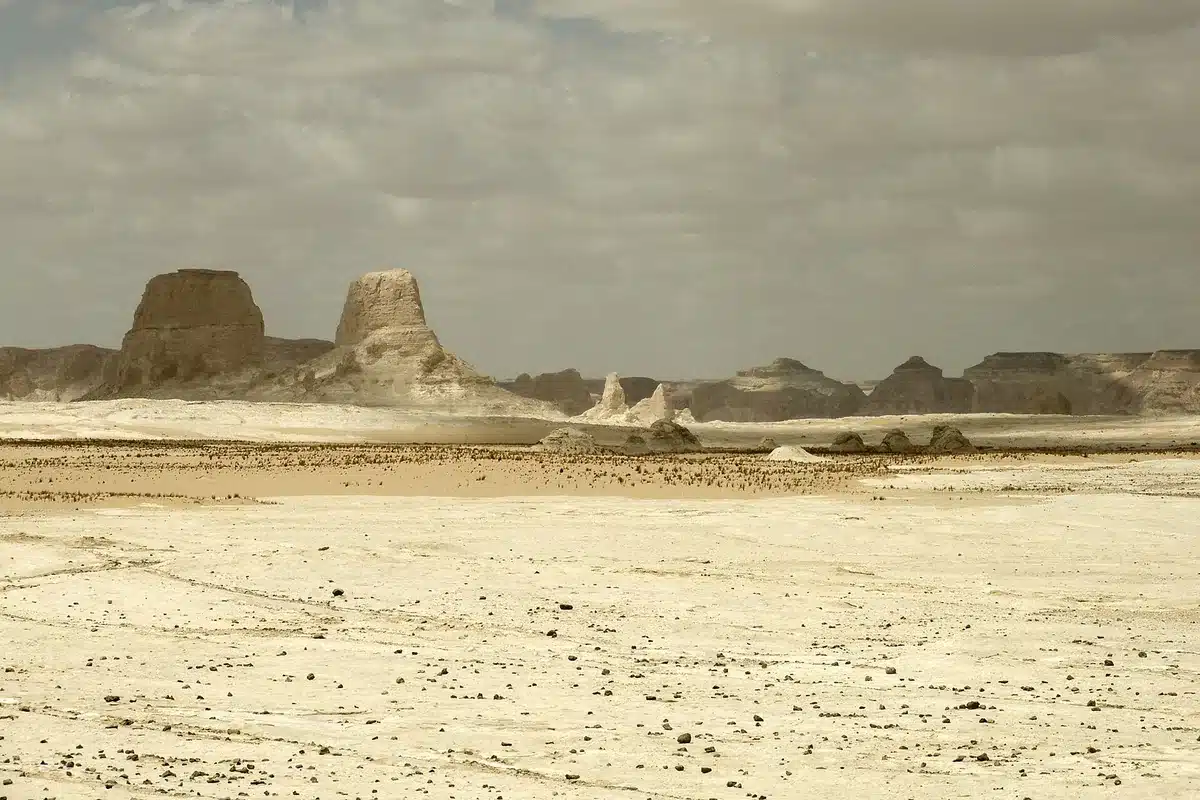
The landscape comparison does not stop at the actual viewing fields.
Bahariya opens the door to the White Desert
The current four-day photography itinerary travels through:
Black Desert;
Crystal Mountain;
Agabat Valley;
and selected White Desert formations
before returning north to the fixed Black Desert eclipse field.
If giant chalk formations and Western Desert photography are high on your Egypt list, Bahariya is the natural gateway.
Siwa opens the door to the Great Sand Sea
The current five-day Siwa itinerary includes a deeper oasis experience, while the longer seven-day journey adds a private Great Sand Sea safari. The official tourism portal also highlights the huge dunes beyond Siwa as one of the region's defining experiences.
So ask yourself which desert image you actually want.
Chalk formations and black hills?
Or dunes, salt lakes and oasis palms?
Which Destination Gives You More Beyond the Eclipse?
This question depends on what “more” means.
Bahariya gives you more flexibility in trip length
You currently have three eclipse-related Western Desert choices built around the Bahariya/Black Desert region:
2 days — focused eclipse trip.
3 days — more balanced Bahariya comfort journey.
4 days — Black & White Desert photography journey.
That makes Bahariya easier to adapt to different schedules.
Siwa gives you more destination immersion
The current Siwa-specific eclipse journey runs five days.
The seven-day version adds Cairo, Giza, the Grand Egyptian Museum, Alexandria and the Mediterranean route around the Siwa experience.
Siwa therefore naturally becomes a larger portion of your Egypt holiday.
That is neither better nor worse.
It is simply more commitment.
Comparing the Current 3-Day Bahariya and 5-Day Siwa Tours
For the cleanest apples-to-apples comparison, let's look at the two destination-focused packages rather than the shortest or longest alternatives.
| Feature | 3-Day Bahariya Comfort | 5-Day Siwa Oasis |
|---|---|---|
| Dates | 1–3 Aug 2027 | 30 Jul–3 Aug 2027 |
| Duration | 3 days / 2 nights | 5 days / 4 nights |
| Starting price | $1,195 per adult | $1,595 per adult |
| Solo total | $1,695 | $2,095 |
| Price difference | — | +$400 |
| Private maximum | 12 guests | 10 guests |
| Accommodation | Private serviced camping | Private serviced camping |
| Eclipse region | Black Desert / Bahariya | Eastern Siwa |
| Published field | 28.16208° N, 28.76423° E | 29.21366° N, 25.63071° E |
| Published totality description | More than 6 minutes | More than 5 minutes |
| Main experience | Bahariya + eclipse | Siwa + eclipse |
These are current published values and should always be verified on the live tour page before payment.
What Does the Extra $400 Buy in Siwa?
This is where travelers sometimes make the wrong comparison.
The five-day Siwa starting price is currently $400 above the three-day Bahariya price.
You are not paying $400 for a different class of eclipse.
You are primarily buying:
two additional tour days;
two additional private camping nights;
a significantly longer road journey;
Siwa historic sites;
salt lakes;
springs;
and a deeper oasis itinerary.
At the same time, Bahariya actually has the longer eclipse reference duration.
So the normal travel-industry assumption that:
“more expensive = better core attraction”
does not work here.
Siwa costs more because it contains more journey.
For the full pricing analysis, deposits and exclusions, use the dedicated Egypt Solar Eclipse Tour Cost 2027 guide rather than turning this comparison into another cost article.
Private Camping in Bahariya vs Siwa
Both current destination-focused programs use 100% private serviced camping according to their live pages.
But the number of nights is very different.
Bahariya
The three-day itinerary includes:
2 private camping nights.
That is enough to put the eclipse inside a real desert experience without making camping the majority of a long holiday.
Siwa
The five-day itinerary includes:
4 private camping nights.
That suits travelers who actively enjoy the idea of being outside conventional hotels for several days.
This is worth thinking about honestly.
Some people see four nights of private serviced camping and think:
“Perfect.”
Others think:
“I would love the eclipse but four nights is too much.”
Neither reaction is wrong.
Book the travel style you enjoy.
Eclipse-Day Comfort: Is One Location Better?
Not automatically.
Both current field plans are built around the same basic August reality:
totality occurs around midday and guests will spend several hours around the viewing location.
The live Bahariya program describes shade, cooled rest space, seating, water, food, toilets and charging.
The Siwa page describes a similar prepared field structure with shade, cooled rest space, chairs, water, food, toilets and charging.
So the meaningful question is not:
“Which oasis is cooler?”
It is:
“Which operational setup will our party actually have?”
Never choose an August eclipse site simply because its sunset photographs look comfortable.
Midday is the real test.
Which Is Better for Photography?
This is one of the few sections where Bahariya has a clear structural advantage for one specific kind of photographer.
Bahariya for expedition and landscape photographers
Bahariya connects directly with the Black and White Deserts.
That gives photographers access to:
dark volcanic terrain;
chalk formations;
Agabat;
Crystal Mountain;
wide desert horizons;
and a dedicated current photography itinerary.
The four-day eclipse photography tour is specifically designed around this use case, including three private camping nights, dedicated landscape time and a separate tripod zone at the eclipse field.
If you are building an international photography journey around the eclipse, Bahariya is extremely difficult to ignore.
Siwa for environmental and oasis photography
Siwa offers something Bahariya cannot imitate:
salt water;
white salt edges;
palms;
oasis architecture;
Shali;
springs;
Great Sand Sea dunes;
and an environmental palette completely different from the Black Desert.
If your dream image places the eclipse trip inside an oasis story rather than a geological desert story, Siwa may inspire you more.
For pure long-lens eclipse imaging
The destination difference matters less.
Your priorities become:
correct solar filtering;
stable tripod placement;
equipment handling;
power;
field access;
and sufficient time to rehearse.
Both current fields include a planned tripod area.
Which Is Better for Families?
For many families, Bahariya is the easier starting point.
Not because Siwa is unsuitable for children.
Because road time matters.
A roughly five-hour road journey to Bahariya is different from giving up most of a day to reach Siwa.
The three-day Bahariya itinerary also gives families an additional night after totality rather than requiring an immediate return on eclipse afternoon.
That can make the overall rhythm easier.
But some families love road trips.
Children who enjoy camping, swimming in unusual landscapes and exploring new environments may remember Siwa for the rest of their lives.
Siwa also spreads the experience across five days instead of compressing it.
So the family decision should consider:
children's ages;
car tolerance;
sleep preferences;
dietary requirements;
heat tolerance;
and whether the children would enjoy Siwa itself.
If all the adults want Siwa and the children hate long journeys, pretending that factor does not exist will not improve the trip.
Which Is Better for Couples?
This one is far less technical.
Couples should choose the atmosphere they want.
Bahariya can feel like a private desert expedition:
Cairo disappears behind you.
Dark hills replace the city.
The camp becomes the base.
The eclipse is the central event.
Siwa feels more like a destination escape:
long journey west;
palms;
salt lakes;
historic oasis sites;
sunsets;
desert safari;
then the eclipse at the center of the itinerary.
If you have only three days, Bahariya wins by default.
If you have five days and have always wanted Siwa, Siwa probably wins.
Which Is Better for Solo Travelers?
The current published solo totals are:
3-Day Bahariya: $1,695
5-Day Siwa: $2,095
The same $400 difference exists as in the double-occupancy starting rates.
But price should not be the only solo consideration.
Solo travelers often appreciate schedule control.
If you are traveling specifically for the eclipse and want a compact private arrangement, Bahariya limits the amount of overland travel.
If you enjoy slow solo journeys and want several days inside the oasis experience, Siwa may justify the longer trip.
Neither current program automatically merges the private booking party with unrelated guests according to the published tour structure.
Which Is Better for Serious Eclipse Chasers?
If the eclipse dominates every other priority:
Bahariya.
The Al Bawiti reference duration is approximately 47 seconds longer than Siwa.
Bahariya also requires less road travel from Cairo and offers a fixed Black Desert field described as more than six minutes of totality.
Those factors make it efficient.
A dedicated chaser may reasonably think:
“I came for totality. Give me the longer totality and reduce unrelated travel time.”
That is a perfectly rational decision.
But serious eclipse chasing also involves more than duration.
Experienced observers care about field quality, access, equipment, contingency planning and weather monitoring.
No location should be reduced to the number beside it.
Which Is Better for First-Time Visitors to Egypt?
This depends on what the rest of the trip looks like.
If your first-time itinerary already includes:
Cairo;
Giza;
Luxor;
maybe Aswan;
then adding five more days for Siwa may or may not make sense.
A three-day Bahariya extension can fit more easily around classic Egypt.
But if you are not planning Upper Egypt and want the eclipse trip itself to expose you to a less conventional side of the country, Siwa becomes much more attractive.
The seven-day current eclipse itinerary takes this idea further by combining Cairo, Giza, the Grand Egyptian Museum, Alexandria and the Mediterranean route with Siwa.
So first-time visitor does not automatically mean Bahariya or Siwa.
It depends whether you want the Western Desert to be:
an extension
or:
a major chapter of the trip.
Which Is Better for Repeat Visitors to Egypt?
Repeat visitors are often where Siwa wins.
If you have already seen:
Giza;
Luxor;
Aswan;
the Nile;
and perhaps the Red Sea,
Siwa can reveal a different Egypt.
The Amazigh cultural heritage, salt lakes, oasis architecture and remote geography feel distinct from a conventional Nile itinerary. Egypt's official tourism portal specifically presents Siwa as a culturally distinctive desert sanctuary.
But repeat visitors who have never seen the White Desert may find Bahariya equally compelling.
So again the question becomes:
What part of Egypt are you still missing?
Which Is Better if You Dislike Long Drives?
Bahariya.
This is one of the easiest decisions in the article.
The difference between roughly five hours of practical Cairo–Bahariya travel and a 9–11 hour realistic Cairo–Siwa day is significant.
Siwa's journey can be broken with planned stops and in some itineraries Mediterranean routing, but it remains a long overland destination.
If you actively dislike road travel, do not convince yourself that Siwa's photographs will magically make nine hours feel like ninety minutes.
Bahariya is the better fit.
Which Is Better if You Want a Slower Journey?
Siwa.
This may sound contradictory after discussing the long drive, but it is not.
Once you arrive, the five-day structure allows the oasis to become the journey.
The current program includes a deliberately lighter day before eclipse day for rest, equipment checks and the eclipse briefing, plus Siwa sightseeing across several days.
Bahariya can also be relaxed, particularly on the three-day option.
But its greatest advantage is that it can be compact.
Siwa's advantage is that it encourages you not to be.
Group Size and Private Travel
The current published maximums are:
3-Day Bahariya: up to 12 guests
5-Day Siwa: up to 10 guests.
This is not the same thing as current availability.
A maximum party size means the itinerary is designed to support a private booking up to that size under the current published structure.
It does not mean twelve spaces or ten spaces are necessarily available today.
Large families and private groups should enquire earlier because tents, vehicles, luggage and camp service all scale with party size.
Weather and August Heat
Both destinations are desert environments in August.
Expect heat planning to matter.
Historical climate data for Al Bawiti shows August as one of the hottest periods of the year, with average highs around 102°F / 39°C in the referenced dataset. The Siwa climate page similarly lists August as its hottest month, with an average high around 100°F / 38°C. These are climatological averages, not forecasts for 2 August 2027.
The practical takeaway is not:
Bahariya is hotter.
Or:
Siwa is cooler.
The takeaway is:
both require serious midday heat planning.
Shade.
Water.
Electrolytes.
Rest space.
Appropriate clothing.
And avoiding unnecessary exertion in the hottest part of the day.
No honest article can tell you which oasis will have “better weather” on 2 August 2027 this far ahead.
The Exact Viewing Fields
One mistake would be comparing only Al Bawiti town with Siwa town and assuming your actual observing position is identical.
The current Egypt Safari Travel fields are separate fixed coordinates.
Black Desert
28.16208° N, 28.76423° E
The current Bahariya and Black Desert tour pages describe this field as receiving more than six minutes of totality.
Siwa
29.21366° N, 25.63071° E
The current Siwa page describes the field as receiving more than five minutes of totality.
These coordinates matter because city-level eclipse calculations are useful for comparison but final timing should be based on the actual field.
Do not use:
“Bahariya gets exactly 6:18”
as if every point in the oasis receives the same duration.
6:18 is the Al Bawiti reference.
The exact private field has its own circumstances.
Where Will You Be the Night Before Totality?
Both choices solve one very important problem:
you are not supposed to begin eclipse morning in Cairo.
Bahariya
The current three-day itinerary leaves Cairo on 1 August and sleeps in the Bahariya region before eclipse day.
Siwa
The current five-day itinerary begins on 30 July, giving travelers several days to reach and experience Siwa before the eclipse.
This creates a major reduction in operational risk.
The Moon does not care about traffic.
There is no replay at 3 pm if the vehicle is delayed.
Whichever destination you choose, be positioned before the event.
Common Bahariya vs Siwa Misconceptions
“Siwa must have the better eclipse because it is more remote.”
No.
Remoteness and totality duration are unrelated.
At the current town-reference calculations, Bahariya has the longer totality.
“Bahariya is only for the eclipse.”
No.
Bahariya is an oasis destination and gateway to the Black and White Deserts.
“Siwa is better because its tour is more expensive.”
No.
The current Siwa trip costs more primarily because it is longer and covers more travel and destination experiences.
“More totality always means a better trip.”
Not necessarily.
It means more totality.
Travel quality includes many other variables.
“Siwa is just salt lakes.”
No.
It also includes historical sites, oasis culture, springs, palm groves and Great Sand Sea experiences.
“Bahariya and the White Desert are the same place.”
No.
Bahariya is the oasis/gateway. The Black and White Desert landscapes are reached through separate desert routes and appropriate 4×4 travel.
Five Real Traveler Scenarios
Scenario 1: Two travelers with only four free days in Egypt
They have already visited Giza and need a focused eclipse extension.
Recommendation: Bahariya.
The shorter road and two-/three-/four-day flexibility fit the schedule.
Scenario 2: Couple with a full week who have always wanted Siwa
They love slow travel, salt lakes and remote destinations.
Recommendation: Siwa.
Choosing Bahariya merely for 47 additional seconds would ignore why they wanted the trip.
Scenario 3: Serious eclipse photographer with a 600 mm lens and landscape ambitions
They want totality plus environmental photography.
Recommendation: Start with Bahariya and the four-day photography itinerary.
It intentionally connects Black Desert totality with White Desert photography.
Scenario 4: Family with young children who dislikes very long transfers
Recommendation: Start with Bahariya.
The shorter Cairo access is likely to matter more than the destination romance of Siwa.
Scenario 5: Repeat visitor who has already toured the White Desert
They have never seen Siwa.
Recommendation: Siwa.
The eclipse becomes the reason to experience a new part of Egypt rather than repeat a destination they already know.
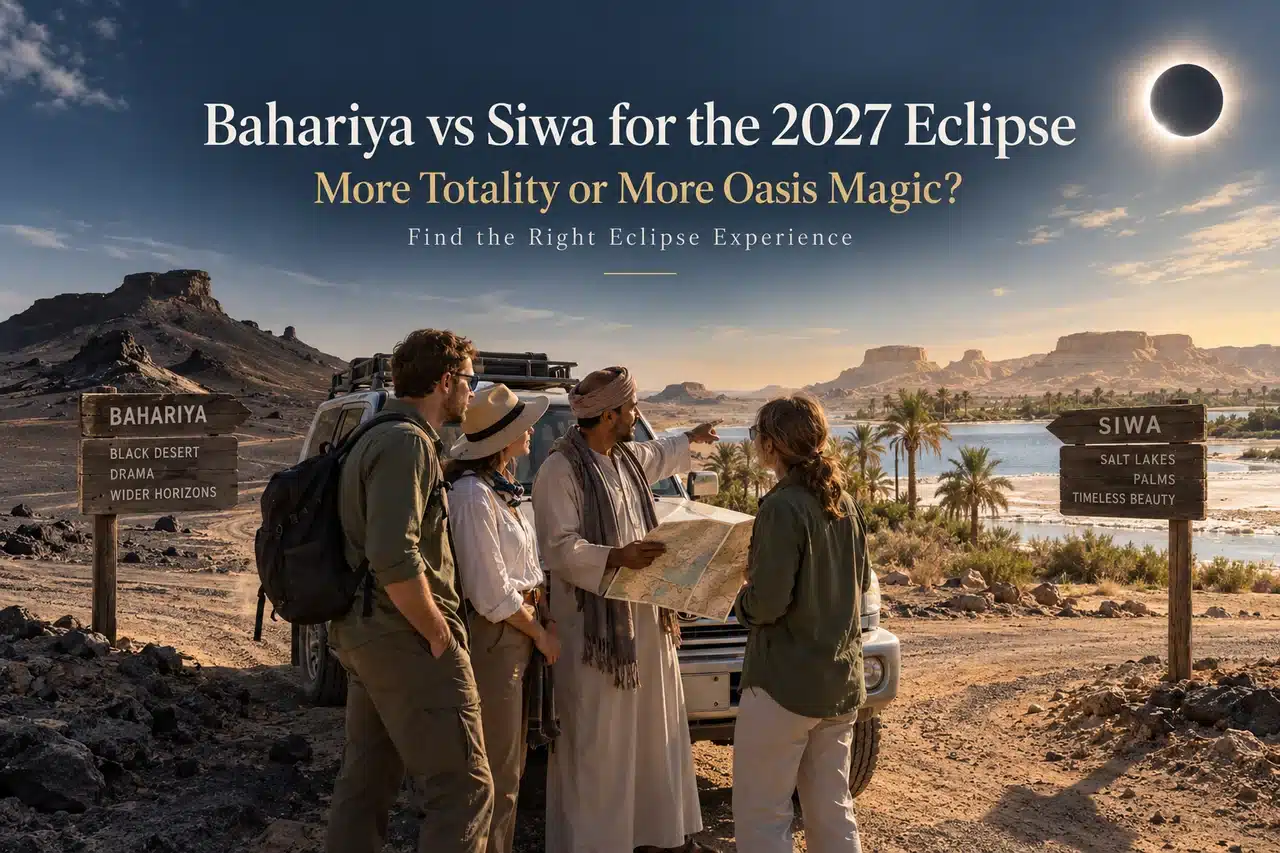
The Simple Decision: Which One Fits You?
Ask yourself these questions in order.
Do you have fewer than five days available?
Yes → Bahariya.
Is Siwa already one of the places you most want to visit in Egypt?
Yes → Siwa.
Is maximum totality your priority?
Bahariya.
Do you hate long road transfers?
Bahariya.
Do you want salt lakes, palms and Siwan culture?
Siwa.
Do you want Black Desert + White Desert photography?
Bahariya.
Do you want the eclipse to be a short extension to Cairo?
Bahariya.
Do you want the eclipse to become a multi-day oasis journey?
Siwa.
That solves the decision for most people.
When Bahariya Clearly Wins
Bahariya is the stronger choice when:
you have limited time;
you are already based in Cairo;
longer totality is important;
you want less road time;
you want Black Desert scenery;
you want White Desert photography;
your family prefers a shorter transfer;
you are treating the eclipse as the central purpose of the trip.
The current three-day Bahariya program is particularly strong as the middle option: more breathing room than the two-day itinerary without becoming a five-day overland journey.
When Siwa Clearly Wins
Siwa is the stronger choice when:
Siwa is already on your bucket list;
you enjoy long overland journeys;
five days fits comfortably into your itinerary;
salt lakes and oasis landscapes excite you;
you want historic oasis culture;
the Great Sand Sea matters;
you prefer a destination journey rather than a compact eclipse extension;
losing roughly 47 seconds of reference totality does not bother you.
The strongest reason to choose Siwa is simple:
you want Siwa.
Everything else follows from that.
When Neither Is Automatically Right
There are travelers for whom neither should win automatically.
If your only obsession is being extremely close to the longest possible totality and you also want ancient Egyptian monuments, Luxor may make more sense.
If you are already holidaying in southern Red Sea areas, another totality-region strategy may be easier.
If four nights of camping sounds unpleasant, you should not book Siwa just because photographs look beautiful.
And if the White Desert is the destination you have dreamed about for years, a two-day Bahariya eclipse trip may be too short.
The goal is not to force your priorities into one of two boxes.
It is to choose a trip that survives contact with reality.
Final Verdict: Bahariya or Siwa?
If you want me to choose without knowing anything about you:
Bahariya is the better all-round eclipse choice.
Why?
It gives a longer reference totality.
It is substantially closer to Cairo.
It works with multiple itinerary lengths.
It connects directly with Black and White Desert experiences.
And it requires less of your overall Egypt holiday.
But that does not make Bahariya universally better.
If you genuinely want Siwa, choose Siwa.
Five minutes and 31 seconds of reference totality is still extraordinary.
The oasis offers landscapes and culture that Bahariya does not replicate.
And for the right traveler, the long road west is not something to endure before reaching the destination.
It is part of reaching somewhere special.
The choice can therefore be reduced to two sentences:
Choose Bahariya because of the eclipse and let the desert make the trip better.
Choose Siwa because you want Siwa and let the eclipse make the trip unforgettable.
That distinction is much more useful than simply comparing two numbers on a map.
Live Sources Checked for This Comparison
Frequently Asked Questions About Bahariya vs Siwa for the 2027 Eclipse
Is Bahariya or Siwa better for the 2027 eclipse?
Bahariya is generally stronger for travelers prioritizing totality duration, shorter access from Cairo and a focused Western Desert eclipse trip. Siwa is stronger for travelers who specifically want a longer oasis journey built around Siwa itself.
Which has longer totality, Bahariya or Siwa?
At the current town reference calculations, Al Bawiti in Bahariya receives approximately 6 minutes 18 seconds, while Siwa receives approximately 5 minutes 31 seconds.
How much longer is totality in Bahariya?
Approximately 47 seconds when comparing the Al Bawiti and Siwa reference calculations.
Is 47 seconds a big difference during a solar eclipse?
It is meaningful, particularly for serious eclipse observers and photographers. However, both locations provide unusually long totality, so many travelers may reasonably prioritize destination and travel style instead.
How far is Bahariya from Cairo?
Egypt's official tourism portal places Bahariya around 370 km southwest of Cairo and describes a typical road journey at roughly five hours.
How far is Siwa from Cairo?
The current Egypt Safari Travel destination guide gives approximately 740–760 km by road depending on route and starting point and recommends allowing roughly 9–11 hours for a private transfer with realistic stops.
Which is easier to reach from Cairo?
Bahariya.
Which is better for a short eclipse trip?
Bahariya, because current eclipse itineraries can work in two or three days.
Which is better for a five-day holiday?
If Siwa is one of your destination priorities, the current five-day Siwa program makes excellent use of that amount of time.
Which destination is more expensive?
The current three-day Bahariya tour starts at $1,195 per adult, while the five-day Siwa program starts at $1,595—a difference of $400, reflecting a longer itinerary and different route rather than a superior eclipse.
How much is the solo price difference?
The current published solo totals are $1,695 for the three-day Bahariya program and $2,095 for the five-day Siwa program, also a $400 difference.
Which is better for photography?
Bahariya is particularly strong for photographers who want the Black Desert and White Desert. Siwa is strong for oasis, salt-lake, palm and Great Sand Sea imagery.
Which is better for eclipse photography specifically?
Either can work when the field and equipment setup are properly prepared. Bahariya currently provides the longer reference totality and also has a dedicated four-day photography itinerary.
Which is better for families?
Bahariya will suit many families because of the shorter Cairo road journey. Families who enjoy long road travel and specifically want Siwa may prefer the five-day oasis itinerary.
Which is better for couples?
Either. Bahariya suits a shorter private desert escape; Siwa suits a longer destination-focused oasis journey.
Which is better for solo travelers?
This depends on how much time and road travel you want. Both current programs publish solo pricing and private arrangements.
Does Siwa have enough totality?
Yes. The current Siwa reference duration is approximately 5 minutes 31 seconds, which is an exceptionally long total phase.
Is Bahariya inside the path of totality?
Yes. Al Bawiti and the current selected Black Desert eclipse field lie inside the totality zone.
Is Siwa inside the path of totality?
Yes. Timeanddate classifies the 2 August 2027 event in Siwa as a total solar eclipse.
What is the current Bahariya eclipse-field coordinate?
The currently published Egypt Safari Travel Black Desert field is 28.16208° N, 28.76423° E.
What is the current Siwa eclipse-field coordinate?
The currently published Siwa field is 29.21366° N, 25.63071° E.
Do the exact field durations equal the town calculations?
Not necessarily. Al Bawiti and Siwa town values are useful reference calculations. Exact eclipse contact times and duration depend on the actual GPS coordinate.
Which one has better scenery?
That is subjective. Bahariya offers dark Black Desert terrain and access to the White Desert, while Siwa offers palms, salt lakes, springs and Great Sand Sea landscapes.
Which has more culture?
Siwa generally provides the deeper destination-cultural component, including historic oasis sites and distinctive Amazigh heritage.
Which one is better if I've already visited Siwa?
Bahariya is a logical choice, particularly if you have not explored the Black and White Deserts.
Which one is better if I've already visited the White Desert?
Siwa can give you a completely different Western Desert experience rather than repeating familiar landscapes.
Are the camps private?
The current Bahariya and Siwa tour pages describe private serviced camping arrangements for each booking party.
Are the sleeping tents air-conditioned?
Do not assume so. The current programs describe private serviced sleeping tents alongside shaded and cooled rest spaces. Confirm the exact current configuration of your itinerary before booking.
Which destination is cooler in August?
Do not choose based on that assumption. Both destinations require serious heat planning in August, and no future eclipse-day weather can currently be guaranteed.
Should I drive from Cairo to either location on eclipse morning?
No. The current itineraries position guests in the chosen Western Desert region before eclipse day.
What if I still cannot decide?
Send Ahmed your number of travelers, available days, preferred landscapes, road-travel tolerance and any specialist equipment. You can ask for planning advice before paying a deposit.