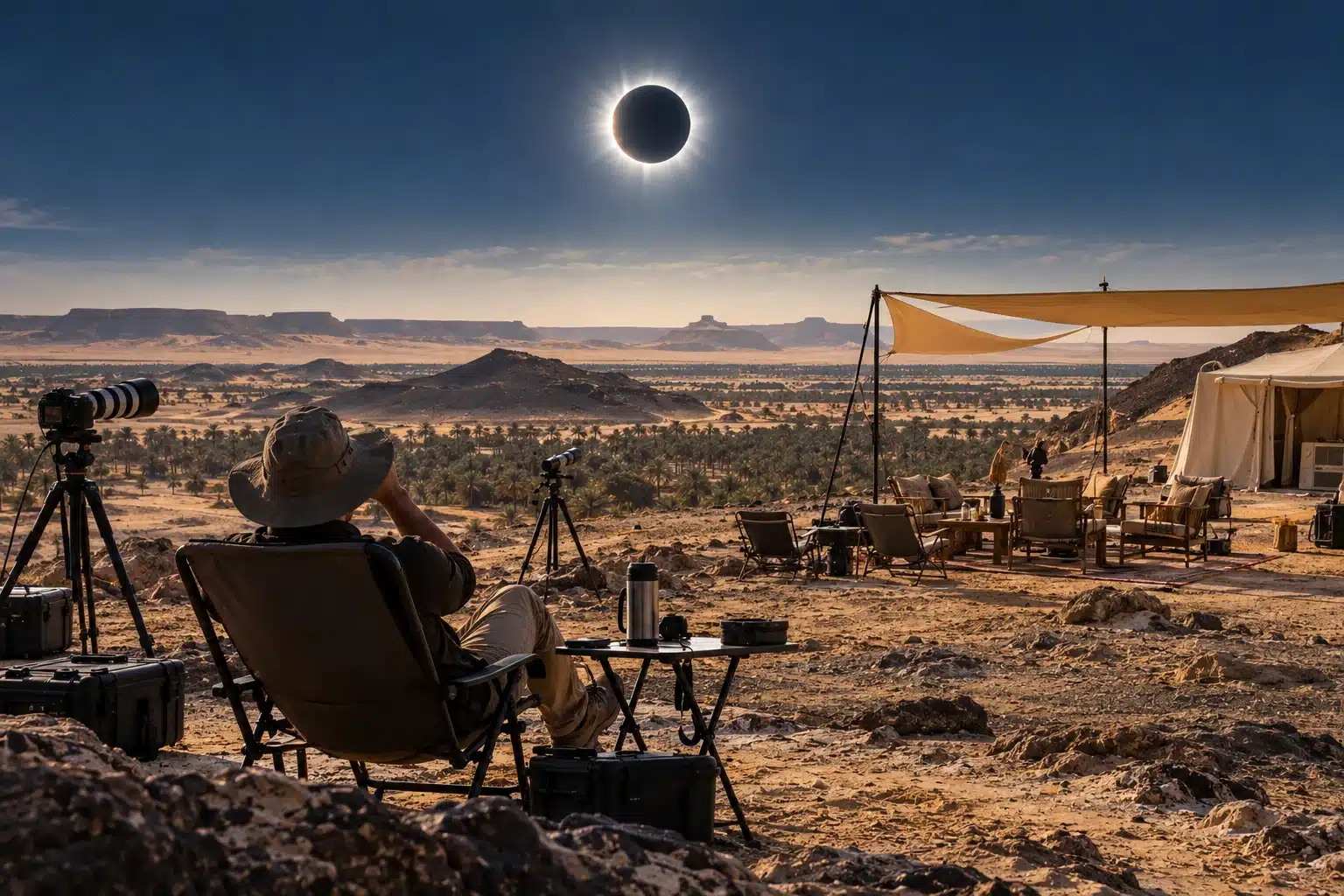
On Monday, 2 August 2027, a moving shadow roughly hundreds of kilometers wide will cross Egypt in the middle of the day. For a few minutes inside that shadow, the ordinary desert Sun will disappear completely.
The temperature and quality of the light will change. The landscape will darken. The solar corona—the Sun’s delicate outer atmosphere normally hidden by the bright solar disk—will become visible around the black silhouette of the Moon.
And in parts of Egypt, this total phase will last for more than six minutes.
That is what makes the 2027 solar eclipse in Egypt much more than another interesting astronomical event. NASA lists the 2 August 2027 eclipse as a total solar eclipse crossing Egypt, while NASA’s eclipse calculations give a maximum central duration of approximately 6 minutes 23 seconds. The point of greatest eclipse lies in Egypt, where the Sun will be extremely high in the sky. NASA’s official future-eclipse calendar
For travelers, however, one detail matters more than almost anything else:
You must actually be inside the path of totality.
Cairo is not inside it. Neither is central Aswan. Other famous tourist cities also experience only a partial eclipse.
Meanwhile, places such as Luxor, Siwa Oasis, Asyut and parts of Egypt’s Western Desert lie inside the totality zone. In the right location, the difference is not a few extra percentage points. It is the difference between seeing a partial eclipse and experiencing the Sun disappear completely.
This guide explains the eclipse from a traveler’s point of view: where the path crosses Egypt, how long totality lasts in major locations, the differences between Luxor, Bahariya and Siwa, what eclipse day may feel like, how to prepare for the August heat, what photographers need to know, how to view the Sun safely, and how to choose a trip that makes sense for your own travel style.
No weather forecast this far in advance can guarantee clear skies, and no responsible tour operator should promise them. What we can do is understand the astronomy, choose the right location, build enough time into the journey and prepare the viewing site properly.
Quick Answer: What You Need to Know About the 2027 Eclipse in Egypt
| Question | Answer |
|---|---|
| Date | Monday, 2 August 2027 |
| Eclipse type | Total solar eclipse |
| Maximum totality | About 6 minutes 23 seconds |
| Is Egypt inside the path? | Yes |
| Is Cairo inside totality? | No — Cairo sees a partial eclipse |
| Is Luxor inside totality? | Yes — about 6 minutes 22 seconds at the city reference point |
| Is Siwa inside totality? | Yes — about 5 minutes 31 seconds |
| Is Bahariya inside totality? | Yes — selected Western Desert locations receive more than 6 minutes |
| Do you need eclipse glasses? | Yes during every partial phase |
| Can glasses come off during totality? | Only while the Sun is completely covered |
| Best location? | It depends on whether you prioritize duration, Western Desert scenery, privacy, photography, Siwa culture or a conventional Egypt itinerary |
Timeanddate currently calculates approximately 6 minutes 22 seconds of totality in Luxor and 5 minutes 31 seconds in Siwa Oasis. Cairo receives a partial eclipse rather than totality. Timeanddate’s Luxor eclipse data
Why the 2 August 2027 Eclipse Is Special
Total solar eclipses happen somewhere on Earth every few years, but they are not interchangeable.
The duration of totality changes from one eclipse to another. The height of the Sun changes. The path may cross oceans, Arctic regions, mountains, tropical areas or cities with very different weather and logistical challenges.
The 2 August 2027 eclipse combines several unusually attractive characteristics.
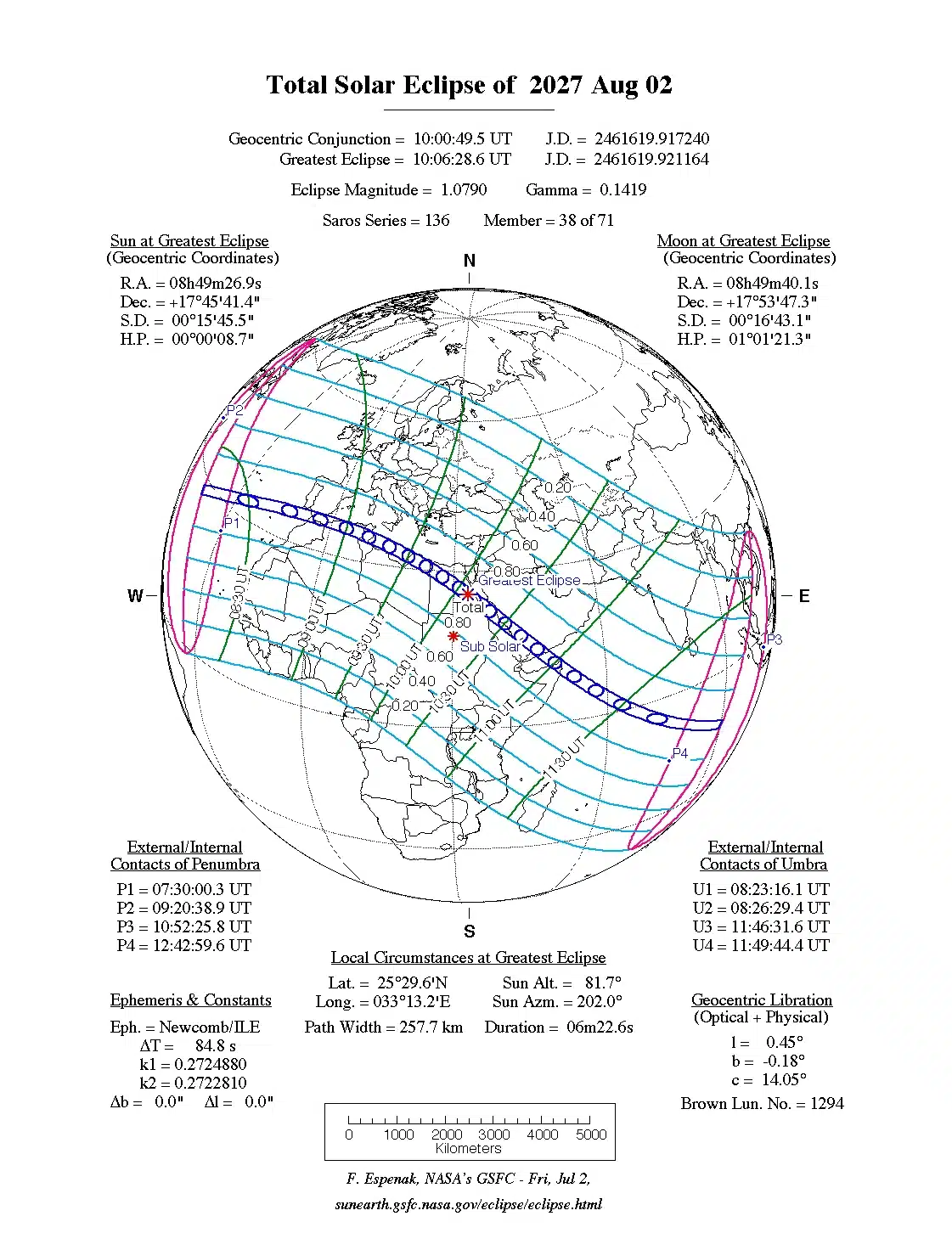
NASA’s catalog places the point of greatest eclipse in Egypt at roughly 25.5° north and 33.2° east. At that point, the Sun is calculated to be about 82 degrees above the horizon, while the central eclipse path is about 258 kilometers wide. Maximum totality is approximately 6 minutes 23 seconds. NASA/GSFC eclipse data
That high solar altitude is important for travelers.
During some eclipses, photographers spend months worrying about a mountain ridge, building, tree line or low cloud bank near the horizon. In Egypt in 2027, the Sun will be extremely high during totality across much of the path.
It also means that shade and heat planning matter.
A traveler should not think only about those extraordinary six minutes. The partial phases last much longer, and guests may be outdoors around midday for several hours before and after totality.
A good eclipse location therefore has two jobs.
It needs a clear astronomical position inside totality.
It also needs to work as a place where real people can comfortably spend several hours in August.
That means shade, seating, water, food, toilets, communication, transport access and a plan for cameras or telescopes can matter almost as much as the theoretical duration printed on an eclipse map.
What a Total Solar Eclipse Actually Means
A solar eclipse occurs when the Moon moves between Earth and the Sun.
During a partial solar eclipse, the Moon covers only part of the Sun from the observer’s location.
During a total solar eclipse, the observer is positioned inside the narrow path where the Moon completely covers the Sun’s bright face for a short period.
That short period is totality.
This distinction is essential for anyone planning an Egypt trip.
A location can experience an extremely deep partial eclipse and still never experience totality.
Until the final exposed part of the Sun disappears, the sky remains fundamentally different from totality and safe solar viewing protection is still required.
During true totality, conditions change dramatically. The corona becomes visible. The horizon may glow while the landscape around you darkens. Bright planets or stars may become visible depending on conditions. Shadows and ambient light change rapidly.
Then totality ends.
The first bright part of the Sun returns and eclipse glasses must immediately go back on.
NASA is explicit on this point: safe solar viewers are required during the partial phases before and after totality. Direct viewing without eye protection is only safe during the brief interval when the Moon completely covers the bright face of the Sun. NASA eclipse safety guidance
That is why a 95%, 98% or even extremely deep partial eclipse should not be treated as an alternative to standing inside the totality path.
For travelers coming to Egypt specifically for the eclipse, choosing the correct location is the first decision that matters.
The 2027 Eclipse Path Across Egypt
The Moon’s shadow reaches Egypt from the west and travels generally eastward across the country before continuing toward the Red Sea and Arabian Peninsula.
NASA lists Egypt among the countries crossed by the total eclipse path on 2 August 2027. NASA’s official future-eclipse calendar
Inside Egypt, the path covers a wide band across parts of the Western Desert, Middle and Upper Egypt and the eastern desert region.
The exact experience changes by location.
The western side of the country receives totality earlier. Siwa is among the first major Egyptian travel destinations inside the total path.
The shadow then moves eastward toward areas such as Bahariya and the Nile Valley.
Farther east, locations around Luxor and other Upper Egyptian regions experience the eclipse later.
This creates a very interesting choice for international travelers.
The obvious place is not automatically the only good place.
Many commercial eclipse programs focus on Luxor because it combines an exceptionally long totality with major archaeological attractions, large hotels and Nile tourism infrastructure.
But travelers who value open horizons, smaller parties, desert landscapes, private camping or astrophotography have other serious options.
Western Desert locations can combine very long totality with a fundamentally different atmosphere.
Instead of hotel roofs, riverbanks and large organized groups, the experience can center on desert space, controlled access, shade structures, cameras, local 4×4 support and a private camp.
And Siwa creates another version again: an oasis environment with palms, salt landscapes, desert culture and more than five minutes of totality.
Egypt Eclipse Times by Location
The following times are reference values rather than instructions for where an individual person should stand.
Exact contact times vary with precise latitude and longitude, and serious eclipse plans should always use the final GPS coordinate of the viewing field.
| Location | Eclipse Type | Approx. Maximum | Approx. Totality |
|---|---|---|---|
| Siwa Oasis | Total | 12:45 pm | 5m 31s |
| Bahariya / selected Black Desert field | Total | Around midday | More than 6 minutes at the planned field |
| Asyut | Total | 12:59 pm | About 6m 08s |
| Luxor | Total | 1:05 pm | 6m 22s |
| Cairo | Partial | 12:55 pm | None |
| Aswan city | Partial | 1:08 pm | None |
Timeanddate confirms the Luxor, Siwa, Asyut, Cairo and Aswan reference circumstances above. Timeanddate’s Luxor eclipse data
One important caution: do not choose your viewing site using a city name alone.
The path has edges.
Moving several kilometers can alter totality duration, and going outside the edge removes totality completely.
For a fixed private viewing field, the important data is the actual coordinate—not just “Bahariya,” “Siwa” or “Luxor.”
Why Cairo Is Not Enough
For many first-time visitors, Cairo seems like the obvious place to watch an Egyptian eclipse.
It is where most international flights arrive. It has the Pyramids. It has the Grand Egyptian Museum. It has a huge range of hotels.
But Cairo is not inside the 2027 path of totality.
Timeanddate classifies the 2 August 2027 eclipse in Cairo as a partial solar eclipse, with maximum eclipse around 12:55 pm local time. Timeanddate’s Cairo eclipse data
That makes Cairo useful as a gateway, but not as the final eclipse viewing destination for somebody traveling specifically to experience totality.
This distinction is one of the most valuable things an international traveler can learn early.
Do not book a beautiful Cairo rooftop and assume that “almost total” is effectively the same event.
It is not.
If the eclipse is the main reason for your journey, travel inside the path at least the day before.
For Western Desert itineraries, that may mean leaving Cairo for Bahariya or traveling onward toward Siwa.
For Nile Valley itineraries, it may mean positioning in the correct Upper Egyptian region.
Trying to travel hundreds of kilometers on eclipse morning introduces unnecessary risk: traffic, checkpoints, vehicle issues, road delays and simple human uncertainty.
The viewing field should feel boringly ready long before anything interesting begins in the sky.
That is exactly what you want.
The Best Places to Watch the 2027 Solar Eclipse in Egypt
There is no universal “best place” because travelers want different things.
Someone carrying a large telescope may care about a stable tripod zone and electricity.
A family may prioritize shade, toilets and a cooled rest area.
A first-time visitor to Egypt may want the Pyramids and major historical sites around the eclipse.
A dedicated eclipse chaser may simply want the longest practical totality with a clear open horizon.
A photographer may prefer the shapes and textures of the Western Desert.
For that reason, it is more useful to compare locations by experience rather than simply ranking them from one to five.
Luxor: best for maximum duration plus classic Egypt
Luxor is one of the most obvious eclipse destinations in the country.
Timeanddate calculates about 6 minutes 22 seconds of totality at the Luxor reference point, extremely close to the eclipse’s global maximum duration. Timeanddate’s Luxor eclipse data
It also provides international travelers with familiar infrastructure and extraordinary cultural attractions.
The trade-off is equally obvious.
Because Luxor is so prominent, it is likely to attract a large share of organized eclipse tourism.
That does not make Luxor a bad choice. It simply makes it a different choice from a private desert field.
Bahariya and the Black Desert: best for a short private Western Desert escape
Bahariya gives travelers a completely different proposition.
It can be reached overland from Cairo and provides access to the Black Desert and wider Western Desert.
The planned Egypt Safari Travel Black Desert field is fixed at 28.16208° N, 28.76423° E, where the itinerary is designed around more than six minutes of totality. The current two- and three-day packages include private shade, a cooled rest space, water, meals, eclipse glasses, a separate photography area and direct local support. 2-day Black Desert itinerary
This is especially attractive to travelers who already plan to spend time in Cairo but do not want to add a long Nile itinerary.
Siwa Oasis: best for an eclipse journey that is a destination in itself
Siwa is not just somewhere to stand under the eclipse path.
It is a journey.
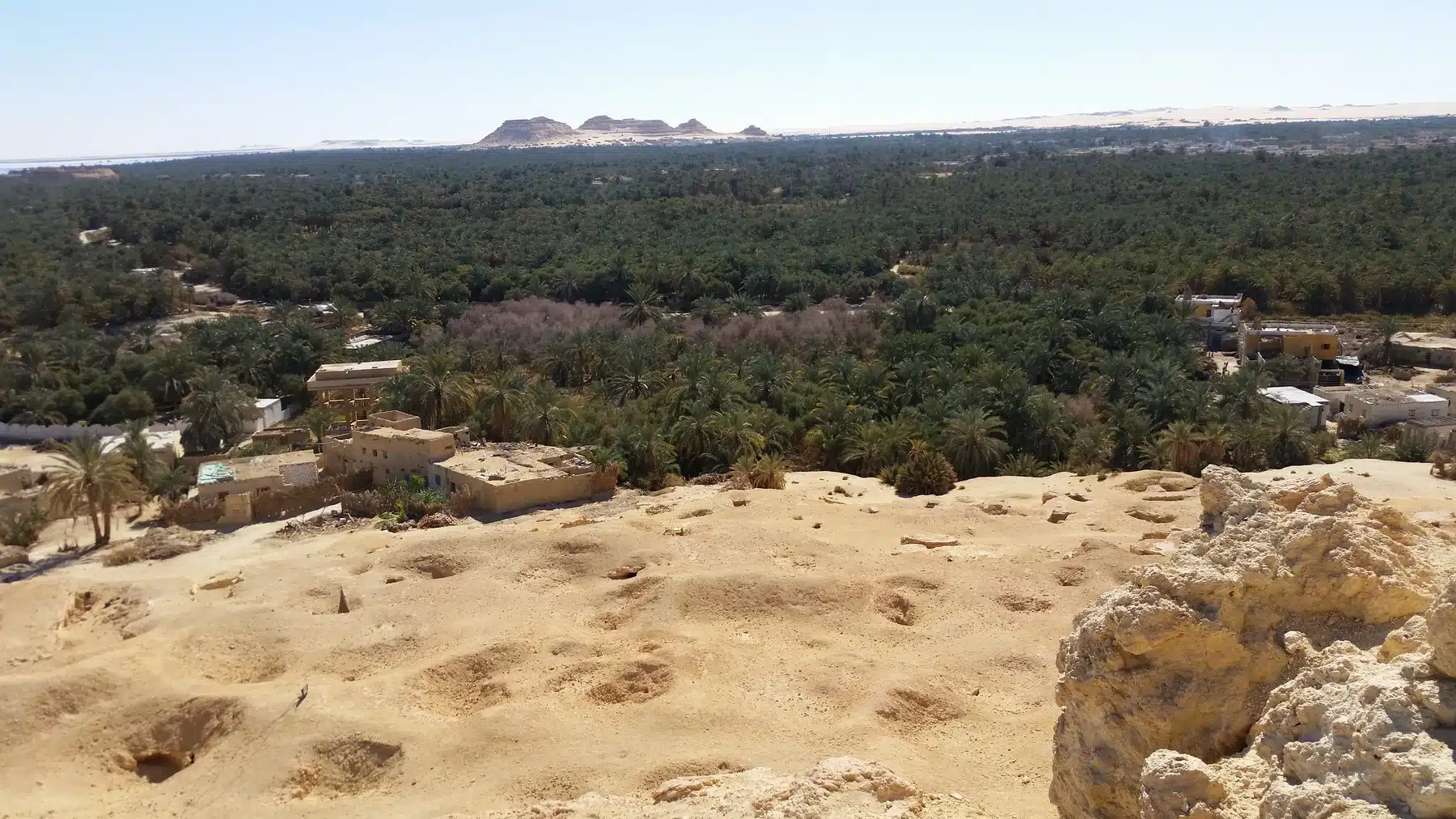
Palm groves, salt landscapes, desert roads and Siwan culture give the eclipse a completely different setting from the Nile Valley.
Timeanddate calculates 5 minutes 31 seconds of totality for Siwa Oasis. Timeanddate’s Siwa eclipse data
The planned private Siwa field used by Egypt Safari Travel is located at 29.21366° N, 25.63071° E and the existing itinerary includes more than five minutes of totality, shade, cooled rest space, chairs, food, water and a separate tripod area. 5-day Siwa itinerary
The price of that atmosphere is travel time.
Siwa deserves several days rather than being treated as a quick eclipse-day excursion.
Asyut and other Nile Valley locations
Travelers should not assume Luxor is the only Nile Valley option.
Timeanddate lists Asyut at about 6 minutes 8 seconds of totality. Timeanddate’s Egypt eclipse data
Other areas inside the path can also receive long totality.
The practical question becomes infrastructure, accommodation, access, crowding and what else you want your Egypt trip to include.
Bahariya Oasis and the Black Desert: The Western Desert Alternative
Imagine two travelers arriving in Egypt with the same objective.
Both want totality.
One imagines a large hotel, temples, Nile scenery and an established tourist city.
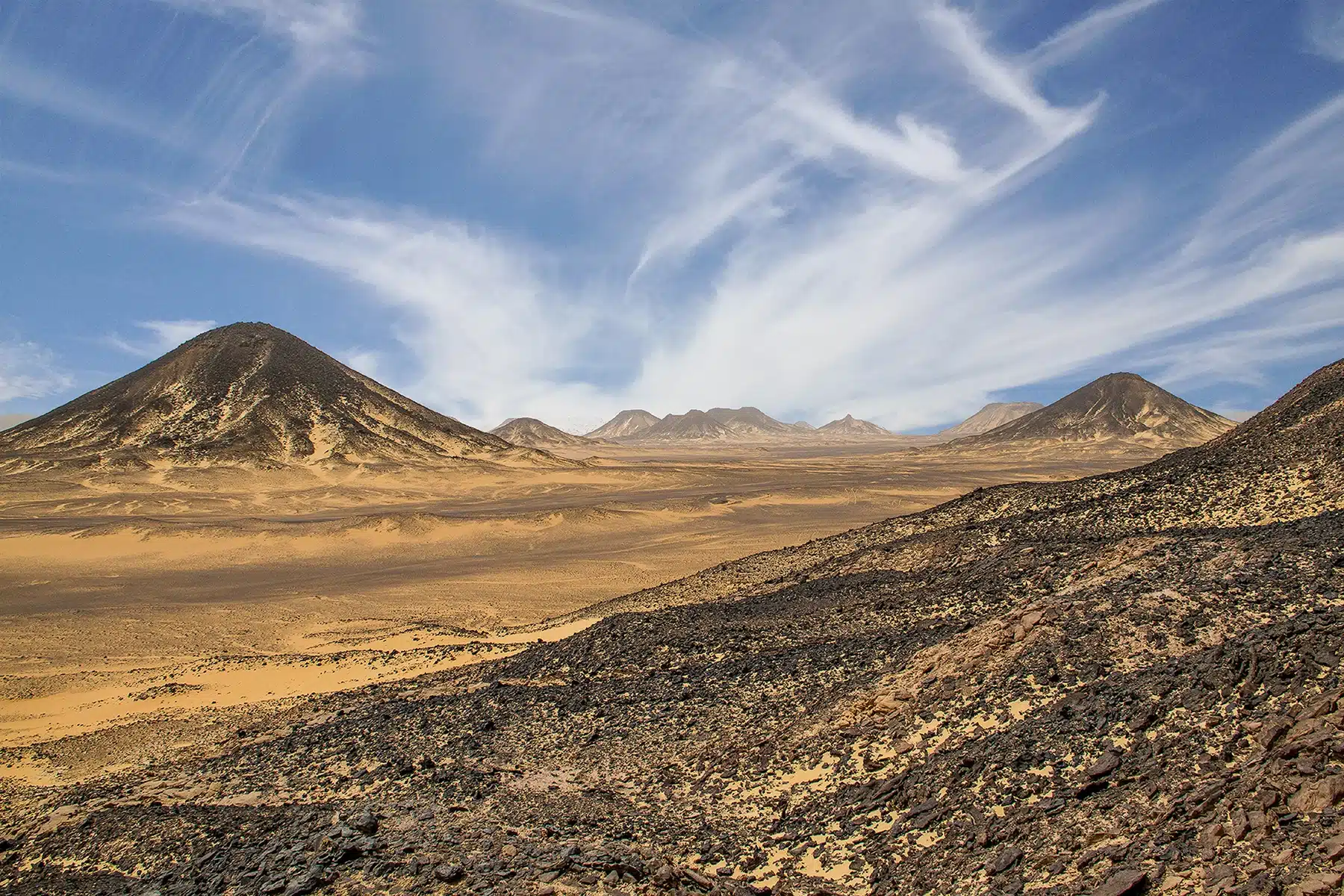
The other imagines silence, dark volcanic hills, a broad desert horizon and a handful of people beside tripods.
Neither is wrong.
They are choosing different experiences.
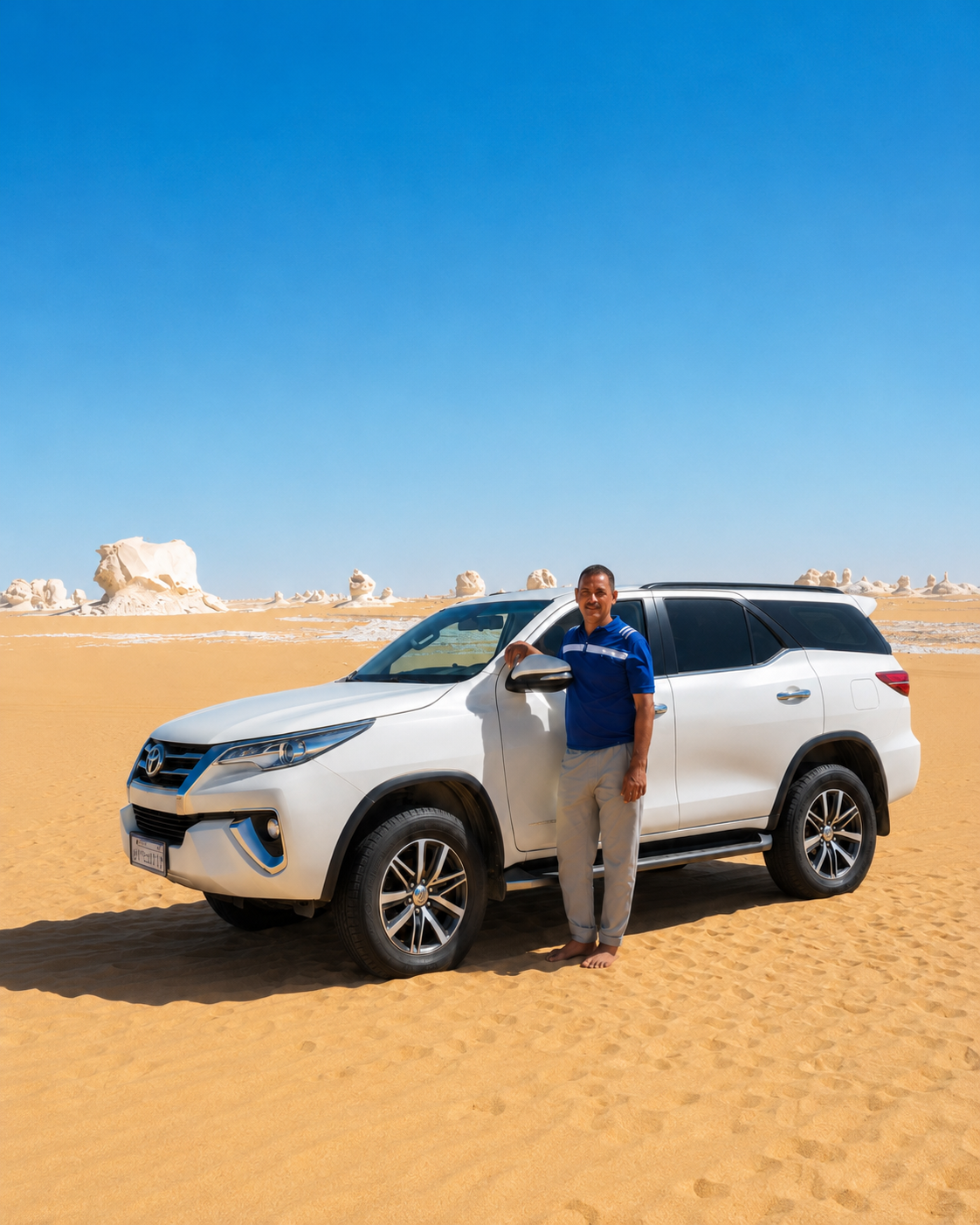
Bahariya Oasis sits at the gateway to one of Egypt’s most visually unusual desert landscapes. The Black Desert is characterized by dark hills and black rock contrasting with pale desert ground.
For eclipse travelers, that matters because the landscape can become part of the event.
You are not simply finding a coordinate inside an eclipse path. You are choosing the foreground, horizon and atmosphere you will remember when you think about those minutes of totality years later.
For photographers, the Black Desert also presents an interesting advantage: the visual identity is strong without requiring a famous monument.
That allows the eclipse itself to remain the focus.
The operational side matters even more.
The current 2-Day Black Desert Total Solar Eclipse Tour from Cairo begins on 1 August rather than attempting a same-day Cairo departure. Guests travel to Bahariya, meet the local team and continue by prepared 4×4 to a private serviced camp.
The published field coordinate is 28.16208° N, 28.76423° E.
The planned camp setup includes shade, cooled rest space, sleeping tents, seating, water, toilets, charging and a separate tripod zone. 2-day Black Desert itinerary
This is exactly the kind of planning that becomes important when the eclipse takes place close to midday in August.
A theoretical empty patch of desert may be astronomically perfect.
A prepared field with access, water, communications, cooling and an emergency vehicle may be operationally much better.
The three-day Bahariya option adds another day and another private camping night, creating more time to experience the oasis and recover before or after the eclipse rather than making the entire trip a fast transfer from Cairo and back. 3-day Bahariya itinerary
For couples, families and travelers who want privacy without committing to a longer expedition, Bahariya may therefore be one of the most balanced 2027 options in Egypt.
Siwa Oasis: Five Minutes of Totality in a Completely Different Landscape
Siwa sits much farther west and feels geographically and culturally distinct from the Nile-centered Egypt many visitors know.
That is part of its appeal.
The road journey itself changes the rhythm of the trip. Urban Egypt gives way to long desert distances. Palm groves appear around the oasis. Salt and water create bright colors against the surrounding arid landscape.
For travelers who want the eclipse embedded inside a real Western Desert journey rather than treated as a single event day, Siwa makes strong sense.
At the Siwa Oasis reference location, maximum eclipse occurs at about 12:45 pm and totality lasts approximately 5 minutes 31 seconds. Timeanddate’s Siwa eclipse data
Five and a half minutes is still an exceptionally long time when compared with many total solar eclipses.
It is enough time to experience the event without the frantic feeling associated with very short totalities.
That difference is particularly meaningful to first-time eclipse viewers.
The initial seconds of totality can be overwhelming.
There are changes in light, temperature, sound, sky color and human behavior happening together.
A longer totality provides time to look at the corona, look around the horizon, glance at the landscape, take photographs and—most importantly—stop touching the camera for a moment and simply watch.
Egypt Safari Travel’s existing five-day Siwa eclipse itinerary uses a fixed eastern Siwa field at 29.21366° N, 25.63071° E.
The field plan includes large shade, a cooled rest tent, reclining chairs, toilets, food, water, electrolytes, certified eclipse glasses, charging access and a separate tripod area. 5-day Siwa itinerary
The longer seven-day itinerary uses the same Siwa eclipse region but adds Cairo, the Pyramids, the Grand Egyptian Museum, Alexandria and the Mediterranean route before reaching Siwa. 7-day Egypt and Siwa itinerary
That makes the decision fairly simple.
If the eclipse is your only priority and you have limited time, Bahariya is more efficient from Cairo.
If Siwa itself is part of the dream, do not compress it.
Give the oasis the days it deserves.
Luxor vs Bahariya vs Siwa: Which One Is Better?
The answer depends on what “better” means to you.
| Priority | Strongest Fit |
|---|---|
| Maximum possible totality among major tourism centers | Luxor |
| Short private eclipse trip from Cairo | Bahariya / Black Desert |
| Western Desert atmosphere | Bahariya or Siwa |
| Small private camp experience | Bahariya or Siwa |
| Classic temples and Nile history | Luxor |
| Oasis culture and salt landscapes | Siwa |
| Black Desert photography | Bahariya |
| Longer multi-stop Egypt road journey | Siwa 7-day journey |
| Travelers carrying significant camera gear | Photography-specific Black & White Desert option |
| Families seeking a private setup | Bahariya or Siwa private options |
Notice what is not in the table: a single winner.
The eclipse duration difference between Luxor and Bahariya can be measured in seconds, while the difference in travel experience can be enormous.
Likewise, Siwa gives up some totality duration compared with central-line locations, but gives travelers an entirely different destination.
This is why simply searching “longest eclipse Egypt” is not enough to plan a trip.
Six minutes in a location you do not enjoy is not automatically better than five and a half minutes inside the journey you actually wanted.
What Eclipse Day May Feel Like
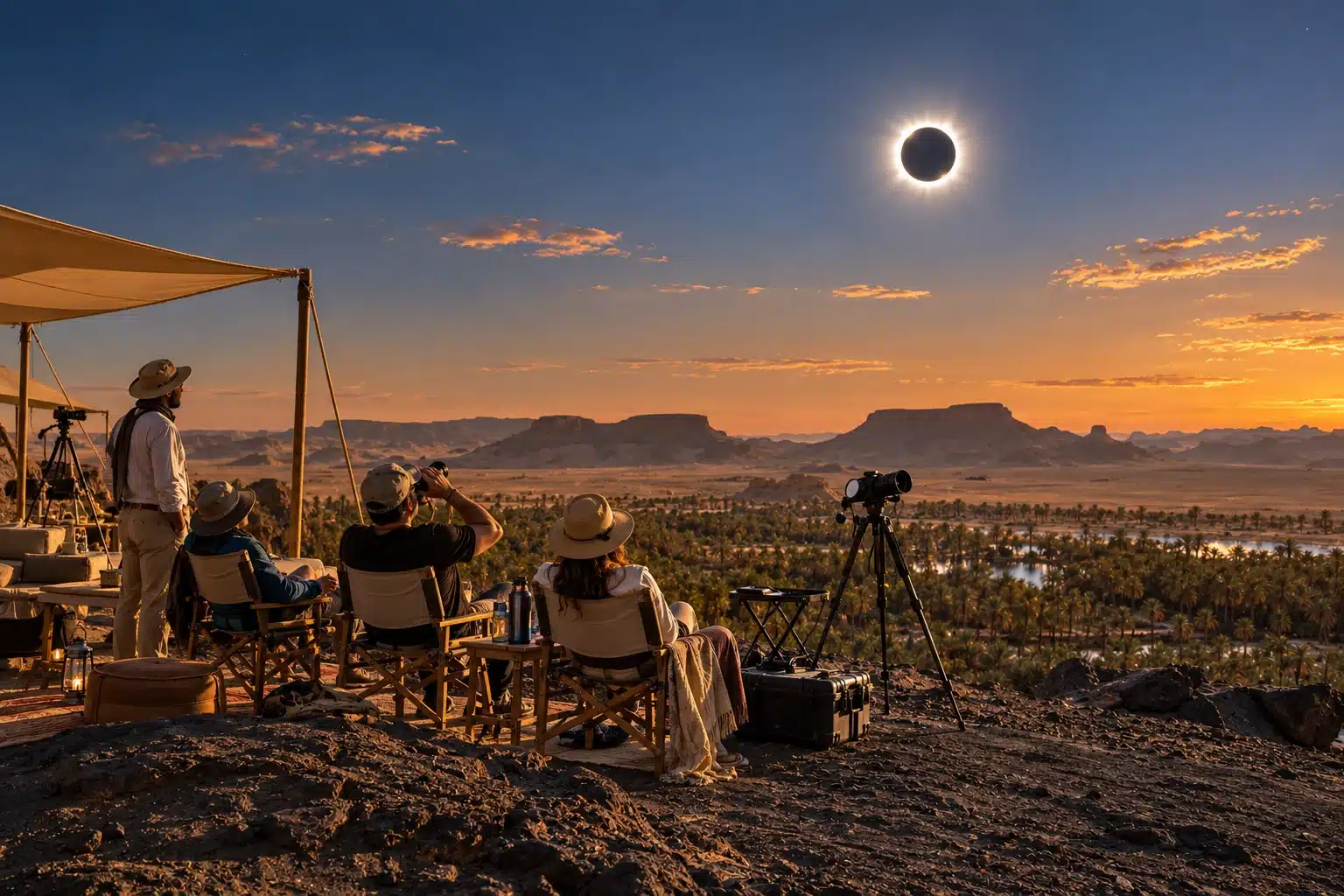
The most dramatic moment is totality, but an eclipse day is not six minutes long.
The experience builds gradually.
During the early partial phase, the Sun may appear almost normal to the naked eye—which is exactly why safe solar viewers are needed.
Through eclipse glasses, you will see the Moon slowly covering a larger portion of the solar disk.
The change in the landscape is subtle at first.
As the eclipse deepens, shadows may become sharper or stranger. The intensity of the daylight begins to feel wrong even when the sky remains bright.
For photographers, this period is useful but dangerous in another way: it is easy to spend the whole morning staring at a camera screen and miss the physical changes happening around you.
As totality approaches, the pace accelerates.
The final bright portion of the Sun becomes very small.
Then, at second contact, totality begins.
Only when the bright face of the Sun has completely disappeared can direct viewing begin without eclipse glasses.
The corona appears around the Moon.
The horizon can remain brighter than the sky above because sunlight continues outside the Moon’s shadow in distant directions.
For several minutes, a daytime desert landscape experiences a strange twilight-like darkness.
Then the process reverses abruptly.
A bright point of sunlight returns.
Glasses go back on immediately.
Totality is over, but the partial eclipse continues for more than an hour afterward.
A well-designed viewing day therefore does not rush everyone into vehicles as soon as the Sun returns.
Guests need water, food, shade and time to process what just happened.
For photographers, there are also cameras to check, filters to replace and equipment to pack carefully.
That post-totality period is part of the experience too.
August Heat: Why the Camp Setup Matters
The eclipse occurs near midday in Egypt in August.
That sentence should influence almost every logistical decision.
NASA’s eclipse safety guidance does not stop at eye protection. It reminds observers who may spend hours outside to protect themselves from sunlight with sunscreen, hats and protective clothing. NASA eclipse safety guidance
A desert viewing field therefore should not be judged only by the panorama.
Ask practical questions.
Where is the shade?
Can guests recline rather than stand for several hours?
Is drinking water continuously available?
Is there a cooled enclosed rest area?
Where are the toilets?
What happens if someone feels unwell?
Is there an emergency vehicle?
How far is the field from the nearest road or settlement?
Can older travelers and children rest somewhere away from the direct Sun?
What food will be served before and after totality?
For photographers, add another set of questions.
Where do large tripods go?
Can people walk through the camera line?
Is charging available?
Can cases stay in the shade?
Can a telescope remain set up without blocking general viewing?
The published Bahariya, Black Desert and Siwa eclipse itineraries currently address many of these questions with shade structures, cooled rest spaces, chairs, continuous water, food, first-aid planning, charging and separate tripod zones. 2-day Black Desert itinerary
These may sound like small operational details when reading a tour page from home.
On 2 August 2027, they may be some of the most important differences between a stressful day and a calm one.
Eclipse Glasses and Eye Safety
There is one area where improvisation is not acceptable: solar viewing.
Regular sunglasses are not eclipse glasses.
NASA states that safe solar viewers used for direct solar observation should comply with the ISO 12312-2 international standard. NASA eclipse safety guidance
During the partial phases, eclipse glasses stay on whenever you are looking directly toward the Sun.
They come off only after the Sun’s bright face is completely covered during totality.
The moment any part of the bright Sun reappears, eye protection goes back on immediately. NASA eclipse safety guidance
There is another common mistake photographers need to understand.
Eclipse glasses are for your eyes.
They are not filters for cameras, binoculars or telescopes.
NASA warns that concentrated sunlight passing through optical equipment can damage the viewer and the equipment. Cameras, telescopes and binoculars need solar filters designed for those devices and placed appropriately at the Sun-facing end of the optics. NASA eclipse safety guidance
For a private tour, ask before booking whether normal eclipse glasses are supplied.
For specialist cameras and telescopes, expect to provide or confirm your own equipment-specific filters.
The existing Egypt Safari Travel eclipse programs include certified ISO 12312-2 glasses for guests, while personal front-mounted camera and telescope filters remain the traveler’s responsibility. 2-day Black Desert itinerary
Photographing the 2027 Solar Eclipse in Egypt
The 2027 eclipse will attract serious photographers because long totality creates opportunities that short eclipses do not.
But more time does not eliminate the need for preparation.
If you arrive at the viewing field still deciding how your camera works, six minutes can disappear very quickly.
The best approach is to solve as much as possible before eclipse day.
Practice mounting the solar filter.
Practice removing it without moving the tripod.
Practice changing exposure quickly.
Know how your intervalometer or remote shutter works.
Disable settings that may unexpectedly sleep the camera.
Have batteries charged and memory cards formatted.
If using multiple cameras, decide which one is the “leave it alone” camera.
Photography also changes the physical requirements of a tour.
A traveler with a phone and a pair of eclipse glasses needs very little space.
A photographer carrying two tripods, a 600 mm lens, hard cases and power equipment can require an entirely different setup.
That is why equipment should be declared when booking.
The current Black & White Desert photography itinerary limits the private group and includes three serviced camping nights, a separate photography zone, charging access and the same fixed Black Desert eclipse field used for the shorter Bahariya programs. 4-day photography itinerary
The itinerary continues into the White Desert, meaning the photography component is not limited to the eclipse itself.
For a photographer traveling all the way to Egypt, that can be valuable.
The eclipse becomes the central event inside a broader desert photography journey.
One final piece of advice is less technical.
Plan a moment when you will stop shooting.
A total eclipse is unusually difficult to describe to somebody who has never seen one.
Do not return home with thousands of frames but no memory of simply looking up.
How Early Should You Arrive in the Totality Zone?
At minimum, do not plan to enter the totality region on eclipse morning.
Event traffic is difficult to predict, and desert travel already involves longer distances than many visitors expect.
A mechanical issue, road closure or delay that would normally be an inconvenience can become catastrophic if it causes you to miss a fixed astronomical event.
The Moon does not wait because the vehicle was late.
The current two-day Black Desert program leaves Cairo on 1 August and sleeps inside the Western Desert before the eclipse. 2-day Black Desert itinerary
The three-day Bahariya version also begins on 1 August but gives travelers an additional night after totality. 3-day Bahariya itinerary
The Siwa programs allocate several days because Siwa is a destination rather than a quick extension from Cairo. 5-day Siwa itinerary
For international flights, give yourself even more margin.
Do not design an itinerary where a delayed flight into Cairo on 1 August destroys the entire eclipse plan.
Ideally, arrive in Egypt early enough to absorb a disruption.
Likewise, avoid booking a critical international flight immediately after a long desert return.
The seven-day Egypt itinerary specifically recommends that travelers returning from Siwa should book an international flight for the following day rather than the same evening. 7-day Egypt and Siwa itinerary
That is sensible eclipse travel planning in general.
Build margin around the irreplaceable event.
Compare Private Eclipse Tours in Egypt for 2027
The five current Egypt Safari Travel eclipse itineraries are intentionally different.
This table should help readers understand the difference before opening individual tour pages.
| Tour | Duration | From | Eclipse Region | Best For |
|---|---|---|---|---|
| 2-Day Black Desert Total Solar Eclipse Tour | 2 days | $895 | Bahariya / Black Desert | Shortest focused eclipse journey from Cairo |
| 3-Day Bahariya Comfort Eclipse Camp & Oasis Tour | 3 days | $1,195 | Bahariya / Black Desert | Comfort, extra time and oasis experience |
| 4-Day Black & White Desert Eclipse Photography Journey | 4 days | $1,495 | Black & White Desert | Photographers and desert scenery |
| 5-Day Siwa Oasis Total Solar Eclipse Camping Tour | 5 days | $1,595 | Siwa Oasis | Siwa-focused cultural and desert journey |
| 7-Day Cairo, Alexandria & Siwa Eclipse Journey | 7 days | $2,150 | Siwa Oasis | First-time Egypt visitors wanting a fuller itinerary |
2-Day Black Desert Tour — best for a focused eclipse trip
2-Day Black Desert Total Solar Eclipse Tour from Cairo
This is the most concentrated and lowest-priced current eclipse itinerary.
It leaves Cairo on 1 August, reaches Bahariya and positions the party in a private Black Desert camp before eclipse day.
Current published price: from $895 per adult, based on double occupancy.
The fixed field, private service plan and short duration make it particularly suitable for travelers who already have another Egypt itinerary and simply need a properly organized totality extension. 2-day Black Desert itinerary
3-Day Bahariya Comfort Tour — best balance for many travelers
3-Day Bahariya Comfort Eclipse Camp & Oasis Tour
This version slows the experience down.
Instead of treating Bahariya only as access to the eclipse field, it adds oasis time and another private camp night.
Current published price: from $1,195 per adult.
For couples, families and travelers who do not want a long program but also do not want the eclipse to feel rushed, this may be the easiest option to understand. 3-day Bahariya itinerary
4-Day Black & White Desert Photography Journey
4-Day Black & White Desert Eclipse Photography Journey
Current published price: from $1,495.
This is the specialist option.
The program combines the eclipse with the Black and White Desert, three private camping nights and photography-oriented logistics. 4-day photography itinerary
5-Day Siwa Eclipse Tour
5-Day Siwa Oasis Total Solar Eclipse Camping Tour 2027
Current published price: from $1,595.
This should be selected because you want Siwa, not simply because it is another point on the eclipse map.
The five-day structure makes the road journey worthwhile and builds the eclipse into a broader oasis experience. 5-day Siwa itinerary
7-Day Cairo, Alexandria & Siwa Eclipse Journey
7-Day Cairo, Alexandria & Siwa Eclipse Private Camping Journey
Current published price: from $2,150.
This is the option for travelers who want the eclipse to become the centerpiece of a larger first-time Egypt journey.
The published itinerary includes Cairo, Giza, the Grand Egyptian Museum, Alexandria, the Mediterranean route and Siwa. 7-day Egypt and Siwa itinerary
What Do the Private Tours Currently Have in Common?
Although the destinations and lengths differ, the eclipse packages share several principles.
They are designed as private bookings rather than unrelated travelers being merged into a large group.
The Bahariya and Black Desert programs use a fixed viewing field.
The Siwa programs use a fixed eastern Siwa field.
Certified eclipse glasses are included.
The current published booking terms state that the written price is locked after deposit and that listed services do not receive compulsory local surcharges later.
For the Bahariya and Black Desert programs, the current deposit is $250 per adult after written availability confirmation. 2-day Black Desert itinerary
These details matter because eclipse travel has a fixed date.
A normal safari can sometimes move by one day.
The eclipse cannot.
The closer we get to August 2027, the more accommodation, vehicles, specialist equipment and prepared viewing fields may become constrained.
This does not mean travelers should panic-book.
It means they should understand exactly what a deposit reserves, what is included, how cancellation works and what happens if the operator cancels.
Read the individual trip page before paying anything.
How to Choose the Right Eclipse Trip
Start by ignoring price for five minutes.
Ask yourself what you actually want.
If your time is limited
The two-day Black Desert program is the cleanest option.
It gets you out of Cairo, inside totality, into a prepared camp and back without turning the eclipse into a week-long expedition.
If comfort and pacing matter more
The three-day Bahariya trip adds breathing room.
For families or travelers who dislike constant transfers, one extra day can be more valuable than adding another destination.
If photography is central
Choose the itinerary designed around cameras rather than trying to convert a normal leisure trip into a photography expedition after booking.
Tripods, cases, filters, power and shooting positions should be part of the plan from the beginning.
If Siwa is already on your Egypt wish list
Choose Siwa.
Five and a half minutes of totality is exceptional, and the oasis becomes part of the story rather than merely the place where you happened to stand.
If this may be your only trip to Egypt
The seven-day journey makes more sense.
Flying internationally to Egypt, seeing the eclipse and leaving without seeing the Pyramids may not be the trip everyone wants.
For others, the desert itself is enough.
That is why the right tour should fit the traveler rather than forcing every traveler into the same package.
Do Not Choose an Eclipse Tour Based Only on Luxury
Eclipse tourism creates an unusual temptation.
Because the event is rare, operators can feel pressure to describe everything as “exclusive,” “VIP” or “once in a lifetime luxury.”
But an expensive tent does not make the Moon cover the Sun for longer.
What matters is operational reliability.
A comfortable chair is useful.
A shaded area is useful.
A cooled rest tent is useful.
A safe drinking-water system is useful.
A functioning vehicle is useful.
A clean toilet is useful.
A clearly separated tripod position is useful.
A guide who knows the local roads is useful.
Decorative excess is not the same as operational quality.
When evaluating any eclipse package in Egypt—ours or somebody else’s—ask for specifics rather than adjectives.
Where is the viewing region?
Is it inside totality?
When will you arrive there?
How many unrelated guests will share the site?
What happens in extreme heat?
How much shade exists?
What eye protection is provided?
How are large cameras handled?
What happens if the operator cancels?
Which fees remain payable locally?
Those answers reveal more than the word “premium” ever will.
Weather: What Can Be Promised and What Cannot
Nobody can guarantee clear skies on 2 August 2027.
That should be stated plainly.
Long-range climate patterns can help travelers choose regions, but they are not a weather forecast.
Timeanddate currently shows extremely low historical cloud values for several Egyptian locations on 2 August, while also noting that genuine weather forecasts become available much closer to the event. Timeanddate’s Siwa eclipse data
Egypt’s desert geography is one reason the eclipse has attracted so much international interest.
But “historically favorable” is not the same as “guaranteed.”
A responsible plan focuses on things we can control:
choosing a field properly inside totality;
arriving early;
maintaining transport;
monitoring conditions;
preparing shade and hydration;
having communication;
and avoiding unnecessary movement on eclipse morning.
Weather remains nature’s decision.
A Practical Packing Checklist
For most travelers, the eclipse does not require an enormous amount of specialist equipment.
Bring lightweight, breathable travel clothing suitable for strong sun.
Bring a hat.
Bring sunscreen.
Carry any personal medication in your day bag rather than burying it in checked luggage.
Use proper eclipse glasses supplied by a reliable source.
Bring a reusable personal water bottle if you like having water beside your chair even when bottled drinking water is provided.
If you wear prescription glasses, test how your eclipse viewers fit over them before traveling.
Photographers should bring spare batteries, memory cards, remote shutter equipment, lens cloths and correctly sized solar filters.
Do not assume a local shop in a desert oasis will have the exact photographic accessory you forgot.
Telescope users should communicate dimensions, weight, cases and power requirements before booking.
Families should explain ages and any mobility or dietary requirements in advance.
The operator should have time to design the camp around real people rather than discovering special requirements when the vehicle arrives.
Final Recommendation: Plan the Journey First, Then Choose the Exact Tour
There are two mistakes travelers can make when planning the 2027 solar eclipse in Egypt.
The first is treating the eclipse like a normal sightseeing attraction.
It is not.
You cannot visit it tomorrow if the road is blocked today.
The second mistake is treating the eclipse like an astronomical coordinate and forgetting that humans have to spend hours at that coordinate.
The best plan combines both sides.
Astronomically, you need to be comfortably inside the path of totality.
Logistically, you need to arrive early.
Physically, you need shade, water and a safe viewing environment.
Experientially, you should choose a place you actually want to remember.
For some people, that is Luxor with the Nile and ancient temples around them.
For others, it is Bahariya: a small private party looking across dark Western Desert hills.
For others, it is Siwa: salt, palms and a journey far from Egypt’s conventional tourist circuit.
All three can produce extraordinary eclipse memories.
The right choice depends on the journey you want surrounding those minutes when the Sun disappears.
Frequently Asked Questions About the 2027 Solar Eclipse in Egypt
When is the total solar eclipse in Egypt?
The eclipse takes place on Monday, 2 August 2027. NASA lists Egypt inside the path of totality. NASA’s official future-eclipse calendar
How long will the 2027 eclipse last in Egypt?
The maximum central duration of the eclipse is about 6 minutes 23 seconds. Exact totality duration depends on where you stand inside the path. NASA/GSFC eclipse data
Is Luxor inside the path of totality?
Yes. Timeanddate calculates approximately 6 minutes 22 seconds of totality in Luxor, with maximum eclipse around 1:05 pm local time. Timeanddate’s Luxor eclipse data
Is Cairo inside the path of totality?
No. Cairo experiences a partial solar eclipse. Travelers who want to experience totality need to travel to a location inside the total eclipse path. Timeanddate’s Cairo eclipse data
Is Siwa Oasis inside totality?
Yes. Timeanddate calculates approximately 5 minutes 31 seconds of totality in Siwa Oasis, with maximum eclipse around 12:45 pm. Timeanddate’s Siwa eclipse data
Can I watch the eclipse from Bahariya Oasis?
Yes, correctly selected locations in the Bahariya/Black Desert region are inside the totality path. Egypt Safari Travel’s planned private field is at 28.16208° N, 28.76423° E and the current itinerary describes more than six minutes of totality. 2-day Black Desert itinerary
Is a 99% partial eclipse almost the same as totality?
No. The defining effects of a total solar eclipse occur only when the bright face of the Sun is completely covered. A very deep partial eclipse still requires safe solar viewing protection and does not produce the same totality experience.
Do I need eclipse glasses?
Yes. Proper solar viewers are needed during all partial phases. NASA says solar viewers should comply with the ISO 12312-2 standard. NASA eclipse safety guidance
Can I take eclipse glasses off during totality?
Only when the bright face of the Sun is completely covered. As soon as any bright sunlight reappears, glasses must go back on immediately. NASA eclipse safety guidance
Can I use eclipse glasses as a camera filter?
No. NASA warns that cameras, telescopes and binoculars require their own suitable solar filters. Eclipse glasses should not be used as substitutes for optical equipment filters. NASA eclipse safety guidance
Which is better for the eclipse: Bahariya or Siwa?
Bahariya is generally better for travelers who want a shorter trip from Cairo and more than six minutes of totality. Siwa requires a longer journey but combines the eclipse with one of Egypt’s most distinctive oasis destinations and around five and a half minutes of totality.
Which Egypt eclipse tour is cheapest?
Among the five current Egypt Safari Travel eclipse programs, the two-day private Black Desert itinerary currently starts from $895 per adult based on the published tour page. 2-day Black Desert itinerary
Are the eclipse tours private?
The current Egypt Safari Travel eclipse pages state that each booking party remains private and is not merged with unrelated guests. 2-day Black Desert itinerary
Are eclipse glasses included on the private tours?
Yes. The current published itineraries include certified ISO 12312-2 eclipse glasses and a safety briefing. 2-day Black Desert itinerary
Can photographers bring tripods or telescopes?
Yes, but large equipment, hard cases, telescope dimensions and power requirements should be declared before booking so the viewing field can be planned correctly. Personal camera and telescope solar filters remain the traveler’s responsibility on the current packages. 2-day Black Desert itinerary
Can the weather be guaranteed?
No. No operator can responsibly guarantee clear skies for a specific date this far in advance. Travelers should choose a region based on sound eclipse and climate planning, then monitor actual conditions closer to the event.
Official Eclipse Sources & Further Reading