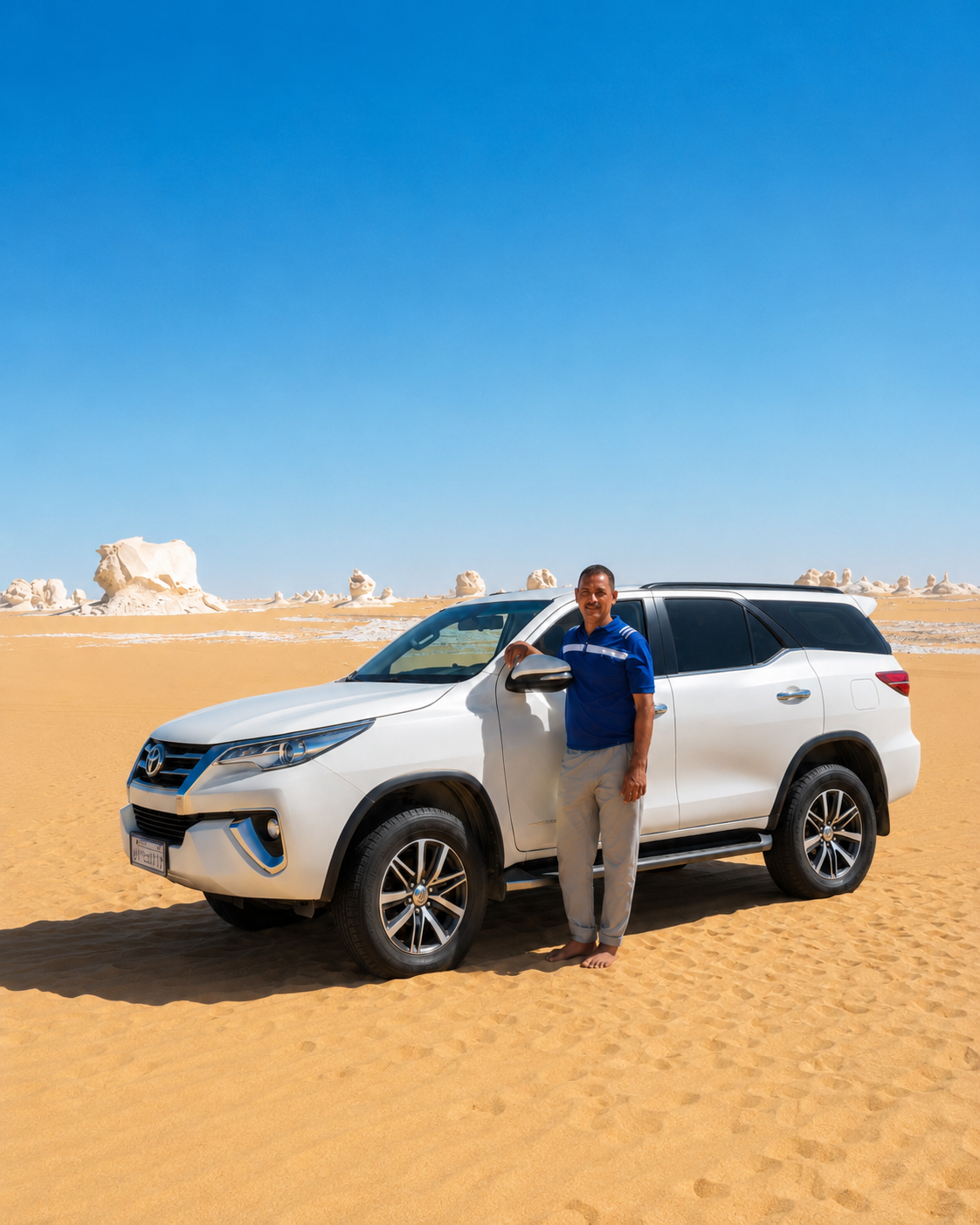
The Black and White Desert day trip from Cairo is the most popular way for visitors to see Egypt’s Western Desert in a single day. Starting at Bahariya Oasis, the route crosses a volcanic landscape of black hills, stops at a ridge of quartz crystals, drops into the cliffs of Agabat Valley and ends among the chalk towers of the White Desert. This guide explains every stop on the route, how much time each one deserves, what foreign travelers usually want to see, and how to plan the best possible day without wasting hours on the road.
Black Desert, Crystal Mountain and White Desert in one day
Private 4×4 day trip from your Cairo or Giza hotel with a local Bahariya team, breakfast, lunch, dinner and park fees included. From $119 per person.
Black and White Desert day trip at a glance
The route links four very different landscapes within about 100 km of desert south of Bahariya Oasis. In one day you go from volcanic black to crystal white, with golden dunes in between. Here is the full route with the time we recommend at each stop.
| Stop | What you see | Time to spend |
|---|---|---|
| Bahariya Oasis | Palm groves, Bawiti town, switch to 4×4 | 20 to 30 minutes |
| Black Desert | Volcanic hills covered in dark stones | 40 to 60 minutes |
| Crystal Mountain | Quartz ridge and rock window | 15 to 20 minutes |
| Agabat Valley | Cliffs, dunes and wind-carved rocks | 45 to 60 minutes |
| Lunch | Picnic in the shade of the rocks | 40 minutes |
| White Desert National Park | Mushroom, Chicken and chalk towers | 2 to 2.5 hours |
Add about 4 hours of driving each way between Cairo and Bahariya, and you have a full day of around 17 hours. Our private White Desert day trip follows exactly this order.
What foreign travelers usually want to see
We ask every guest what made them book a desert day from Cairo. The answers are remarkably consistent, and they shape how we plan the route.
- The White Desert formations. Almost everyone has seen a photo of the Mushroom rock or the chalk towers and wants to stand next to them. This is the non-negotiable part of the day, so it gets the most time.
- A different side of Egypt. After the pyramids and museums, many travelers want silence, space and nature. The Western Desert gives them that within a few hours of Cairo.
- Dramatic photos. Black hills, sparkling crystals, golden cliffs and white towers in a single day make for a very varied photo album.
- A real oasis. Bahariya is a living agricultural community with palm groves and springs, not a tourist resort. Even a short stop gives a sense of oasis life.
- Off-road adventure. Driving down into Agabat Valley or across the open desert in a Land Cruiser is a highlight for many guests, especially families with teenagers.
Less important for most day-trip guests are the museums and tombs of Bahariya. They are interesting, but on a single day they take time away from the landscapes people came to see. We recommend them on longer trips instead.
Stop 1: Bahariya Oasis, the gateway
Bahariya Oasis lies in a depression about 370 km southwest of Cairo, surrounded by black-topped hills. Its main town, Bawiti, is a small, quiet town and the starting point for almost every White Desert trip. The oasis has been inhabited since antiquity: it was an important wine-producing area in Pharaonic times, and in 1996 archaeologists found the Valley of the Golden Mummies here, a Greco-Roman cemetery with hundreds of mummies, some covered in gold.
On a day trip you stop in Bawiti for breakfast and tea and to change to a 4×4. On the way back you return to Bahariya for a soak in one of its natural hot sulfur springs. If you arrive early, your guide may drive you through the palm groves on the way out of town. The springs and gardens give you a first sense of how water turns the desert green.
Stop 2: the Black Desert
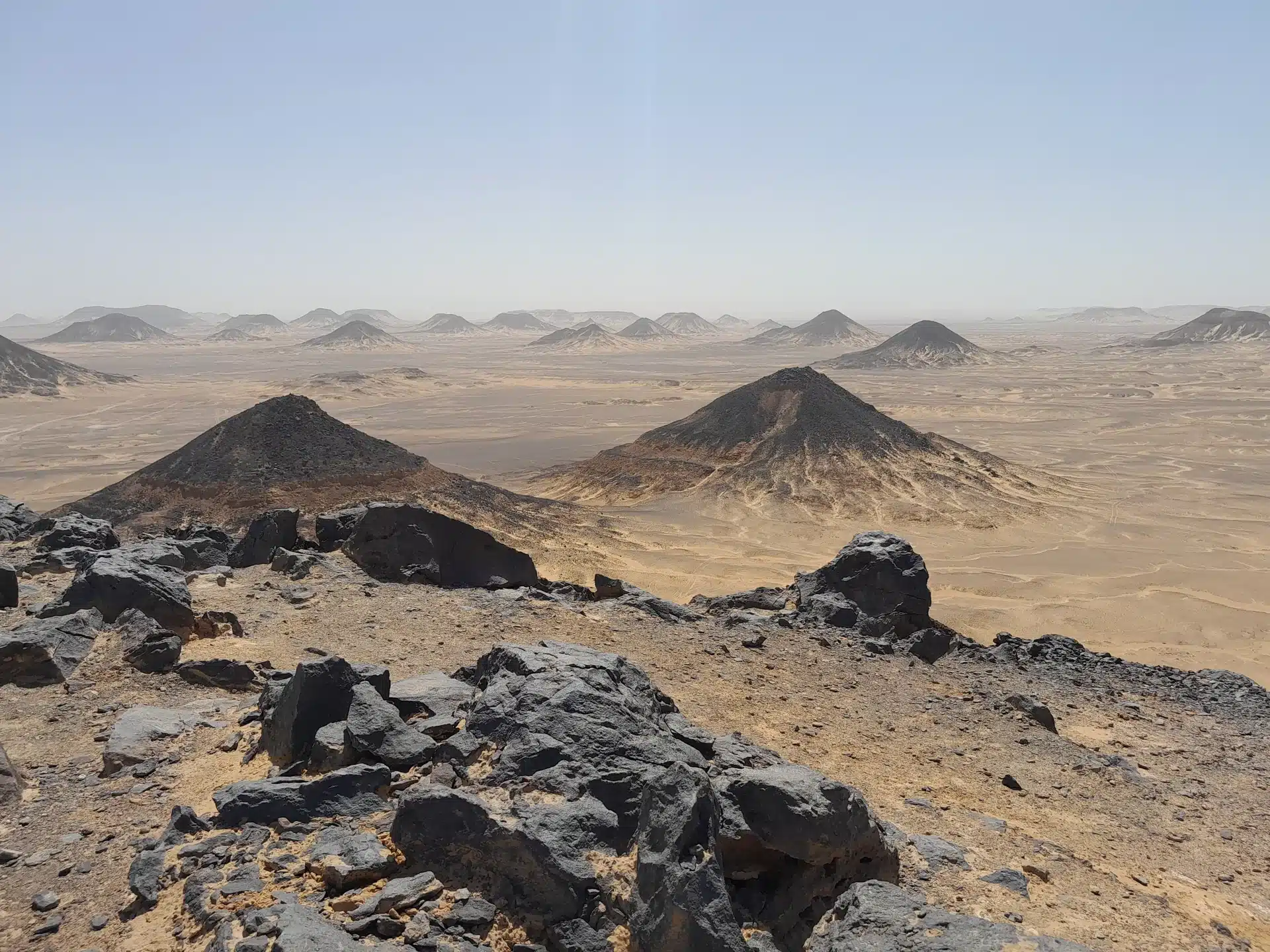
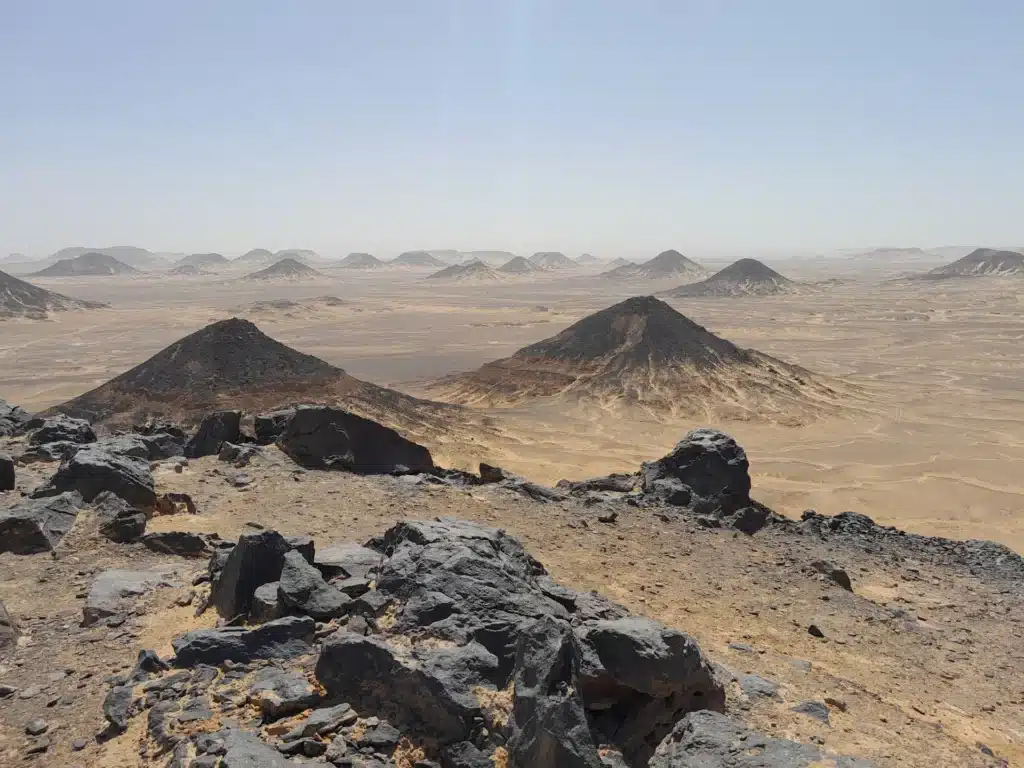
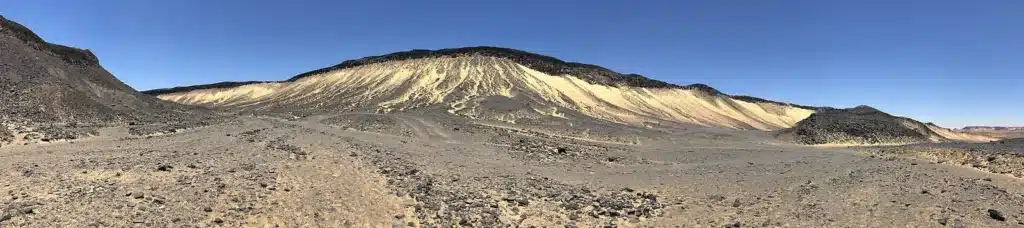
About 30 minutes south of Bawiti the landscape changes completely. Small cone-shaped hills rise from orange sand, and each one is covered in a layer of dark stones. This is the Black Desert. The color comes from volcanic rock, mostly dolerite and basalt, along with iron-rich quartzite, that weathered out of the hills and spread across their slopes over millions of years. The result looks like sand dusted with soot.
The usual stop is at one of the larger hills beside the road, sometimes called English Mountain because of a lookout built here by British forces during the First World War. The climb takes 10 to 15 minutes on an easy path, and from the top you see dozens of black cones stretching toward the horizon. Wear closed shoes: the stones are loose and sharp.
The Black Desert deserves 40 to 60 minutes. It is also the best place for a group photo early in the day, before the sun gets high.
Stop 3: Crystal Mountain
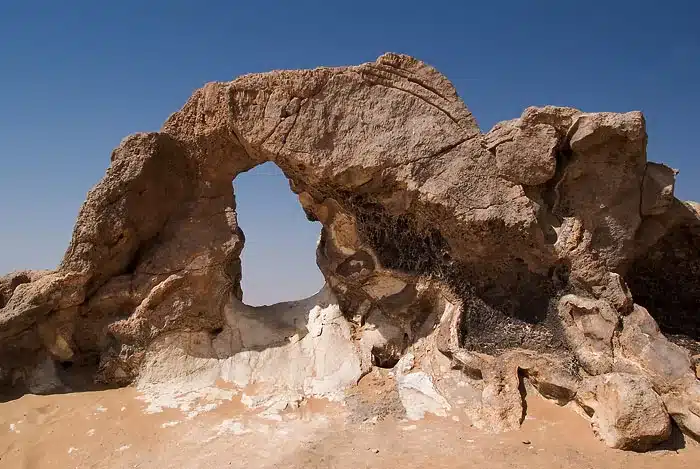
Further south, right beside the road to Farafra, a low ridge glitters in the sun. Crystal Mountain is made of quartz crystals that formed in cracks of the limestone and were exposed by erosion. Up close you can see clusters of clear and milky crystals in the rock. Next to the ridge stands a natural rock window, a hole worn through the stone that makes a perfect frame for photos.
Crystal Mountain is protected, and over the years visitors have broken off pieces as souvenirs. Please look and photograph but leave the crystals in place. A stop of 15 to 20 minutes is enough.
Stop 4: Agabat Valley
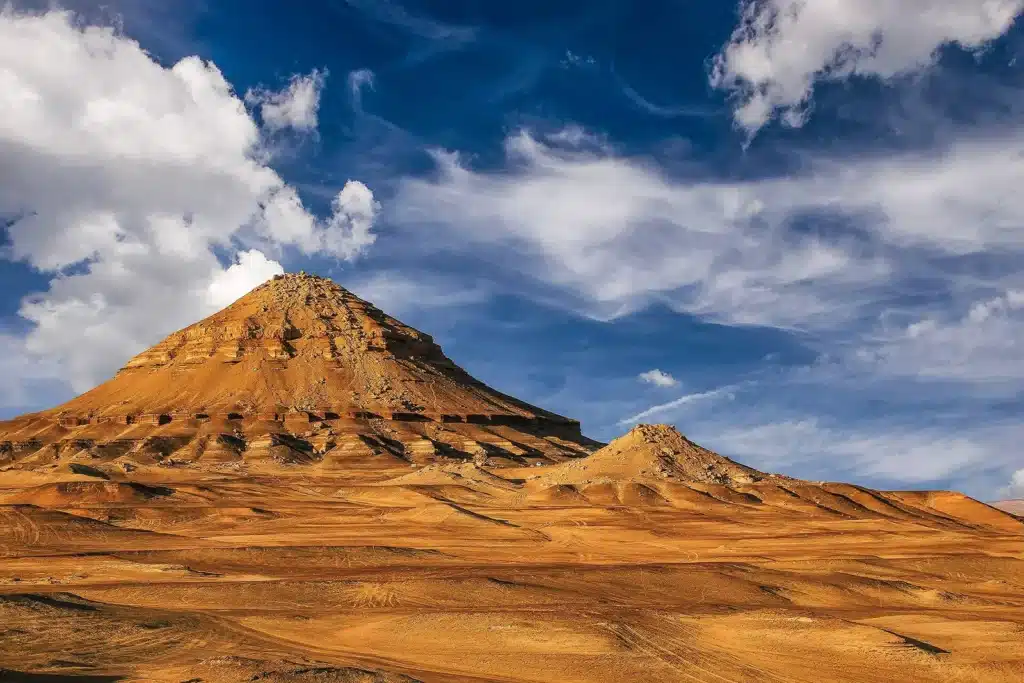
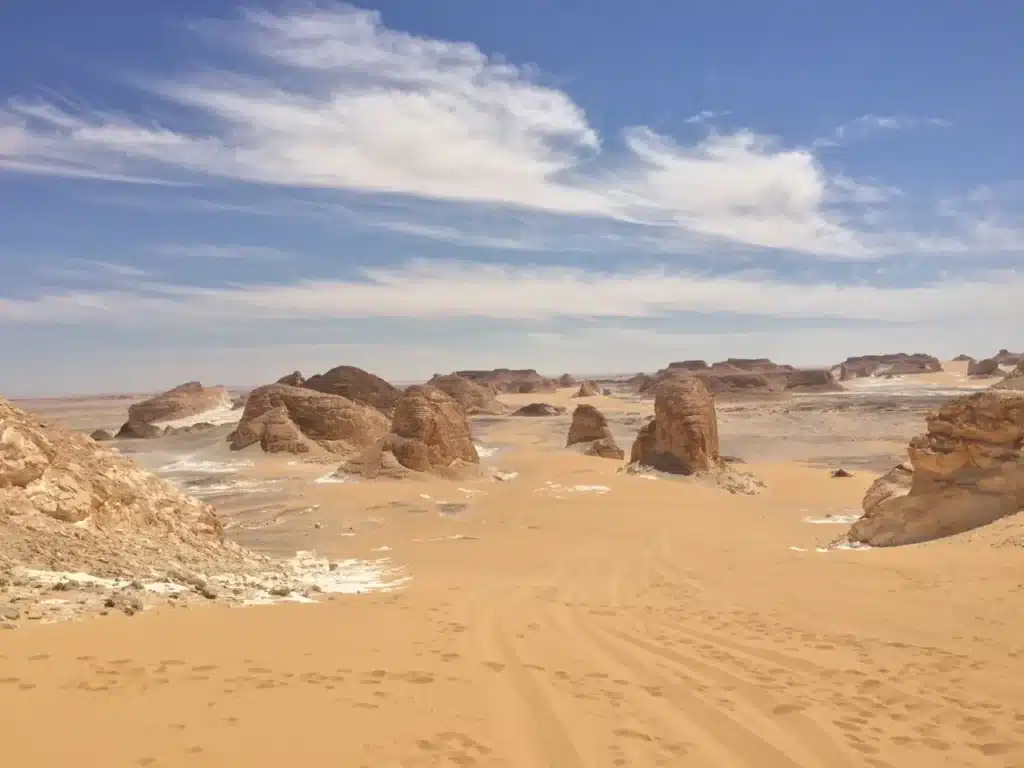
Agabat, sometimes written Aqabat, means “obstacles” in Arabic, a name that comes from the difficulty of crossing it in the days of camel caravans. Today it is one of the most spectacular viewpoints in the Western Desert. From the top of the pass you look down on a wide valley of soft golden sand, framed by tall white and cream cliffs and scattered with rock towers carved by the wind.
Your 4×4 drives down into the valley, and if the sand allows, your driver will add some gentle dune driving. This is where many guests feel the real desert for the first time: the engine stops, the wind drops and there is complete silence. Plan 45 to 60 minutes here, including photos from the top and time on the valley floor.
Lunch in the desert
After Agabat, the crew sets up a simple picnic lunch, usually in the shade of a rock wall at the edge of the White Desert. Expect rice or bread, vegetables, salad, cheese and fruit, with tea brewed on a small fire. It is a quiet, unhurried break, and a chance to talk with your Bedouin guide about life in the oasis.
Stop 5: the White Desert National Park
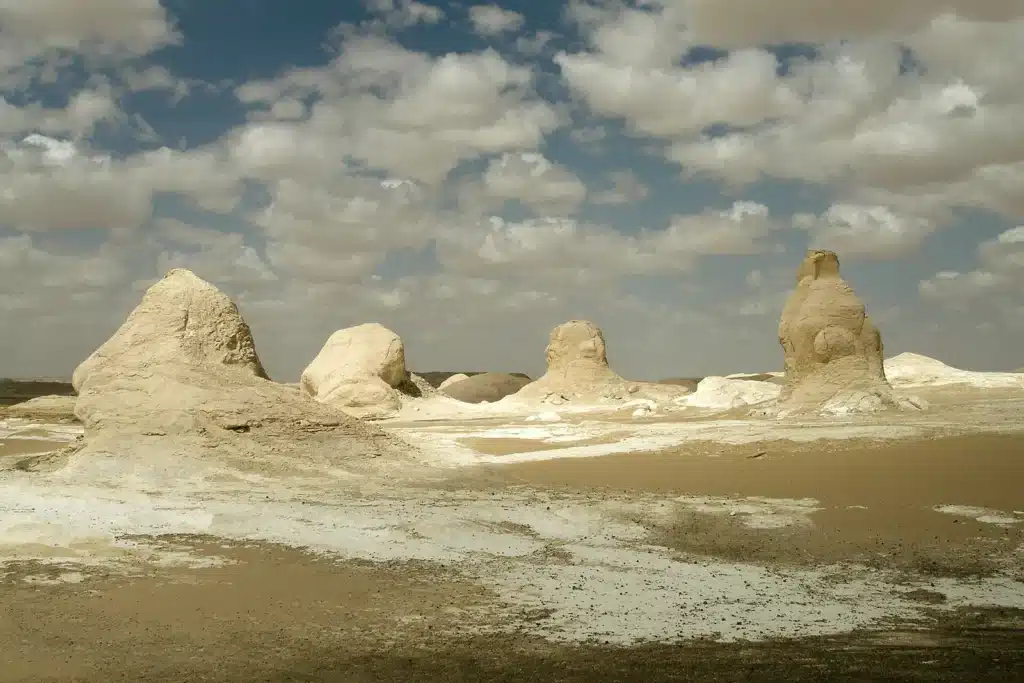
The White Desert is the reason for the trip. The park covers around 3,000 square kilometers between Bahariya and Farafra, and its landscape is made of chalk, the compressed shells of tiny sea creatures that lived here when the area was covered by an ancient sea. Wind and sand have carved this soft rock into thousands of shapes.
The New White Desert
The first area you enter is often called the New White Desert. Here the chalk forms long, flat white fields and low ridges, with scattered formations rising from the sand. It looks like a frozen lake in the middle of the desert, and it is the best place to understand the scale of the park.
The Old White Desert
Further in, the formations become taller and more sculptural. This is where you find the famous shapes: the Mushroom, a white cap on a narrow stem; the Chicken, which really does look like a bird sitting on the sand; the Monolith; and countless towers and pillars that each guide names differently. You can walk freely between them, and your guide will take you to the best angles.
How much time to spend
Give the White Desert at least 2 hours, ideally 2.5. That is enough to drive through both areas, stop at the main formations, walk and take photos without rushing. On our day trip this is the longest single stop, from about 1:45 PM to 4:00 PM, and it can be extended with the sunset option.
Is it better to go one day or stay the night?
Most guidebooks recommend at least one night in the White Desert, and for good reason: sunset, the campfire, the night sky and sunrise are unforgettable. But many travelers simply do not have the extra day, or do not want to sleep in a tent. For them a well-planned day trip is a very good option.
| If you want | Choose |
|---|---|
| All the main sights in daylight, back to your hotel the same night | White Desert day trip |
| Sunset, stars and a night in camp | 2-day safari with camping |
| The desert with a real bed for the night | Bahariya hotel stay and safari |
| A slower pace and more time in Agabat and the dunes | 3-day safari |
If you are still unsure, read our full comparison in White Desert Day Trip from Cairo: Is It Worth It?
Other desert day trips from Cairo, compared
The Black and White Desert route is not the only desert day trip from Cairo. Here is how it compares with the alternatives foreign travelers most often consider.
| Day trip | Drive from Cairo | Landscape | Best for |
|---|---|---|---|
| Black and White Desert | About 4 hours each way plus 4×4 | Volcanic hills, crystals, chalk towers | The most unique scenery in Egypt |
| Fayoum and Wadi El Rayan | About 2 hours each way | Lakes, waterfalls, dunes | A shorter, easier desert day |
| Quad biking near the pyramids | Under 1 hour | Sand near Giza | A quick taste of the desert |
If the 17-hour day feels like too much, our Fayoum safari day trip is the best shorter alternative. But nothing near Cairo looks like the White Desert, and that is why so many travelers accept the long drive.
Sample day trip schedule, hour by hour
This is the timing our team uses on the private day trip. It is built around two goals: reach the White Desert while the light is still good, and get you back to Cairo at a reasonable hour.
- 6:00 AM: pickup from your hotel in Cairo or Giza in a private air-conditioned car.
- 8:00 AM: short rest stop on the Bahariya road for coffee and toilets.
- 10:00 AM: arrival in Bawiti, breakfast and tea, meet the 4×4 driver and guide.
- 10:30 AM: Black Desert and the climb to the viewpoint.
- 11:30 AM: Crystal Mountain and the rock window.
- 12:00 PM: Agabat Valley, viewpoint and drive down to the valley floor.
- 1:00 PM: picnic lunch in the desert.
- 1:45 PM to 4:00 PM: New and Old White Desert, the Mushroom and Chicken formations.
- Optional: one extra hour for sunset in winter.
- 5:30 PM: hot sulfur spring and dinner in Bahariya, then change to the road car.
- About 11:00 PM: drop-off at your hotel.
Times move a little with the season, the checkpoints and the group, but the structure stays the same. If something interests you more, such as photography in Agabat, tell your guide in the morning and the day can be adjusted.
A short history of the route
Long before tourism, the road from the Nile Valley to Bahariya and Farafra was a caravan route. Camel trains carried dates, olives and wine from the oases to the Nile, and the name Agabat, meaning obstacles, comes from the hardest section for those caravans. In Pharaonic times Bahariya was known for its wine, and in the Greco-Roman period it was a prosperous agricultural center, as the Golden Mummies show.
During the First World War, British forces watched the desert from the hill now called English Mountain, near the Black Desert, during their campaign against the Senussi. Modern travel to the White Desert began in the late 20th century, and in 2002 the area was declared a national park to protect its unique formations. The paved road you drive today made a day trip possible: until recent decades, reaching the White Desert from Cairo took several days.
Wildlife and fossils along the way
The Western Desert looks empty, but it is not lifeless. The most famous resident of the White Desert is the fennec fox, a small fox with very large ears that comes out at dusk and night. On a day trip you are unlikely to see one, but you may see their tracks in the sand around the formations. You may also see desert birds, lizards and beetles, especially in the cooler months.
The chalk itself is full of history. Look closely at the rock and you can sometimes see small fossil shells, the remains of the sea creatures that formed the chalk millions of years ago. Please leave them where they are: collecting fossils inside the park is not allowed, and every piece removed makes the landscape a little poorer for the next visitor.
Practical planning tips
Start early
A 6:00 AM pickup is the key to a good day. It lets you reach Bahariya by 10:00 AM and spend the best afternoon light in the White Desert, while still returning to Cairo around 11:00 PM.
Choose a private trip
Shared day trips to the White Desert are rare because few travelers want the same long day on the same date. A private trip lets you set the pace, stop longer where you want and skip what does not interest you.
Check that the 4×4 is included
The tracks to Agabat Valley and the Old White Desert need a four-wheel-drive vehicle. If an offer seems cheap, confirm that a 4×4 with a desert driver is part of it.
Bring your passport
There are police checkpoints on the road to Bahariya, and you need to show your passport or a copy.
Dress in layers
From November to March the early morning and evening are cold, while the middle of the day is warm. Layers let you stay comfortable all day.
Respect the park
Do not take crystals, fossils or pieces of chalk, do not carve or write on the rocks, and take all rubbish with you. The White Desert is fragile and protected.
What to pack for the day
A desert day trip does not need special equipment, but a few items make a big difference to your comfort.
- Passport or a clear copy for the checkpoints on the Bahariya road.
- Closed walking shoes with good grip for the volcanic stones of the Black Desert and the soft sand of Agabat.
- Sunglasses, a wide hat and sunscreen, because the white chalk reflects the sun strongly.
- A warm jacket for the early start and the drive back, from November to March.
- A scarf or buff to protect your face if the wind picks up sand.
- A swimsuit and small towel for the hot sulfur spring in Bahariya.
- A power bank and a lens cloth for your phone or camera.
- Small cash for tips for your driver and guide and small purchases in Bahariya.
Water and all meals are provided on our trip, but bring a refillable bottle if you like to keep your own close at hand.
Best season for a Black and White Desert day trip
October to April is the best time. Afternoons are pleasant, roughly 20 to 28°C, and the light is clear. In December and January early mornings can be close to freezing in the desert, so a warm jacket is essential for the drive. Spring brings occasional sandstorms, usually short, which can reduce visibility for a few hours.
Summer, from May to September, is very hot, often above 38°C in the afternoon. The trip is still possible, but plan for heat: light clothing, a hat, sunscreen and more water than you think you need. For a detailed month-by-month view, see our guide to the best time to visit the White Desert.
Costs: what a Black and White Desert day trip should cost
The main costs are the same for every operator: a car and driver from Cairo for around 750 km, a 4×4 with a desert driver, a guide, park fees and lunch. Because the car and 4×4 are shared by your group, price per person depends heavily on group size. Our private day trip, with all meals included, costs from $119 per person for groups of 5 or more, $129 for 4, $139 for 3, $199 for 2 and $375 for a solo traveler. For a full explanation of what drives desert tour prices, read our White Desert tour price guide.
Frequently asked questions
What is the difference between the Black Desert and the White Desert?
The Black Desert is a volcanic area of hills covered in dark basalt and iron-rich stones. The White Desert is made of white chalk carved by wind into towers and mushroom shapes. They are about 1.5 hours apart by 4×4 and are usually visited on the same trip.
Can I visit the Black and White Desert in one day?
Yes. A private day trip from Cairo leaves at about 6:00 AM, covers Bahariya, the Black Desert, Crystal Mountain, Agabat Valley and the White Desert, and returns at about 11:00 PM.
How far is the Black Desert from Cairo?
The Black Desert starts about 30 minutes south of Bahariya Oasis, which is about 370 km or 4 hours by road from Cairo.
Is Crystal Mountain worth visiting?
Yes, as a short stop on the way. It takes 15 to 20 minutes and adds variety to the day, especially the natural rock window beside the ridge.
Do I need a guide for the White Desert?
Yes. The park is large, there is no signage, and the tracks need a 4×4 and local knowledge. Visitors go with licensed local operators.
Can I do the trip without a 4×4?
Not properly. A normal car can drive the highway past the Black Desert and Crystal Mountain, but Agabat Valley and the Old White Desert need a 4×4.
Is lunch included on a day trip?
On our private day trip all meals are included: breakfast with tea on arrival in Bahariya, a picnic lunch in the desert and dinner in Bahariya, plus drinks: water, tea, coffee and soft drinks. Always check what is included before you book with any operator.
What is the best month for the trip?
October, November, February, March and April offer the best balance of comfortable temperatures and good light.